OCR · A-Level · Chemistry
Course version: H432 · Version from Sept 2017
Spectroscopy: (i) the number of carbon environments in the molecule
Carbon-13 NMR tells you how many distinct carbon environments a molecule contains.
- Point 1 of 16
- 4 key terms
Study notes
From the teaching notes for this specification point.
The idea
Carbon-13 NMR tells you how many distinct carbon environments a molecule contains. Each set of equivalent carbons gives one signal, so the number of signals equals the number of carbon environments. To count them, look for symmetry: carbons related by a mirror plane or a rotation axis are equivalent and share a signal. For example, ethanol, CH₃CH₂OH, has two carbon environments (the CH₃ carbon and the CH₂ carbon), so its ¹³C NMR spectrum shows two signals. Butan-2-ol, CH₃CH(OH)CH₂CH₃, has four distinct carbons and gives four signals, whereas butan-1-ol has four too but with different shifts. A molecule such as benzene has one environment because all six carbons are equivalent. Count signals, not atoms, and check for symmetry before deciding.
What earns the marks
- Counts the number of signals in the ¹³C NMR spectrum as the number of carbon environments.
- Identifies equivalent carbons related by symmetry as sharing a single signal.
- States that ethanol shows two carbon environments and therefore two signals.
- Recognises that benzene has one carbon environment because all six carbons are equivalent.
- Distinguishes the number of carbon atoms from the number of carbon environments.
Common mistakes and how to put them right
Counts every carbon atom as a separate environment.
Put it right: Check for symmetry so equivalent carbons share one signal.
Assumes each signal represents one carbon atom.
Put it right: One signal represents a set of equivalent carbons.
Ignores molecular symmetry when counting environments.
Put it right: Identify mirror planes and rotation axes first.
Exam tips
- Draw the structure and mark equivalent carbons with the same label before counting signals.
- Check for symmetry elements such as a mirror plane that make carbons equivalent.
- Remember the number of signals equals the number of carbon environments, not the number of carbon atoms.
Try the lesson
The start of the Spectroscopy: (i) the number of carbon environments in the molecule lesson, made from teaching notes for this specification point.
Listen
Carbon-13 NMR tells you how many distinct carbon environments a molecule contains. Each set of equivalent carbons gives one signal, so the number of signals equals the number of carbon environments. To count them, look for symmetry: carbons related by a mirror plane or a rotation axis are equivalent and share a signal. For example, ethanol, CH₃CH₂OH, has two carbon environments (the CH₃ carbon and the CH₂ carbon), so its ¹³C NMR spectrum shows two signals. Butan-2-ol, CH₃CH(OH)CH₂CH₃, has four distinct carbons and gives four signals, whereas butan-1-ol has four too but with different shifts. A molecule such as benzene has one environment because all six carbons are equivalent. Count signals, not atoms, and check for symmetry before deciding. A strong answer earns marks for these points. Counts the number of signals in the ¹³C NMR spectrum as the number of carbon environments. Identifies equivalent carbons related by symmetry as sharing a single signal. States that ethanol shows two carbon environments and therefore two signals. Recognises that benzene has one carbon environment because all six carbons are equivalent. Exam tip: Draw the structure and mark equivalent carbons with the same label before counting signals.
See it
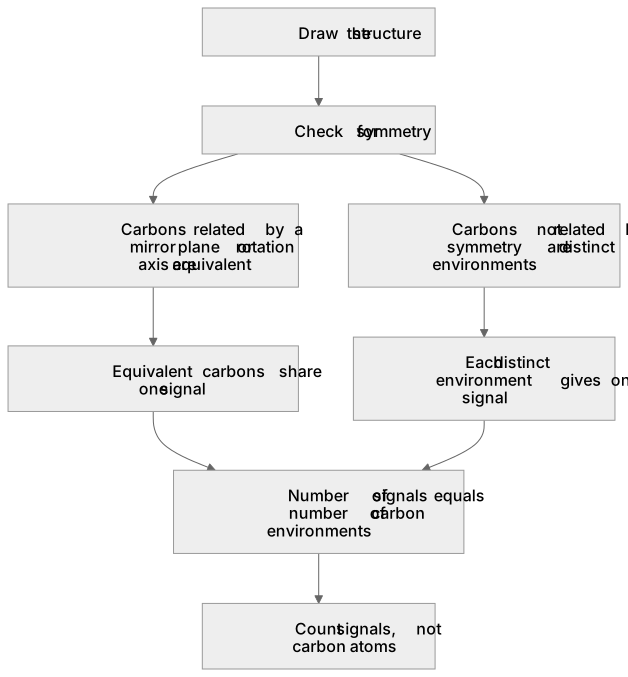
Key words
Say what each word means before you turn the card.
Carbon-13 NMR spectroscopy
Try answering aloud or in your head before turning the card.
Chemical equivalence and symmetry
Try answering aloud or in your head before turning the card.
Number of signals and environments
Try answering aloud or in your head before turning the card.
Molecular structure interpretation
Try answering aloud or in your head before turning the card.
See every definition
- Carbon-13 NMR spectroscopy
- A technique that tells you how many distinct carbon environments a molecule contains, where each set of equivalent carbons gives one signal.
- Chemical equivalence and symmetry
- Carbons related by a mirror plane or a rotation axis are equivalent and share a signal, so symmetry must be checked before deciding.
- Number of signals and environments
- The number of signals equals the number of carbon environments, so count signals, not atoms.
- Molecular structure interpretation
- Drawing the structure and marking equivalent carbons with the same label before counting signals helps relate the number of ¹³C NMR signals to molecular symmetry.
Label the diagram
Some boxes have lost their names. Pick the right name for each number.
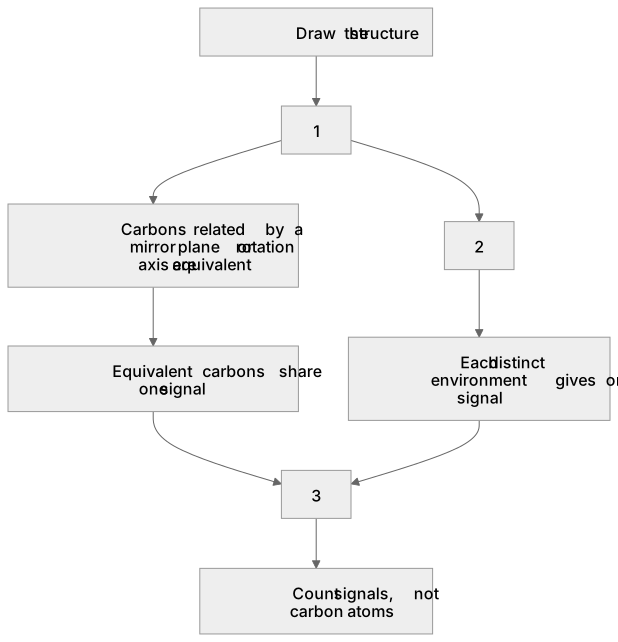
1Box 1
2Box 2
3Box 3
There is more to this lesson
The full lesson goes on to check your understanding and help you earn the marks. Create a free account to carry on, with your progress saved.
A week of Premium from your first lesson · Then the free plan continues · No card, no charge
Test your understanding of Spectroscopy: (i) the number of carbon environments in the molecule
Active recall beats re-reading. Take an instant quiz now to test what you’ve learned and lock it into long-term memory.
A week of Premium from your first lesson · Then the free plan continues · No card, no charge