OCR · A-Level · Chemistry
Course version: H432 · Version from Sept 2017
(ii) the different types of carbon environment present, from chemical…
Full specification wording
Spectroscopy: (ii) the different types of carbon environment present, from chemical shift values
The chemical shift of each ¹³C NMR signal, measured in parts per million (ppm) relative to tetramethylsilane (TMS) at 0 ppm, indicates the type of carbon environment.
- Point 2 of 16
- 4 key terms
Study notes
From the teaching notes for this specification point.
The idea
The chemical shift of each ¹³C NMR signal, measured in parts per million (ppm) relative to tetramethylsilane (TMS) at 0 ppm, indicates the type of carbon environment. The shift depends on the local electronic environment: carbons near electronegative atoms or in unsaturated groups are deshielded and appear at higher ppm. Typical ranges help identify environments: alkyl carbons appear around 10–50 ppm, carbons adjacent to oxygen in alcohols and ethers around 50–90 ppm, alkene carbons around 100–150 ppm, and carbonyl carbons of aldehydes, ketones, esters and carboxylic acids around 160–220 ppm. For example, a signal near 170 ppm suggests a carbonyl carbon, while one near 60 ppm suggests a carbon bonded to oxygen. Match each observed shift to these ranges to assign the type of environment.
What earns the marks
- Uses chemical shift values in ppm to identify the type of carbon environment.
- States that shifts are measured relative to TMS at 0 ppm.
- Links higher chemical shifts to deshielding by electronegative atoms or unsaturation.
- Assigns a shift near 170 ppm to a carbonyl carbon environment.
- Assigns a shift near 50–90 ppm to a carbon bonded to oxygen in an alcohol or ether.
Common mistakes and how to put them right
Treats chemical shift as a measure of the number of carbons.
Put it right: Use it to identify the type of environment instead.
Forgets that shifts are measured relative to TMS at 0 ppm.
Put it right: State the reference when interpreting values.
Assigns a high shift to an alkyl carbon.
Put it right: Deshielding by electronegative atoms or unsaturation raises the shift.
Exam tips
- Learn the approximate shift ranges for alkyl, oxygen-bonded, alkene and carbonyl carbons.
- Compare each observed shift with the ranges rather than guessing from a single value.
- State the reference standard TMS at 0 ppm when explaining chemical shift.
Try the lesson
The start of the Spectroscopy: (ii) the different types of carbon environment present, from chemical shift values lesson, made from teaching notes for this specification point.
Listen
The chemical shift of each ¹³C NMR signal, measured in parts per million (ppm) relative to tetramethylsilane (TMS) at 0 ppm, indicates the type of carbon environment. The shift depends on the local electronic environment: carbons near electronegative atoms or in unsaturated groups are deshielded and appear at higher ppm. Typical ranges help identify environments: alkyl carbons appear around 10–50 ppm, carbons adjacent to oxygen in alcohols and ethers around 50–90 ppm, alkene carbons around 100–150 ppm, and carbonyl carbons of aldehydes, ketones, esters and carboxylic acids around 160–220 ppm. For example, a signal near 170 ppm suggests a carbonyl carbon, while one near 60 ppm suggests a carbon bonded to oxygen. Match each observed shift to these ranges to assign the type of environment. A strong answer earns marks for these points. Uses chemical shift values in ppm to identify the type of carbon environment. States that shifts are measured relative to TMS at 0 ppm. Links higher chemical shifts to deshielding by electronegative atoms or unsaturation. Assigns a shift near 170 ppm to a carbonyl carbon environment. Exam tip: Learn the approximate shift ranges for alkyl, oxygen-bonded, alkene and carbonyl carbons.
See it
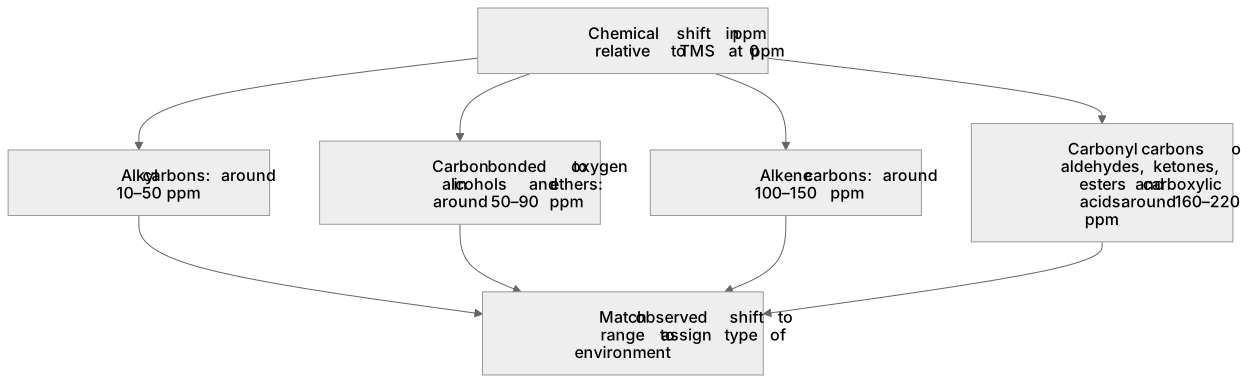
Key words
Say what each word means before you turn the card.
Chemical shift
Try answering aloud or in your head before turning the card.
Deshielding
Try answering aloud or in your head before turning the card.
Reference standard TMS
Try answering aloud or in your head before turning the card.
Carbon environment
Try answering aloud or in your head before turning the card.
See every definition
- Chemical shift
- Measured in parts per million relative to tetramethylsilane at 0 ppm, it indicates the type of carbon environment.
- Deshielding
- Carbons near electronegative atoms or in unsaturated groups are deshielded and appear at higher ppm.
- Reference standard TMS
- Tetramethylsilane, at 0 ppm, is the standard relative to which shifts are measured.
- Carbon environment
- The type of carbon present, identified from chemical shift values by matching each observed shift to the typical ranges.
Label the diagram
Some boxes have lost their names. Pick the right name for each number.
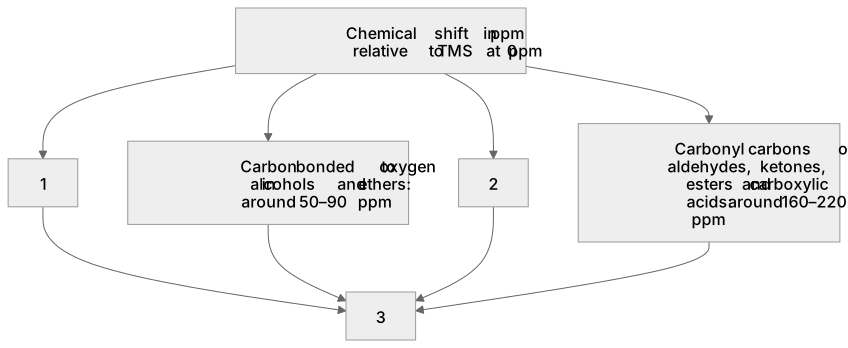
1Box 1
2Box 2
3Box 3
There is more to this lesson
The full lesson goes on to check your understanding and help you earn the marks. Create a free account to carry on, with your progress saved.
A week of Premium from your first lesson · Then the free plan continues · No card, no charge
Test your understanding of Spectroscopy: (ii) the different types of carbon environment present, from chemical shift values
Active recall beats re-reading. Take an instant quiz now to test what you’ve learned and lock it into long-term memory.
A week of Premium from your first lesson · Then the free plan continues · No card, no charge