OCR · A-Level · Chemistry
Course version: H432 · Version from Sept 2017
(iv) the number of non-equivalent protons adjacent to a given proton from…
Full specification wording
Spectroscopy: (iv) the number of non-equivalent protons adjacent to a given proton from the spin–spin splitting pattern, using the n + 1 rule
High-resolution ¹H NMR spectra show spin–spin splitting because a proton's signal is influenced by the magnetic states of non-equivalent protons on adjacent carbon atoms.
- Point 7 of 16
- 4 key terms
Study notes
From the teaching notes for this specification point.
The idea
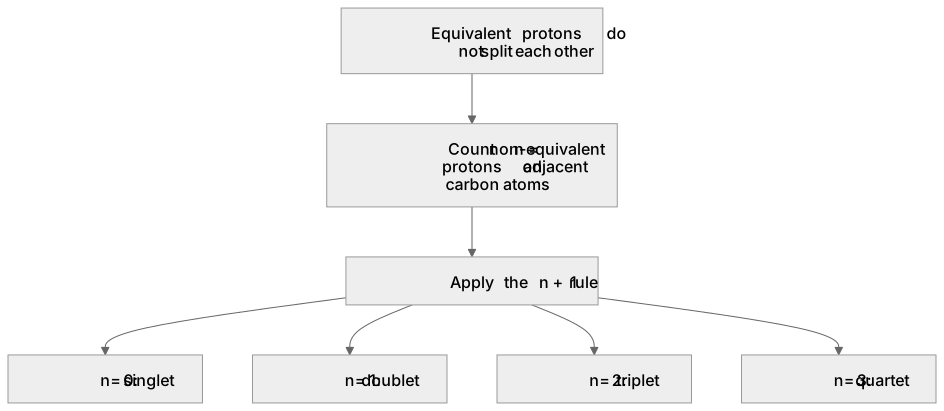
High-resolution ¹H NMR spectra show spin–spin splitting because a proton's signal is influenced by the magnetic states of non-equivalent protons on adjacent carbon atoms. Apply the n + 1 rule: if n non-equivalent protons sit on the neighbouring carbon atom(s), the signal splits into n + 1 peaks. One adjacent proton gives a doublet, two give a triplet, three give a quartet and none gives a singlet. Only protons that are non-equivalent to the observed proton and are on adjacent atoms cause splitting; equivalent protons do not split each other.
For example: In CH₃CH₂OH the CH₂ protons are adjacent to three CH₃ protons, so the CH₂ signal is a quartet, while the CH₃ signal is a triplet from the two CH₂ protons.
What earns the marks
- States that spin–spin splitting is observed in high-resolution ¹H NMR spectra.
- Applies the n + 1 rule so that n non-equivalent adjacent protons give a signal split into n + 1 peaks.
- Counts only non-equivalent protons on adjacent atoms as the n value for a given signal.
- Matches a splitting pattern to a structure, for example a triplet from two adjacent protons or a quartet from three adjacent protons.
- Explains that equivalent protons do not split one another's signals.
Common mistakes and how to put them right
Attributes spin–spin splitting to low-resolution ¹H NMR.
Put it right: State that splitting is resolved in high-resolution ¹H NMR spectra.
Counts all neighbouring protons including equivalent ones.
Put it right: Count only non-equivalent protons on adjacent atoms.
Reverses the rule by adding one to the number of peaks.
Put it right: Apply n + 1 to the number of adjacent non-equivalent protons to obtain the number of peaks.
Treats protons on the same carbon as splitting each other.
Put it right: State that equivalent protons on the same carbon do not split one another.
Exam tips
- Identify the adjacent carbon atoms first, then count only the non-equivalent protons on them.
- State the n value and the resulting n + 1 peak count explicitly for each signal.
- Use a worked structure such as CH₃CH₂OH to check that your splitting pattern matches the number of adjacent protons.
Try the lesson
The start of the Spectroscopy: (iv) the number of non-equivalent protons adjacent to a given proton from the spin–spin splitting pattern, using the n + 1 rule lesson, made from teaching notes for this specification point.
Listen
High-resolution ¹H NMR spectra show spin–spin splitting because a proton's signal is influenced by the magnetic states of non-equivalent protons on adjacent carbon atoms. Apply the n + 1 rule: if n non-equivalent protons sit on the neighbouring carbon atom(s), the signal splits into n + 1 peaks. One adjacent proton gives a doublet, two give a triplet, three give a quartet and none gives a singlet. Only protons that are non-equivalent to the observed proton and are on adjacent atoms cause splitting; equivalent protons do not split each other. For example, in CH₃CH₂OH the CH₂ protons are adjacent to three CH₃ protons, so the CH₂ signal is a quartet, while the CH₃ signal is a triplet from the two CH₂ protons. A strong answer earns marks for these points. States that spin–spin splitting is observed in high-resolution ¹H NMR spectra. Applies the n + 1 rule so that n non-equivalent adjacent protons give a signal split into n + 1 peaks. Counts only non-equivalent protons on adjacent atoms as the n value for a given signal. Matches a splitting pattern to a structure, for example a triplet from two adjacent protons or a quartet from three adjacent protons. Exam tip: Identify the adjacent carbon atoms first, then count only the non-equivalent protons on them.
See it
Key words
Say what each word means before you turn the card.
High-resolution ¹H NMR
Try answering aloud or in your head before turning the card.
Spin–spin splitting
Try answering aloud or in your head before turning the card.
The n + 1 rule
Try answering aloud or in your head before turning the card.
Non-equivalent adjacent protons
Try answering aloud or in your head before turning the card.
See every definition
- High-resolution ¹H NMR
- A technique whose spectra show spin–spin splitting because a proton's signal is influenced by the magnetic states of non-equivalent protons on adjacent carbon atoms.
- Spin–spin splitting
- The splitting of a proton's signal in high-resolution ¹H NMR caused by the magnetic states of non-equivalent protons on adjacent carbon atoms.
- The n + 1 rule
- If n non-equivalent protons sit on the neighbouring carbon atom(s), the signal splits into n + 1 peaks.
- Non-equivalent adjacent protons
- Protons that are non-equivalent to the observed proton and are on adjacent atoms, and only these cause splitting.
Label the diagram
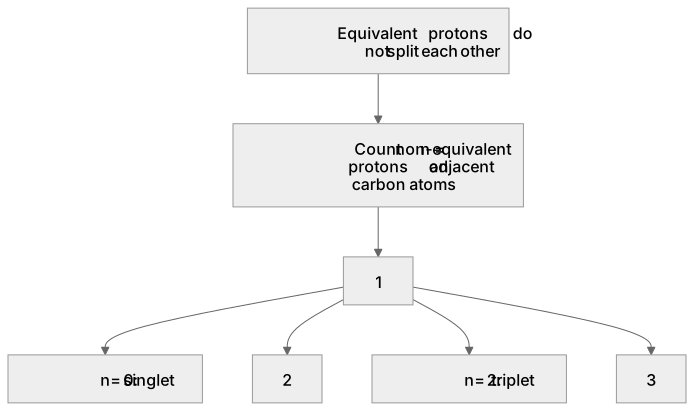
Some boxes have lost their names. Pick the right name for each number.
1Box 1
2Box 2
3Box 3
There is more to this lesson
The full lesson goes on to check your understanding and help you earn the marks. Create a free account to carry on, with your progress saved.
A week of Premium from your first lesson · Then the free plan continues · No card, no charge
Test your understanding of Spectroscopy: (iv) the number of non-equivalent protons adjacent to a given proton from the spin–spin splitting pattern, using the n + 1 rule
Active recall beats re-reading. Take an instant quiz now to test what you’ve learned and lock it into long-term memory.
A week of Premium from your first lesson · Then the free plan continues · No card, no charge