OCR · A-Level · Chemistry
Course version: H432 · Version from Sept 2017
Spectroscopy: (v) possible structures for the molecule
This outcome asks you to move from spectral data to a structure.
- Point 8 of 16
- 4 key terms
Study notes
From the teaching notes for this specification point.
The idea
This outcome asks you to move from spectral data to a structure. Combine the molecular formula with infrared absorptions, carbon-13 NMR chemical shifts and proton NMR integration, splitting and chemical shift to decide which candidate structure fits. For example, a formula C₄H₈O₂ with an infrared absorption near 1700 cm⁻¹, a carbon-13 signal near 170 ppm and a proton NMR spectrum of a triplet, a quartet and a singlet in ratio 3:2:3 points to ethyl ethanoate rather than a carboxylic acid or an alcohol. Work by eliminating candidates: check the number of carbon environments against the carbon-13 signals, check the number of proton environments and their integration against the proton NMR, and check splitting patterns against neighbouring hydrogens. Confirm that every piece of evidence is consistent before selecting the option.
What earns the marks
- Selects the structure that accounts for the number of carbon-13 environments shown in the spectrum.
- Matches the integration ratio of proton environments to the number of hydrogens in each environment of the chosen structure.
- Uses splitting patterns to confirm the number of hydrogens on adjacent carbon atoms.
- Uses infrared absorptions to confirm or exclude functional groups such as C=O or O–H.
- Eliminates each incorrect option by identifying at least one piece of spectral evidence it contradicts.
Common mistakes and how to put them right
Counts carbon-13 signals without checking symmetry.
Put it right: Equivalent carbons give one signal, so a symmetrical molecule shows fewer peaks than carbon atoms.
Ignores the integration ratio when choosing a structure.
Put it right: Use the relative areas to fix how many hydrogens sit in each environment.
Treats a singlet as proof of a methyl group without checking neighbouring hydrogens.
Put it right: Confirm that no hydrogen sits on an adjacent carbon before accepting the splitting.
Exam tips
- Write the molecular formula and calculate the number of double bond equivalents before comparing options.
- Tabulate each option against the observed carbon-13 count, proton environments, integration and splitting, then cross out options that fail any test.
- Check the infrared spectrum last as a confirmation step rather than relying on it alone.
Try the lesson
The start of the Spectroscopy: (v) possible structures for the molecule lesson, made from teaching notes for this specification point.
Listen
This outcome asks you to move from spectral data to a structure. Combine the molecular formula with infrared absorptions, carbon-13 NMR chemical shifts and proton NMR integration, splitting and chemical shift to decide which candidate structure fits. For example, a formula C₄H₈O₂ with an infrared absorption near 1700 cm⁻¹, a carbon-13 signal near 170 ppm and a proton NMR spectrum of a triplet, a quartet and a singlet in ratio 3:2:3 points to ethyl ethanoate rather than a carboxylic acid or an alcohol. Work by eliminating candidates: check the number of carbon environments against the carbon-13 signals, check the number of proton environments and their integration against the proton NMR, and check splitting patterns against neighbouring hydrogens. Confirm that every piece of evidence is consistent before selecting the option. A strong answer earns marks for these points. Selects the structure that accounts for the number of carbon-13 environments shown in the spectrum. Matches the integration ratio of proton environments to the number of hydrogens in each environment of the chosen structure. Uses splitting patterns to confirm the number of hydrogens on adjacent carbon atoms. Uses infrared absorptions to confirm or exclude functional groups such as C=O or O–H. Exam tip: Write the molecular formula and calculate the number of double bond equivalents before comparing options.
See it
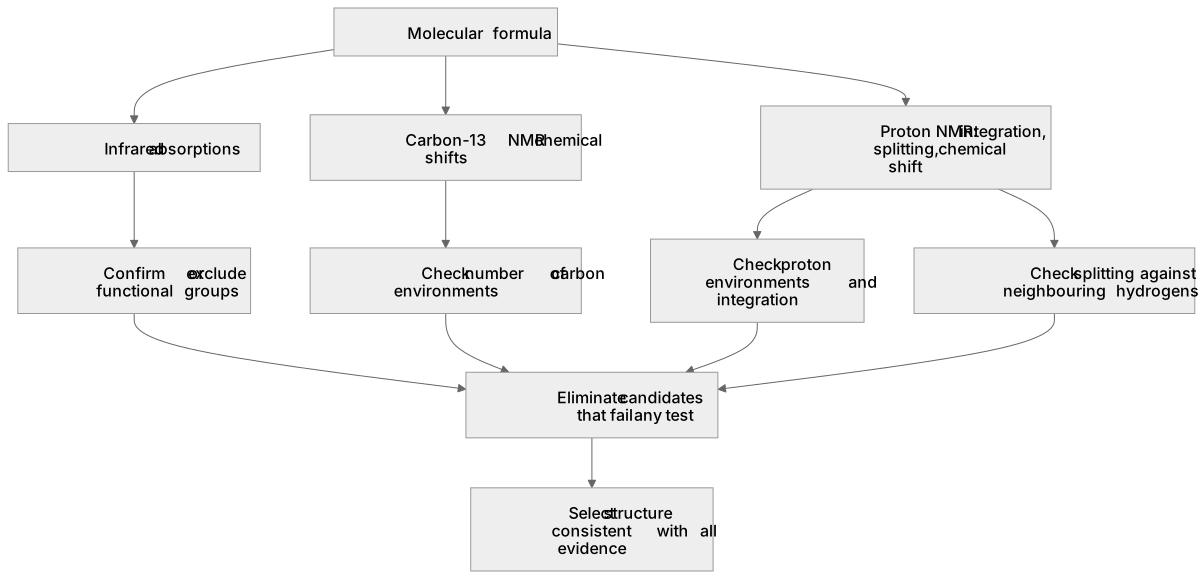
Key words
Say what each word means before you turn the card.
Carbon-13 NMR and molecular symmetry
Try answering aloud or in your head before turning the card.
Proton NMR integration and splitting patterns
Try answering aloud or in your head before turning the card.
Infrared absorptions and functional groups
Try answering aloud or in your head before turning the card.
Deducing structure from combined spectral evidence
Try answering aloud or in your head before turning the card.
See every definition
- Carbon-13 NMR and molecular symmetry
- Equivalent carbons give one signal, so a symmetrical molecule shows fewer peaks than carbon atoms.
- Proton NMR integration and splitting patterns
- Relative areas fix how many hydrogens sit in each environment, and splitting patterns confirm the number of hydrogens on adjacent carbon atoms.
- Infrared absorptions and functional groups
- Infrared absorptions are used to confirm or exclude functional groups such as C=O or O–H.
- Deducing structure from combined spectral evidence
- The molecular formula is combined with infrared absorptions, carbon-13 NMR chemical shifts and proton NMR integration, splitting and chemical shift to decide which candidate structure fits.
Label the diagram
Some boxes have lost their names. Pick the right name for each number.
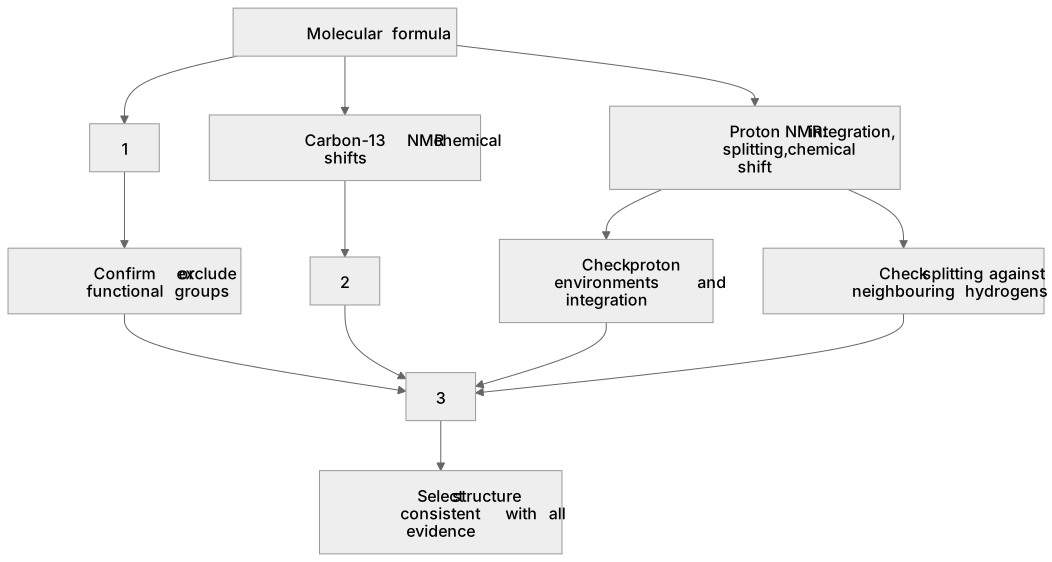
1Box 1
2Box 2
3Box 3
There is more to this lesson
The full lesson goes on to check your understanding and help you earn the marks. Create a free account to carry on, with your progress saved.
A week of Premium from your first lesson · Then the free plan continues · No card, no charge
Test your understanding of Spectroscopy: (v) possible structures for the molecule
Active recall beats re-reading. Take an instant quiz now to test what you’ve learned and lock it into long-term memory.
A week of Premium from your first lesson · Then the free plan continues · No card, no charge