OCR · A-Level · Chemistry
Course version: H432 · Version from Sept 2017
The halogens: Characteristic reactions of halide ions
Halide ions show characteristic reactions that let you identify them.
- Point 10 of 11
- 3 key terms
Study notes
From the teaching notes for this specification point.
The idea
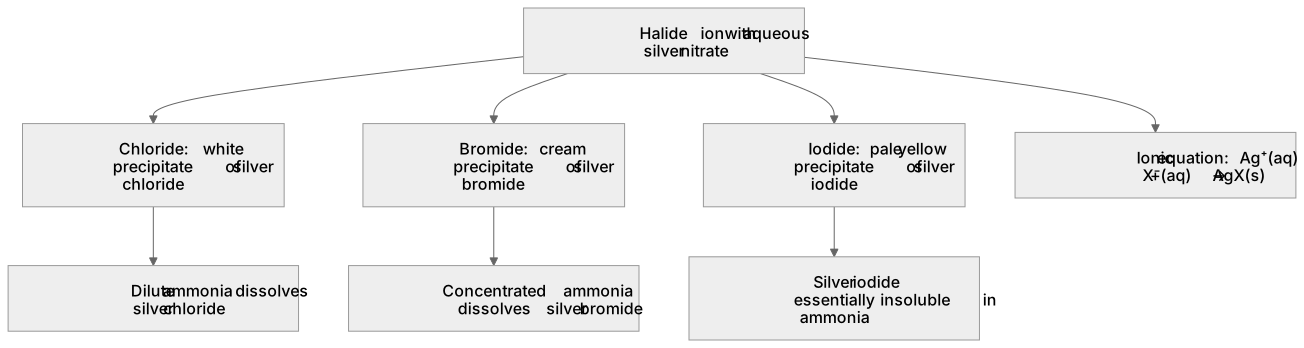
Halide ions show characteristic reactions that let you identify them. With aqueous silver nitrate, chloride gives a white precipitate of silver chloride, bromide a cream precipitate of silver bromide and iodide a pale yellow precipitate of silver iodide. Adding dilute ammonia dissolves the silver chloride; concentrated ammonia dissolves the silver bromide, and silver iodide is essentially insoluble in ammonia. These differences arise because the solubility of the silver halide in ammonia decreases from chloride to iodide. A reducing property also distinguishes the ions: concentrated sulfuric acid oxidises iodide to iodine, giving a purple vapour, while bromide gives bromine vapour and chloride is largely unaffected.
What earns the marks
- States that aqueous silver nitrate gives a white precipitate with chloride ions.
- Identifies the cream precipitate formed by bromide ions with silver nitrate.
- Describes the pale yellow precipitate produced by iodide ions with silver nitrate.
- Explains that dilute ammonia dissolves silver chloride but not silver bromide or silver iodide.
- States that concentrated ammonia dissolves silver bromide while silver iodide remains insoluble.
- Writes the ionic equation for precipitation as Ag⁺(aq) + X⁻(aq) → AgX(s).
Common mistakes and how to put them right
Confuses the precipitate colours.
Put it right: Learn white for chloride, cream for bromide and pale yellow for iodide.
Assumes concentrated ammonia dissolves every silver halide.
Put it right: Silver iodide stays insoluble.
Omits state symbols in the ionic equation.
Put it right: Include (aq) for the ions and (s) for the precipitate.
Treats the ammonia test as a single step.
Put it right: Distinguish the effect of dilute ammonia from that of concentrated ammonia.
Exam tips
- Link each precipitate colour directly to its halide ion in a short table you can recall quickly.
- State clearly which concentration of ammonia dissolves which precipitate, because the distinction is the discriminating step.
- Write the general ionic equation with correct state symbols and substitute the halide symbol.
- When a question describes an unknown halide, work through colour first, then ammonia solubility, then any redox evidence.
Try the lesson
The start of the The halogens: Characteristic reactions of halide ions lesson, made from teaching notes for this specification point.
Listen
Halide ions show characteristic reactions that let you identify them. With aqueous silver nitrate, chloride gives a white precipitate of silver chloride, bromide a cream precipitate of silver bromide and iodide a pale yellow precipitate of silver iodide. Adding dilute ammonia dissolves the silver chloride; concentrated ammonia dissolves the silver bromide, and silver iodide is essentially insoluble in ammonia. These differences arise because the solubility of the silver halide in ammonia decreases from chloride to iodide. A reducing property also distinguishes the ions: concentrated sulfuric acid oxidises iodide to iodine, giving a purple vapour, while bromide gives bromine vapour and chloride is largely unaffected. A strong answer earns marks for these points. States that aqueous silver nitrate gives a white precipitate with chloride ions. Identifies the cream precipitate formed by bromide ions with silver nitrate. Describes the pale yellow precipitate produced by iodide ions with silver nitrate. Explains that dilute ammonia dissolves silver chloride but not silver bromide or silver iodide. Exam tip: Link each precipitate colour directly to its halide ion in a short table you can recall quickly.
See it
Key words
Say what each word means before you turn the card.
Precipitation of silver halides
Try answering aloud or in your head before turning the card.
Solubility of silver halides in ammonia
Try answering aloud or in your head before turning the card.
Ionic equations with state symbols
Try answering aloud or in your head before turning the card.
See every definition
- Precipitation of silver halides
- Aqueous silver nitrate gives a white precipitate with chloride, a cream precipitate with bromide and a pale yellow precipitate with iodide.
- Solubility of silver halides in ammonia
- Dilute ammonia dissolves silver chloride but not silver bromide or silver iodide, and concentrated ammonia dissolves silver bromide while silver iodide remains insoluble.
- Ionic equations with state symbols
- The precipitation is written as Ag⁺(aq) + X⁻(aq) → AgX(s), with (aq) for the ions and (s) for the precipitate.
Label the diagram
Some boxes have lost their names. Pick the right name for each number.
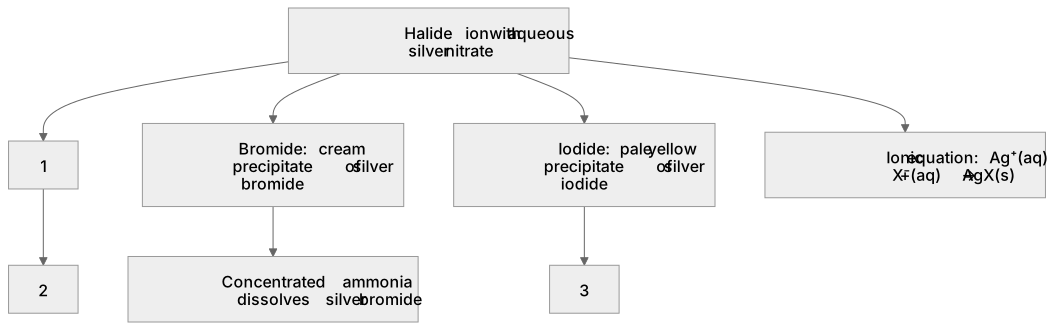
1Box 1
2Box 2
3Box 3
There is more to this lesson
The full lesson goes on to check your understanding and help you earn the marks. Create a free account to carry on, with your progress saved.
A week of Premium from your first lesson · Then the free plan continues · No card, no charge
Test your understanding of The halogens: Characteristic reactions of halide ions
Active recall beats re-reading. Take an instant quiz now to test what you’ve learned and lock it into long-term memory.
A week of Premium from your first lesson · Then the free plan continues · No card, no charge