OCR · A-Level · Chemistry
Course version: H432 · Version from Sept 2017
(f) the benefits of chlorine use in water treatment (killing bacteria)…
Full specification wording
The halogens: (f) the benefits of chlorine use in water treatment (killing bacteria) contrasted with associated risks (e.g. hazards of toxic chlorine gas and possible risks from formation of chlorinated hydrocarbons)
This clause requires a balanced evaluation of chlorine in water treatment.
- Point 9 of 11
- 4 key terms
Study notes
From the teaching notes for this specification point.
The idea
This clause requires a balanced evaluation of chlorine in water treatment. The benefit is that chlorine kills bacteria in drinking water and so reduces the spread of waterborne disease. The risks include the toxicity of chlorine gas to workers and the public if it escapes, and the possibility that chlorine reacts with organic matter to form chlorinated hydrocarbons, some of which are suspected carcinogens. A strong answer states both sides and reaches a judgement, for example that the disease-prevention benefit outweighs the risks when chlorine is handled and dosed correctly. Use the equation Cl₂ + H₂O ⇌ HCl + HClO to show how chlorine forms the disinfecting species.
What earns the marks
- States that chlorine kills bacteria in water and so reduces waterborne disease.
- Identifies the hazard of toxic chlorine gas to those handling or exposed to it.
- Explains that chlorine can form chlorinated hydrocarbons with organic matter and notes the associated risk.
- Reaches a balanced judgement weighing the benefits against the risks.
Common mistakes and how to put them right
Lists only the benefits or only the risks.
Put it right: Present both sides before judging.
Claims chlorine is harmless at all concentrations.
Put it right: Recognise the toxicity of chlorine gas.
Describes chlorinated hydrocarbons as definitely safe.
Put it right: Note the possible health risks instead.
Exam tips
- Use the phrase 'on balance' to signal a judgement.
- Link the benefit directly to killing bacteria and preventing disease.
- Give a specific risk such as toxic gas or chlorinated hydrocarbon formation rather than a vague statement.
Try the lesson
The start of the The halogens: (f) the benefits of chlorine use in water treatment (killing bacteria) contrasted with associated risks (e.g. hazards of toxic chlorine gas and possible risks from formation of chlorinated hydrocarbons) lesson, made from teaching notes for this specification point.
Listen
This clause requires a balanced evaluation of chlorine in water treatment. The benefit is that chlorine kills bacteria in drinking water and so reduces the spread of waterborne disease. The risks include the toxicity of chlorine gas to workers and the public if it escapes, and the possibility that chlorine reacts with organic matter to form chlorinated hydrocarbons, some of which are suspected carcinogens. A strong answer states both sides and reaches a judgement, for example that the disease-prevention benefit outweighs the risks when chlorine is handled and dosed correctly. Use the equation Cl₂ + H₂O ⇌ HCl + HClO to show how chlorine forms the disinfecting species. A strong answer earns marks for these points. States that chlorine kills bacteria in water and so reduces waterborne disease. Identifies the hazard of toxic chlorine gas to those handling or exposed to it. Explains that chlorine can form chlorinated hydrocarbons with organic matter and notes the associated risk. Reaches a balanced judgement weighing the benefits against the risks. Exam tip: Use the phrase 'on balance' to signal a judgement.
See it
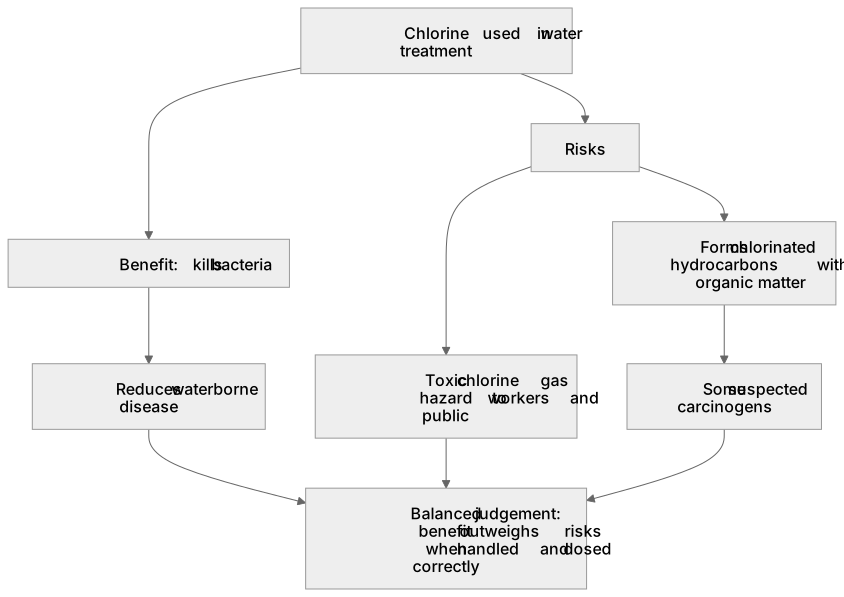
Key words
Say what each word means before you turn the card.
Chlorine in water treatment
Try answering aloud or in your head before turning the card.
Toxic chlorine gas hazards
Try answering aloud or in your head before turning the card.
Formation of chlorinated hydrocarbons
Try answering aloud or in your head before turning the card.
Benefits versus risks
Try answering aloud or in your head before turning the card.
See every definition
- Chlorine in water treatment
- Chlorine kills bacteria in drinking water and so reduces the spread of waterborne disease.
- Toxic chlorine gas hazards
- The risks include the toxicity of chlorine gas to workers and the public if it escapes.
- Formation of chlorinated hydrocarbons
- Chlorine reacts with organic matter to form chlorinated hydrocarbons, some of which are suspected carcinogens.
- Benefits versus risks
- A strong answer states both sides and reaches a judgement, for example that the disease-prevention benefit outweighs the risks when chlorine is handled and dosed correctly.
Label the diagram
Some boxes have lost their names. Pick the right name for each number.
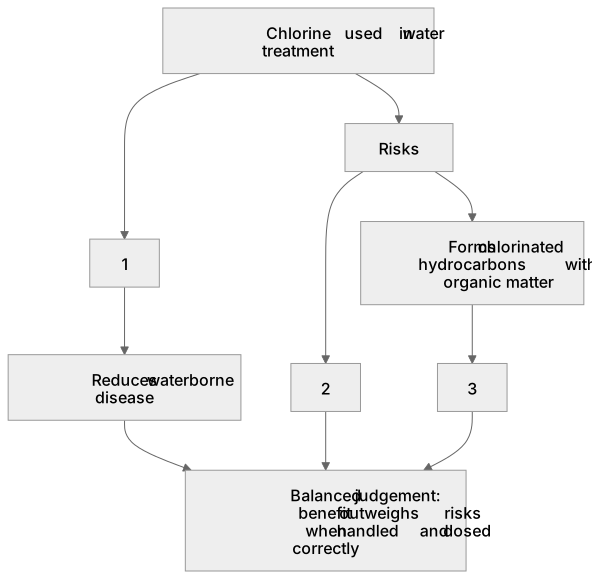
1Box 1
2Box 2
3Box 3
There is more to this lesson
The full lesson goes on to check your understanding and help you earn the marks. Create a free account to carry on, with your progress saved.
A week of Premium from your first lesson · Then the free plan continues · No card, no charge
Test your understanding of The halogens: (f) the benefits of chlorine use in water treatment (killing bacteria) contrasted with associated risks (e.g. hazards of toxic chlorine gas and possible risks from formation of chlorinated hydrocarbons)
Active recall beats re-reading. Take an instant quiz now to test what you’ve learned and lock it into long-term memory.
A week of Premium from your first lesson · Then the free plan continues · No card, no charge