OCR · A-Level · Chemistry
Course version: H432 · Version from Sept 2017
(e) explanation of the term disproportionation as oxidation and reduction…
Full specification wording
The halogens: (e) explanation of the term disproportionation as oxidation and reduction of the same element, illustrated by:
Disproportionation is a reaction in which the same element is simultaneously oxidised and reduced.
- Point 5 of 11
- 3 key terms
Study notes
From the teaching notes for this specification point.
The idea
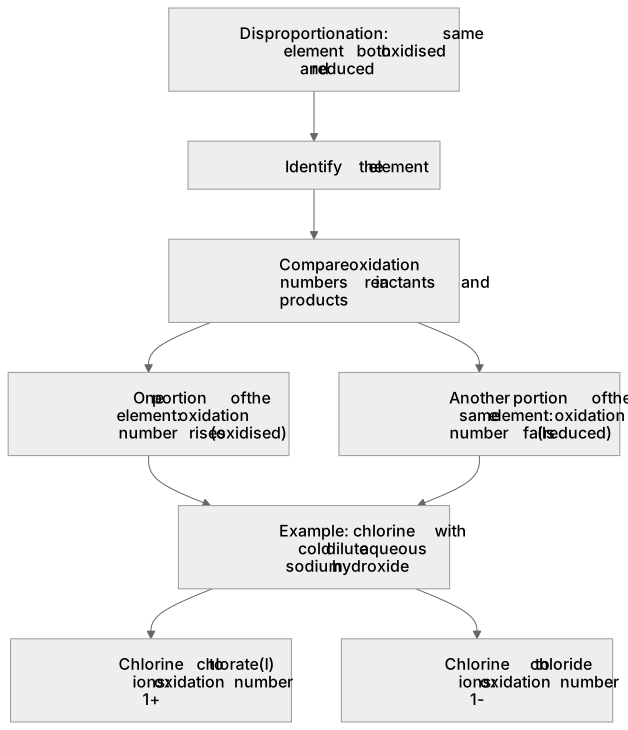
Disproportionation is a reaction in which the same element is simultaneously oxidised and reduced. In such a reaction one portion of the element increases its oxidation number while another portion of the same element decreases its oxidation number. The halogens illustrate this well. When chlorine reacts with cold dilute aqueous sodium hydroxide, chlorine is both oxidised and reduced: some chlorine atoms move to an oxidation number of 1⁻ in chloride ions while others move to an oxidation number of 1⁺ in chlorate(I) ions. Similarly, chlorine with water forms hydrochloric acid and chloric(I) acid, again with chlorine both oxidised and reduced. To explain disproportionation, identify the element, compare its oxidation numbers in the reactants and products, and show that one value rises while another falls for that same element.
What earns the marks
- Defines disproportionation as a reaction in which the same element is both oxidised and reduced at the same time.
- States that the oxidation number of one portion of the element increases while that of another portion decreases.
- Illustrates the definition with a halogen reaction such as chlorine with cold dilute aqueous sodium hydroxide.
- Identifies the oxidation numbers of the same element in the products to show one value rising and another falling, for example chlorine forming chloride ions and chlorate(I) ions.
Common mistakes and how to put them right
Describes disproportionation as two different elements being oxidised and reduced.
Put it right by stating that the same element is both oxidised and reduced.
Gives a reaction without assigning oxidation numbers.
Put it right by showing the oxidation number of the element rising in one product and falling in another.
Treats disproportionation as a redox reaction between two separate species.
Put it right by identifying the single element that changes in two directions.
Exam tips
- Quote the definition precisely: the same element is both oxidised and reduced.
- Support the definition with a named halogen reaction and state the oxidation numbers of the element in the products.
- Check that the element appears in at least two products with different oxidation numbers before calling the reaction disproportionation.
Try the lesson
The start of the The halogens: (e) explanation of the term disproportionation as oxidation and reduction of the same element, illustrated by: lesson, made from teaching notes for this specification point.
Listen
Disproportionation is a reaction in which the same element is simultaneously oxidised and reduced. In such a reaction one portion of the element increases its oxidation number while another portion of the same element decreases its oxidation number. The halogens illustrate this well. When chlorine reacts with cold dilute aqueous sodium hydroxide, chlorine is both oxidised and reduced: some chlorine atoms move to an oxidation number of 1⁻ in chloride ions while others move to an oxidation number of 1⁺ in chlorate(I) ions. Similarly, chlorine with water forms hydrochloric acid and chloric(I) acid, again with chlorine both oxidised and reduced. To explain disproportionation, identify the element, compare its oxidation numbers in the reactants and products, and show that one value rises while another falls for that same element. A strong answer earns marks for these points. Defines disproportionation as a reaction in which the same element is both oxidised and reduced at the same time. States that the oxidation number of one portion of the element increases while that of another portion decreases. Illustrates the definition with a halogen reaction such as chlorine with cold dilute aqueous sodium hydroxide. Identifies the oxidation numbers of the same element in the products to show one value rising and another falling, for example chlorine forming chloride ions and chlorate(I) ions. A common slip: Describes disproportionation as two different elements being oxidised and reduced. Instead, stating that the same element is both oxidised and reduced. Exam tip: Quote the definition precisely: the same element is both oxidised and reduced.
See it
Key words
Say what each word means before you turn the card.
Disproportionation
Try answering aloud or in your head before turning the card.
Halogen reactions with alkali
Try answering aloud or in your head before turning the card.
Halogen reactions with water
Try answering aloud or in your head before turning the card.
See every definition
- Disproportionation
- A reaction in which the same element is simultaneously oxidised and reduced, with one portion increasing its oxidation number while another portion decreases its oxidation number.
- Halogen reactions with alkali
- A reaction such as chlorine with cold dilute aqueous sodium hydroxide, in which chlorine is both oxidised and reduced, forming chloride ions and chlorate(I) ions.
- Halogen reactions with water
- A reaction in which chlorine with water forms hydrochloric acid and chloric(I) acid, with chlorine both oxidised and reduced.
Label the diagram
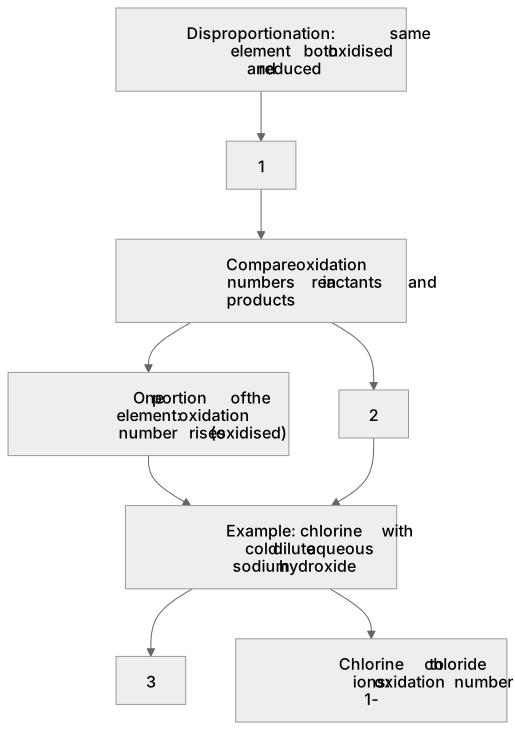
Some boxes have lost their names. Pick the right name for each number.
1Box 1
2Box 2
3Box 3
There is more to this lesson
The full lesson goes on to check your understanding and help you earn the marks. Create a free account to carry on, with your progress saved.
A week of Premium from your first lesson · Then the free plan continues · No card, no charge
Test your understanding of The halogens: (e) explanation of the term disproportionation as oxidation and reduction of the same element, illustrated by:
Active recall beats re-reading. Take an instant quiz now to test what you’ve learned and lock it into long-term memory.
A week of Premium from your first lesson · Then the free plan continues · No card, no charge