OCR · A-Level · Chemistry
Course version: H432 · Version from Sept 2017
(i) the reaction of chlorine with water as used in water treatment
Full specification wording
The halogens: (i) the reaction of chlorine with water as used in water treatment
Chlorine added to water undergoes disproportionation: chlorine is oxidised to chloric(I) acid and reduced to chloride ions.
- Point 6 of 11
- 4 key terms
Study notes
From the teaching notes for this specification point.
The idea
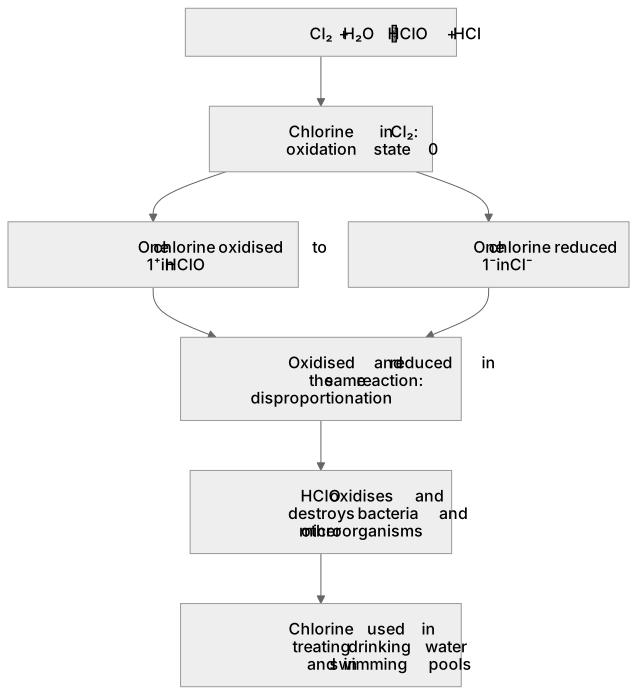
Chlorine added to water undergoes disproportionation: chlorine is oxidised to chloric(I) acid and reduced to chloride ions. The equation is Cl₂ + H₂O ⇌ HClO + HCl, or in ionic form Cl₂ + H₂O ⇌ HClO + H⁺ + Cl⁻. In HClO the chlorine is in oxidation state 1⁺; in Cl⁻ it is 1⁻; in Cl₂ it is 0, so one chlorine atom rises and one falls. The mixture is reversible and the chloric(I) acid is the active disinfectant: it oxidises and destroys bacteria and other microorganisms, which is why chlorine is used in treating drinking water and in swimming pools. Learners should recognise the oxidation states, identify the disproportionation, and explain that HClO rather than Cl⁻ provides the antimicrobial action. A common exam question asks why the reaction is a disproportionation or which species kills bacteria.
What earns the marks
- Identifies chlorine as both oxidised and reduced in the same reaction, so the process is a disproportionation.
- States the equation Cl₂ + H₂O ⇌ HClO + HCl and notes that the reaction is reversible.
- Assigns oxidation state 1⁺ to chlorine in HClO and 1⁻ to chlorine in HCl, with 0 in Cl₂.
- Explains that chloric(I) acid, HClO, is the species that oxidises and kills microorganisms in water treatment.
Common mistakes and how to put them right
Claims that chloride ions disinfect the water.
Put it right by naming HClO as the active antimicrobial species.
Writes chlorine as reduced only.
Put it right by showing one chlorine atom oxidised to 1⁺ and one reduced to 1⁻.
Omits the reversibility of the reaction.
Put it right by using the equilibrium arrow in the equation.
Exam tips
- Write the full equation and the ionic equation so the examiner can see the disproportionation clearly.
- Quote oxidation states for chlorine in each species rather than saying only that it changes.
- Link the chemistry to the practical use: name HClO as the disinfectant in water treatment.
Try the lesson
The start of the The halogens: (i) the reaction of chlorine with water as used in water treatment lesson, made from teaching notes for this specification point.
Listen
Chlorine added to water undergoes disproportionation: chlorine is oxidised to chloric(I) acid and reduced to chloride ions. The equation is Cl₂ + H₂O ⇌ HClO + HCl, or in ionic form Cl₂ + H₂O ⇌ HClO + H⁺ + Cl⁻. In HClO the chlorine is in oxidation state 1⁺; in Cl⁻ it is 1⁻; in Cl₂ it is 0, so one chlorine atom rises and one falls. The mixture is reversible and the chloric(I) acid is the active disinfectant: it oxidises and destroys bacteria and other microorganisms, which is why chlorine is used in treating drinking water and in swimming pools. Learners should recognise the oxidation states, identify the disproportionation, and explain that HClO rather than Cl⁻ provides the antimicrobial action. A common exam question asks why the reaction is a disproportionation or which species kills bacteria. A strong answer earns marks for these points. Identifies chlorine as both oxidised and reduced in the same reaction, so the process is a disproportionation. States the equation Cl₂ + H₂O ⇌ HClO + HCl and notes that the reaction is reversible. Assigns oxidation state 1⁺ to chlorine in HClO and 1⁻ to chlorine in HCl, with 0 in Cl₂. Explains that chloric(I) acid, HClO, is the species that oxidises and kills microorganisms in water treatment. A common slip: Claims that chloride ions disinfect the water. Instead, naming HClO as the active antimicrobial species. Exam tip: Write the full equation and the ionic equation so the examiner can see the disproportionation clearly.
See it
Key words
Say what each word means before you turn the card.
Disproportionation of chlorine
Try answering aloud or in your head before turning the card.
Oxidation states of chlorine
Try answering aloud or in your head before turning the card.
Chloric(I) acid as a disinfectant
Try answering aloud or in your head before turning the card.
Water treatment chemistry
Try answering aloud or in your head before turning the card.
See every definition
- Disproportionation of chlorine
- Chlorine is both oxidised and reduced in the same reaction, as one chlorine atom rises and one falls in oxidation state.
- Oxidation states of chlorine
- Chlorine is in oxidation state 1⁺ in HClO, 1⁻ in HCl, and 0 in Cl₂.
- Chloric(I) acid as a disinfectant
- HClO is the active disinfectant that oxidises and destroys bacteria and other microorganisms, rather than Cl⁻.
- Water treatment chemistry
- Chlorine added to water undergoes a reversible reaction, which is why chlorine is used in treating drinking water and in swimming pools.
Label the diagram
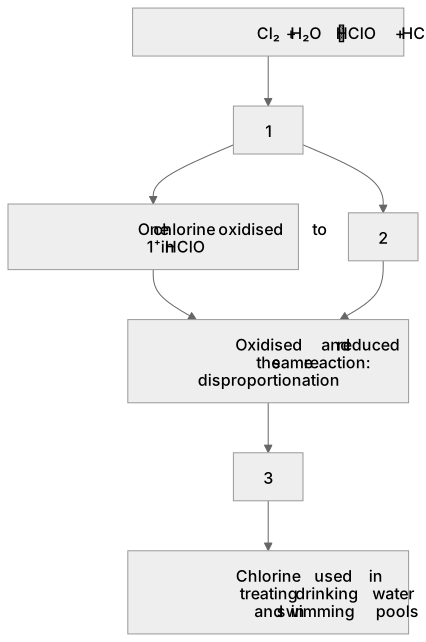
Some boxes have lost their names. Pick the right name for each number.
1Box 1
2Box 2
3Box 3
There is more to this lesson
The full lesson goes on to check your understanding and help you earn the marks. Create a free account to carry on, with your progress saved.
A week of Premium from your first lesson · Then the free plan continues · No card, no charge
Test your understanding of The halogens: (i) the reaction of chlorine with water as used in water treatment
Active recall beats re-reading. Take an instant quiz now to test what you’ve learned and lock it into long-term memory.
A week of Premium from your first lesson · Then the free plan continues · No card, no charge