OCR · A-Level · Chemistry
Course version: H432 · Version from Sept 2017
(ii) the reaction of chlorine with cold, dilute aqueous sodium hydroxide,…
Full specification wording
The halogens: (ii) the reaction of chlorine with cold, dilute aqueous sodium hydroxide, as used to form bleach
When chlorine reacts with cold, dilute aqueous sodium hydroxide, disproportionation again occurs.
- Point 7 of 11
- 4 key terms
Study notes
From the teaching notes for this specification point.
The idea
When chlorine reacts with cold, dilute aqueous sodium hydroxide, disproportionation again occurs. The equation is Cl₂ + 2NaOH → NaCl + NaClO + H₂O, or in ionic form Cl₂ + 2OH⁻ → Cl⁻ + ClO⁻ + H₂O. Chlorine is oxidised to chlorate(I) (hypochlorite) ions, ClO⁻, where chlorine has oxidation state 1⁺, and reduced to chloride ions, Cl⁻, with oxidation state 1⁻; in Cl₂ it is 0. The sodium chlorate(I) produced is the active ingredient of household bleach, which oxidises stains and microorganisms. The conditions matter: cold, dilute sodium hydroxide gives the chlorate(I) product, whereas hot, concentrated alkali gives chlorate(V). Learners should write the equation, identify the disproportionation and explain the link to bleach.
What earns the marks
- Writes the equation Cl₂ + 2NaOH → NaCl + NaClO + H₂O or the ionic form Cl₂ + 2OH⁻ → Cl⁻ + ClO⁻ + H₂O.
- Identifies the reaction as a disproportionation in which chlorine is both oxidised and reduced.
- Assigns oxidation state 1⁺ to chlorine in ClO⁻ and 1⁻ to chlorine in Cl⁻, with 0 in Cl₂.
- Explains that sodium chlorate(I), NaClO, is the active ingredient of bleach and oxidises stains and microorganisms.
Common mistakes and how to put them right
Uses hot, concentrated sodium hydroxide and expects chlorate(I).
Put it right by specifying cold, dilute conditions for bleach formation.
Writes the product as sodium chloride only.
Put it right by including sodium chlorate(I) as the bleaching species.
Gives chlorine a single oxidation state throughout.
Put it right by showing 0 in Cl₂, 1⁺ in ClO⁻ and 1⁻ in Cl⁻.
Exam tips
- State the conditions (cold, dilute) explicitly because they determine the product.
- Balance the equation and check that both sodium and oxygen atoms are conserved.
- Name sodium chlorate(I) as the bleaching agent rather than describing the whole mixture as bleach.
Try the lesson
The start of the The halogens: (ii) the reaction of chlorine with cold, dilute aqueous sodium hydroxide, as used to form bleach lesson, made from teaching notes for this specification point.
Listen
When chlorine reacts with cold, dilute aqueous sodium hydroxide, disproportionation again occurs. The equation is Cl₂ + 2NaOH → NaCl + NaClO + H₂O, or in ionic form Cl₂ + 2OH⁻ → Cl⁻ + ClO⁻ + H₂O. Chlorine is oxidised to chlorate(I) (hypochlorite) ions, ClO⁻, where chlorine has oxidation state 1⁺, and reduced to chloride ions, Cl⁻, with oxidation state 1⁻; in Cl₂ it is 0. The sodium chlorate(I) produced is the active ingredient of household bleach, which oxidises stains and microorganisms. The conditions matter: cold, dilute sodium hydroxide gives the chlorate(I) product, whereas hot, concentrated alkali gives chlorate(V). Learners should write the equation, identify the disproportionation and explain the link to bleach. A strong answer earns marks for these points. Writes the equation Cl₂ + 2NaOH → NaCl + NaClO + H₂O or the ionic form Cl₂ + 2OH⁻ → Cl⁻ + ClO⁻ + H₂O. Identifies the reaction as a disproportionation in which chlorine is both oxidised and reduced. Assigns oxidation state 1⁺ to chlorine in ClO⁻ and 1⁻ to chlorine in Cl⁻, with 0 in Cl₂. Explains that sodium chlorate(I), NaClO, is the active ingredient of bleach and oxidises stains and microorganisms. A common slip: Uses hot, concentrated sodium hydroxide and expects chlorate(I). Instead, specifying cold, dilute conditions for bleach formation. Exam tip: State the conditions (cold, dilute) explicitly because they determine the product.
See it
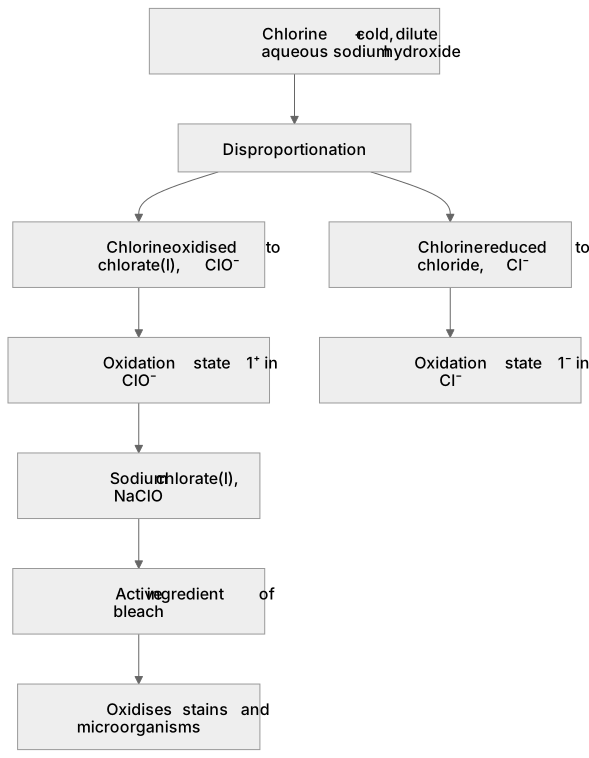
Key words
Say what each word means before you turn the card.
Disproportionation with alkali
Try answering aloud or in your head before turning the card.
Oxidation states of chlorine
Try answering aloud or in your head before turning the card.
Formation of bleach
Try answering aloud or in your head before turning the card.
Effect of conditions on products
Try answering aloud or in your head before turning the card.
See every definition
- Disproportionation with alkali
- A reaction in which chlorine is both oxidised and reduced when it reacts with cold, dilute aqueous sodium hydroxide.
- Oxidation states of chlorine
- Chlorine has oxidation state 0 in Cl₂, 1⁺ in ClO⁻ and 1⁻ in Cl⁻.
- Formation of bleach
- Sodium chlorate(I), NaClO, is the active ingredient of household bleach, which oxidises stains and microorganisms.
- Effect of conditions on products
- Cold, dilute sodium hydroxide gives the chlorate(I) product, whereas hot, concentrated alkali gives chlorate(V).
Label the diagram
Some boxes have lost their names. Pick the right name for each number.
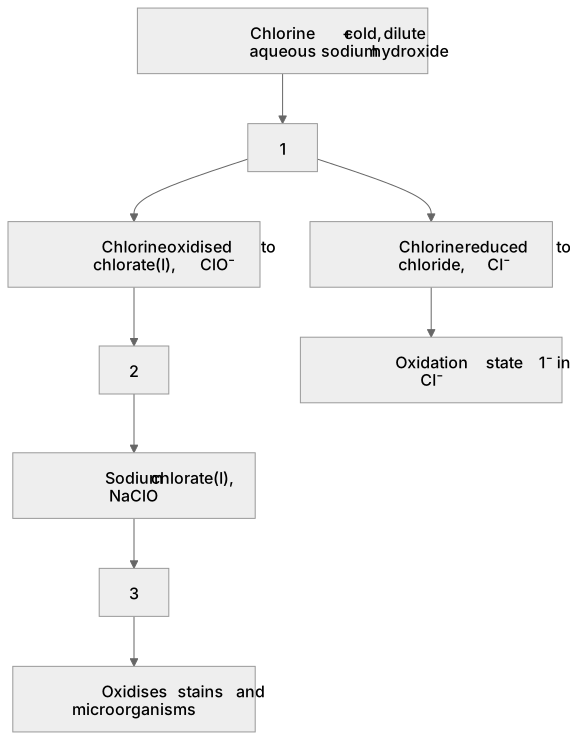
1Box 1
2Box 2
3Box 3
There is more to this lesson
The full lesson goes on to check your understanding and help you earn the marks. Create a free account to carry on, with your progress saved.
A week of Premium from your first lesson · Then the free plan continues · No card, no charge
Test your understanding of The halogens: (ii) the reaction of chlorine with cold, dilute aqueous sodium hydroxide, as used to form bleach
Active recall beats re-reading. Take an instant quiz now to test what you’ve learned and lock it into long-term memory.
A week of Premium from your first lesson · Then the free plan continues · No card, no charge