OCR · A-Level · Chemistry
Course version: H432 · Version from Sept 2017
(a) qualitative analysis of ions on a test-tube scale; processes and…
Full specification wording
The periodic table - 3.1.4 Qualitative analysis: (a) qualitative analysis of ions on a test-tube scale; processes and techniques needed to identify the following ions in an unknown compound:
This statement sets the approach for qualitative analysis on a test-tube scale: use small-scale tests, add reagents carefully and observe changes to identify ions in an unknown compound.
- Point 2 of 7
- 3 key terms
Study notes
From the teaching notes for this specification point.
The idea
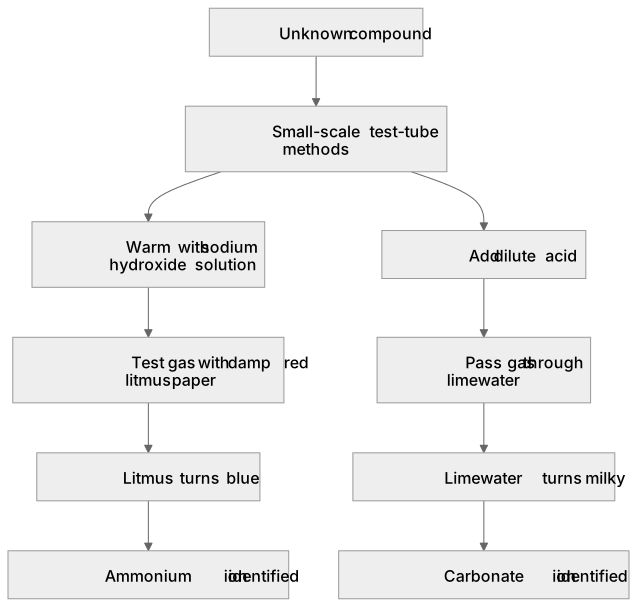
This statement sets the approach for qualitative analysis on a test-tube scale: use small-scale tests, add reagents carefully and observe changes to identify ions in an unknown compound. The processes and techniques include dissolving or suspending the sample, adding the chosen reagent, warming where a gas must be released, and testing any gas with the correct indicator or reagent. For the ammonium ion, warm the sample with sodium hydroxide solution and test the gas with damp red litmus paper, which turns blue. For the carbonate ion, add dilute acid and pass the gas through limewater, which turns milky.
What earns the marks
- Uses small-scale test-tube methods, adding reagents to a sample of the unknown compound and observing the resulting change.
- Warms the unknown compound with sodium hydroxide solution and tests the gas with damp red litmus paper to identify the ammonium ion.
- Adds dilute acid to the unknown compound and passes the gas through limewater to identify the carbonate ion.
- Links each reagent and observed change to the specific ion it confirms in the unknown compound.
Common mistakes and how to put them right
Adds reagents without recording the observation.
Put it right: Note the colour or gas change so the ion can be identified.
Tests for the ammonium ion without warming the mixture.
Put it right: Warm it with sodium hydroxide so ammonia is released.
Uses the limewater test to identify the ammonium ion.
Put it right: Reserve it for the carbonate ion and use damp red litmus for ammonia.
Exam tips
- Describe the technique step by step: add the reagent, note any gas, then test the gas with the named indicator or reagent.
- Keep the observation and the conclusion separate, so the marker can see which ion the change confirms.
- Use the correct reagent for each ion rather than a single test for all ions.
Try the lesson
The start of the The periodic table - 3.1.4 Qualitative analysis: (a) qualitative analysis of ions on a test-tube scale; processes and techniques needed to identify the following ions in an unknown compound: lesson, made from teaching notes for this specification point.
Listen
This statement sets the approach for qualitative analysis on a test-tube scale: use small-scale tests, add reagents carefully and observe changes to identify ions in an unknown compound. The processes and techniques include dissolving or suspending the sample, adding the chosen reagent, warming where a gas must be released, and testing any gas with the correct indicator or reagent. For the ammonium ion, warm the sample with sodium hydroxide solution and test the gas with damp red litmus paper, which turns blue. For the carbonate ion, add dilute acid and pass the gas through limewater, which turns milky. A strong answer earns marks for these points. Uses small-scale test-tube methods, adding reagents to a sample of the unknown compound and observing the resulting change. Warms the unknown compound with sodium hydroxide solution and tests the gas with damp red litmus paper to identify the ammonium ion. Adds dilute acid to the unknown compound and passes the gas through limewater to identify the carbonate ion. Links each reagent and observed change to the specific ion it confirms in the unknown compound. Exam tip: Describe the technique step by step: add the reagent, note any gas, then test the gas with the named indicator or reagent.
See it
Key words
Say what each word means before you turn the card.
Small-scale test-tube qualitative analysis
Try answering aloud or in your head before turning the card.
Processes and techniques for identifying ions
Try answering aloud or in your head before turning the card.
The carbonate ion test with dilute acid and limewater
Try answering aloud or in your head before turning the card.
See every definition
- Small-scale test-tube qualitative analysis
- Adding reagents to a sample of the unknown compound in a test-tube and observing the resulting change to identify ions.
- Processes and techniques for identifying ions
- Dissolving or suspending the sample, adding the chosen reagent, warming where a gas must be released, and testing any gas with the correct indicator or reagent.
- The carbonate ion test with dilute acid and limewater
- Adding dilute acid and passing the gas through limewater, which turns milky.
Label the diagram
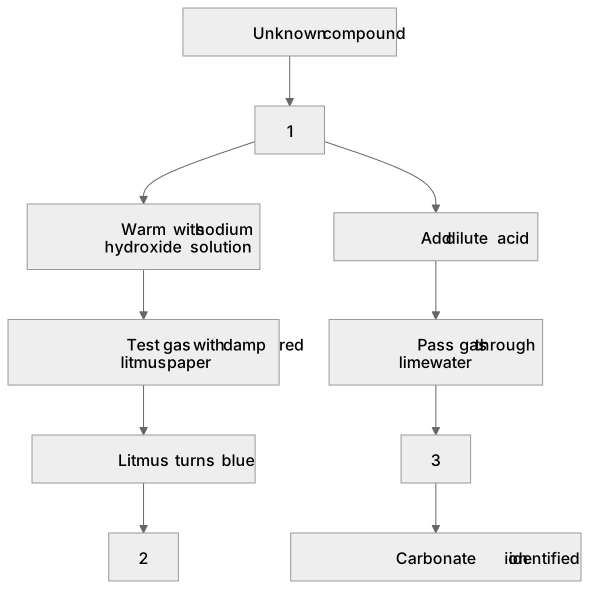
Some boxes have lost their names. Pick the right name for each number.
1Box 1
2Box 2
3Box 3
There is more to this lesson
The full lesson goes on to check your understanding and help you earn the marks. Create a free account to carry on, with your progress saved.
A week of Premium from your first lesson · Then the free plan continues · No card, no charge
Test your understanding of The periodic table - 3.1.4 Qualitative analysis: (a) qualitative analysis of ions on a test-tube scale; processes and techniques needed to identify the following ions in an unknown compound:
Active recall beats re-reading. Take an instant quiz now to test what you’ve learned and lock it into long-term memory.
A week of Premium from your first lesson · Then the free plan continues · No card, no charge