OCR · A-Level · Chemistry
Course version: H432 · Version from Sept 2017
The periodic table - 3.1.4 Qualitative analysis: (i) anions:
This heading introduces the anion tests in qualitative analysis: the identification of negatively charged ions in aqueous solution by characteristic reactions.
- Point 3 of 7
- 3 key terms
Study notes
From the teaching notes for this specification point.
The idea
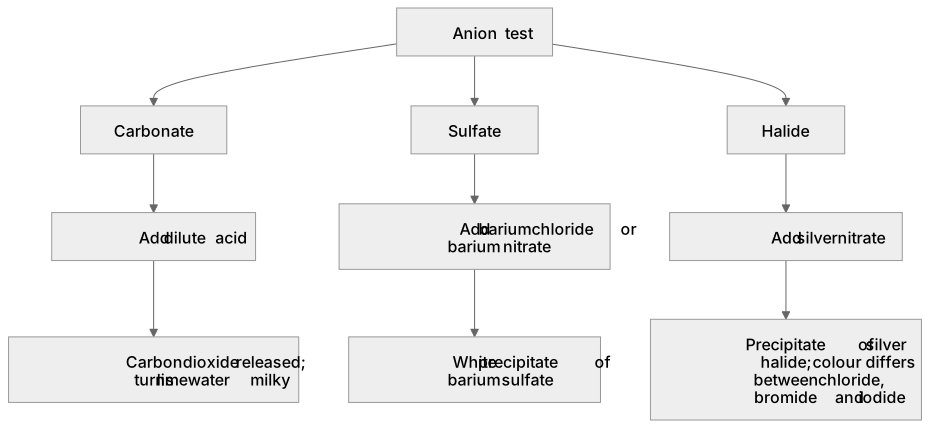
This heading introduces the anion tests in qualitative analysis: the identification of negatively charged ions in aqueous solution by characteristic reactions. Carbonate ions are detected by adding dilute acid, when carbon dioxide gas is released and turns limewater milky. Sulfate ions are detected by adding barium chloride or barium nitrate solution, when a white precipitate of barium sulfate forms. Halide ions are detected by adding silver nitrate solution, when a precipitate of the silver halide forms; the colour differs between chloride, bromide and iodide. A multiple-choice question on this heading asks you to select the correct reagent, ion or observation, so learn each test as a reagent–observation pair rather than a single fact.
What earns the marks
- Selects the reagent that gives a characteristic observation for the named anion.
- Matches each anion to the correct colour or gas observation.
- Distinguishes the anion tests from the cation flame tests.
- Applies the test to an unfamiliar solution by predicting the observation.
Common mistakes and how to put them right
Confuses the reagent for sulfate ions with the reagent for halide ions.
Put it right: Keep barium chloride for sulfate and silver nitrate for halide.
Treats a white precipitate as proof of any anion.
Put it right: Note that the precipitate colour and the reagent together identify the ion.
Assumes all anions give a gas with acid.
Put it right: Only carbonate releases carbon dioxide in this test.
Exam tips
- Learn each anion as a reagent–observation pair so the option can be checked quickly.
- Read the stem for the reagent already added before choosing an observation.
- Eliminate options that name a cation test when the question asks about anions.
Try the lesson
The start of the The periodic table - 3.1.4 Qualitative analysis: (i) anions: lesson, made from teaching notes for this specification point.
Listen
This heading introduces the anion tests in qualitative analysis: the identification of negatively charged ions in aqueous solution by characteristic reactions. Carbonate ions are detected by adding dilute acid, when carbon dioxide gas is released and turns limewater milky. Sulfate ions are detected by adding barium chloride or barium nitrate solution, when a white precipitate of barium sulfate forms. Halide ions are detected by adding silver nitrate solution, when a precipitate of the silver halide forms; the colour differs between chloride, bromide and iodide. A multiple-choice question on this heading asks you to select the correct reagent, ion or observation, so learn each test as a reagent–observation pair rather than a single fact. A strong answer earns marks for these points. Selects the reagent that gives a characteristic observation for the named anion. Matches each anion to the correct colour or gas observation. Distinguishes the anion tests from the cation flame tests. Applies the test to an unfamiliar solution by predicting the observation. Exam tip: Learn each anion as a reagent–observation pair so the option can be checked quickly.
See it
Key words
Say what each word means before you turn the card.
Anion identification
Try answering aloud or in your head before turning the card.
Characteristic reactions
Try answering aloud or in your head before turning the card.
Reagent–observation pairs
Try answering aloud or in your head before turning the card.
See every definition
- Anion identification
- The detection of carbonate, sulfate and halide anions, each confirmed by a distinct observation when the appropriate reagent is added.
- Characteristic reactions
- The reactions by which negatively charged ions in aqueous solution are identified, each anion being confirmed by a distinct observation.
- Reagent–observation pairs
- Each anion test learned as the reagent added together with the observation it gives, rather than as a single fact.
Label the diagram
Some boxes have lost their names. Pick the right name for each number.
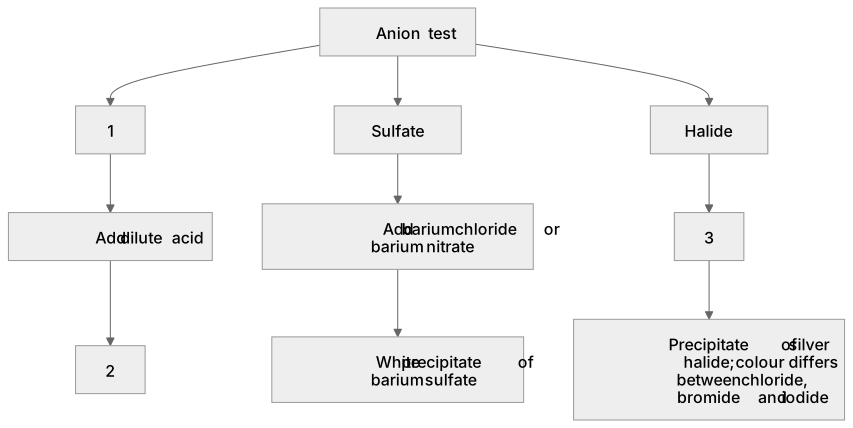
1Box 1
2Box 2
3Box 3
There is more to this lesson
The full lesson goes on to check your understanding and help you earn the marks. Create a free account to carry on, with your progress saved.
A week of Premium from your first lesson · Then the free plan continues · No card, no charge
Test your understanding of The periodic table - 3.1.4 Qualitative analysis: (i) anions:
Active recall beats re-reading. Take an instant quiz now to test what you’ve learned and lock it into long-term memory.
A week of Premium from your first lesson · Then the free plan continues · No card, no charge