OCR · A-Level · Chemistry
Course version: H432 · Version from Sept 2017
• CO₃²⁻, by reaction with H⁺(aq) forming CO₂(g) (see 2.1.4 c)
Full specification wording
The periodic table - 3.1.4 Qualitative analysis: • CO₃²⁻, by reaction with H⁺(aq) forming CO₂(g) (see 2.1.4 c)
Carbonate ions, CO₃²⁻, are identified by adding an aqueous acid, which supplies H⁺(aq).
- Point 4 of 7
- 4 key terms
Study notes
From the teaching notes for this specification point.
The idea
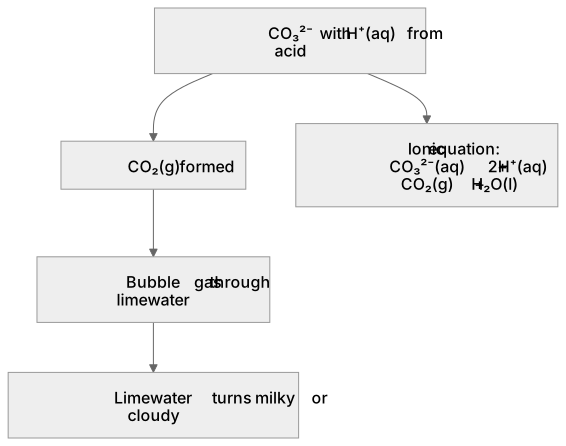
Carbonate ions, CO₃²⁻, are identified by adding an aqueous acid, which supplies H⁺(aq). The reaction releases carbon dioxide gas, CO₂(g), and this gas is confirmed by bubbling it through limewater, which turns milky or cloudy. The ionic equation is CO₃²⁻(aq) + 2H⁺(aq) → CO₂(g) + H₂O(l), so two hydrogen ions are needed for each carbonate ion. A multiple-choice question may ask for the gas produced, the ionic equation, or the observation that confirms the gas. Learn the balanced equation and the limewater test together, and check that charges balance: the left side has a total charge of zero, matching the neutral products.
What earns the marks
- Identifies carbon dioxide as the gas formed when acid reacts with carbonate ions.
- States that limewater turns milky or cloudy as the confirmatory test for carbon dioxide.
- Balances the ionic equation CO₃²⁻(aq) + 2H⁺(aq) → CO₂(g) + H₂O(l).
- Explains that the acid supplies the H⁺(aq) ions that react with CO₃²⁻.
Common mistakes and how to put them right
Writes the equation with one hydrogen ion per carbonate.
Put it right: Balance the charges so two H⁺ are used.
Claims the gas is hydrogen.
Put it right: Identify carbon dioxide and confirm it with limewater.
Omits the state symbols.
Put it right: Include (aq), (g) and (l) as shown in the equation.
Exam tips
- Check charge balance on both sides of the ionic equation before selecting an option.
- Link the gas to its confirmatory limewater test rather than naming it alone.
- Recall that the acid provides H⁺(aq) ions, which is the key reactant.
Try the lesson
The start of the The periodic table - 3.1.4 Qualitative analysis: • CO₃²⁻, by reaction with H⁺(aq) forming CO₂(g) (see 2.1.4 c) lesson, made from teaching notes for this specification point.
Listen
Carbonate ions, CO₃²⁻, are identified by adding an aqueous acid, which supplies H⁺(aq). The reaction releases carbon dioxide gas, CO₂(g), and this gas is confirmed by bubbling it through limewater, which turns milky or cloudy. The ionic equation is CO₃²⁻(aq) + 2H⁺(aq) → CO₂(g) + H₂O(l), so two hydrogen ions are needed for each carbonate ion. A multiple-choice question may ask for the gas produced, the ionic equation, or the observation that confirms the gas. Learn the balanced equation and the limewater test together, and check that charges balance: the left side has a total charge of zero, matching the neutral products. A strong answer earns marks for these points. Identifies carbon dioxide as the gas formed when acid reacts with carbonate ions. States that limewater turns milky or cloudy as the confirmatory test for carbon dioxide. Balances the ionic equation CO₃²⁻(aq) + 2H⁺(aq) → CO₂(g) + H₂O(l). Explains that the acid supplies the H⁺(aq) ions that react with CO₃²⁻. Exam tip: Check charge balance on both sides of the ionic equation before selecting an option.
See it
Key words
Say what each word means before you turn the card.
Carbonate test
Try answering aloud or in your head before turning the card.
Acid–carbonate reaction
Try answering aloud or in your head before turning the card.
Ionic equations
Try answering aloud or in your head before turning the card.
Gas confirmation
Try answering aloud or in your head before turning the card.
See every definition
- Carbonate test
- Carbonate ions are identified by reaction with H⁺(aq), forming CO₂(g).
- Acid–carbonate reaction
- Adding an aqueous acid supplies H⁺(aq) ions that react with CO₃²⁻ to release carbon dioxide gas, CO₂(g).
- Ionic equations
- The balanced equation CO₃²⁻(aq) + 2H⁺(aq) → CO₂(g) + H₂O(l) shows two hydrogen ions needed for each carbonate ion, with charges balancing to zero.
- Gas confirmation
- The gas is confirmed by bubbling it through limewater, which turns milky or cloudy.
Label the diagram
Some boxes have lost their names. Pick the right name for each number.
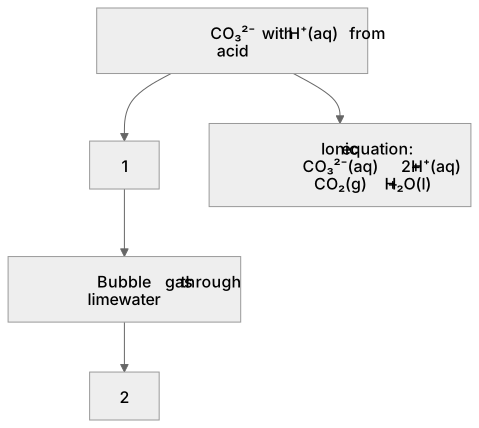
1Box 1
2Box 2
There is more to this lesson
The full lesson goes on to check your understanding and help you earn the marks. Create a free account to carry on, with your progress saved.
A week of Premium from your first lesson · Then the free plan continues · No card, no charge
Test your understanding of The periodic table - 3.1.4 Qualitative analysis: • CO₃²⁻, by reaction with H⁺(aq) forming CO₂(g) (see 2.1.4 c)
Active recall beats re-reading. Take an instant quiz now to test what you’ve learned and lock it into long-term memory.
A week of Premium from your first lesson · Then the free plan continues · No card, no charge