OCR · A-Level · Chemistry
Course version: H432 · Version from Sept 2017
(a) qualitative analysis of ions on a test-tube scale: processes and…
Full specification wording
Transition elements - 5.3.2 Qualitative analysis: (a) qualitative analysis of ions on a test-tube scale: processes and techniques needed to identify the following ions in an unknown compound:
This criterion asks you to carry out qualitative analysis of ions on a test-tube scale and to know the processes and techniques that let you identify ions in an unknown compound.
- Point 1 of 3
- 3 key terms
Study notes
From the teaching notes for this specification point.
The idea
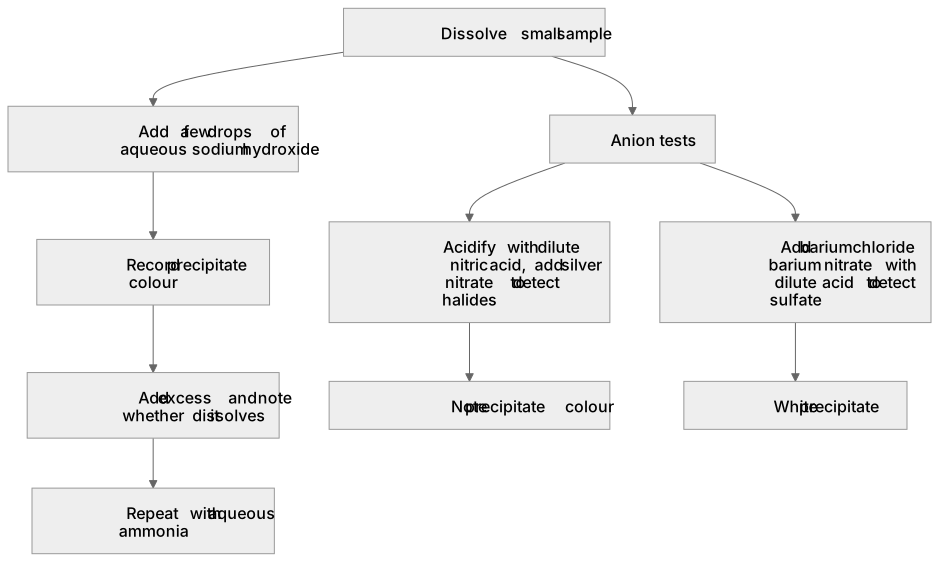
This criterion asks you to carry out qualitative analysis of ions on a test-tube scale and to know the processes and techniques that let you identify ions in an unknown compound. In practice you dissolve a small sample, add a few drops of aqueous sodium hydroxide, record any precipitate colour, then add excess and note whether it dissolves; repeat with aqueous ammonia. For anions, acidify with dilute nitric acid and add silver nitrate to detect halides, or add barium chloride or barium nitrate with dilute acid to detect sulfate. You must also know the ionic equations, including formation of complex ions such as the tetraamminecopper(II) ion, and be able to explain why excess reagent is added and why acidification precedes the anion tests.
What earns the marks
- Selects aqueous sodium hydroxide and aqueous ammonia as the reagents for identifying cations in solution.
- Records the colour of the precipitate formed and whether it dissolves when excess reagent is added.
- Identifies halide ions by acidifying with dilute nitric acid and adding silver nitrate, noting the precipitate colour.
- Identifies sulfate ions by adding barium chloride or barium nitrate with dilute acid to give a white precipitate.
- Writes the ionic equation for a precipitation or for complex ion formation that matches the stated observation.
- Explains that acidification prevents precipitation of carbonate or hydroxide ions that would confuse the anion test.
Common mistakes and how to put them right
Adds excess reagent before recording the initial precipitate.
Put it right: Record the few-drops observation first, then the excess result.
Omits acidification before the silver nitrate test.
Put it right: Add dilute nitric acid first so carbonate ions do not give a misleading precipitate.
Writes formulae with postfix charge notation.
Put it right: Use Unicode superscript signs such as Na⁺, O²⁻ and Cu²⁺.
States a colour without naming the ion responsible.
Put it right: Link each observation to the ion and, where required, the ionic equation.
Exam tips
- Learn a decision tree: cation tests with hydroxide and ammonia, halide tests with acidified silver nitrate, sulfate tests with acidified barium salt.
- Practise writing ionic equations from observations, including the tetraamminecopper(II) ion, so equation and colour are linked.
- Read each question for the words 'few drops' or 'excess' and answer only what that stage shows.
Try the lesson
The start of the Transition elements - 5.3.2 Qualitative analysis: (a) qualitative analysis of ions on a test-tube scale: processes and techniques needed to identify the following ions in an unknown compound: lesson, made from teaching notes for this specification point.
Listen
This criterion asks you to carry out qualitative analysis of ions on a test-tube scale and to know the processes and techniques that let you identify ions in an unknown compound. In practice you dissolve a small sample, add a few drops of aqueous sodium hydroxide, record any precipitate colour, then add excess and note whether it dissolves; repeat with aqueous ammonia. For anions, acidify with dilute nitric acid and add silver nitrate to detect halides, or add barium chloride or barium nitrate with dilute acid to detect sulfate. You must also know the ionic equations, including formation of complex ions such as the tetraamminecopper(II) ion, and be able to explain why excess reagent is added and why acidification precedes the anion tests. A strong answer earns marks for these points. Selects aqueous sodium hydroxide and aqueous ammonia as the reagents for identifying cations in solution. Records the colour of the precipitate formed and whether it dissolves when excess reagent is added. Identifies halide ions by acidifying with dilute nitric acid and adding silver nitrate, noting the precipitate colour. Identifies sulfate ions by adding barium chloride or barium nitrate with dilute acid to give a white precipitate. Exam tip: Learn a decision tree: cation tests with hydroxide and ammonia, halide tests with acidified silver nitrate, sulfate tests with acidified barium salt.
See it
Key words
Say what each word means before you turn the card.
Test-tube scale qualitative analysis
Try answering aloud or in your head before turning the card.
Anion tests with silver nitrate and barium salts
Try answering aloud or in your head before turning the card.
Ionic equations and complex ion formation
Try answering aloud or in your head before turning the card.
See every definition
- Test-tube scale qualitative analysis
- Carrying out reactions in a test tube to identify ions in an unknown compound, recording observations such as precipitate colour and whether it dissolves in excess reagent.
- Anion tests with silver nitrate and barium salts
- Acidifying with dilute nitric acid and adding silver nitrate to detect halides, or adding barium chloride or barium nitrate with dilute acid to detect sulfate as a white precipitate.
- Ionic equations and complex ion formation
- Writing the ionic equation for a precipitation or for complex ion formation, such as the tetraamminecopper(II) ion, that matches the stated observation.
Label the diagram
Some boxes have lost their names. Pick the right name for each number.
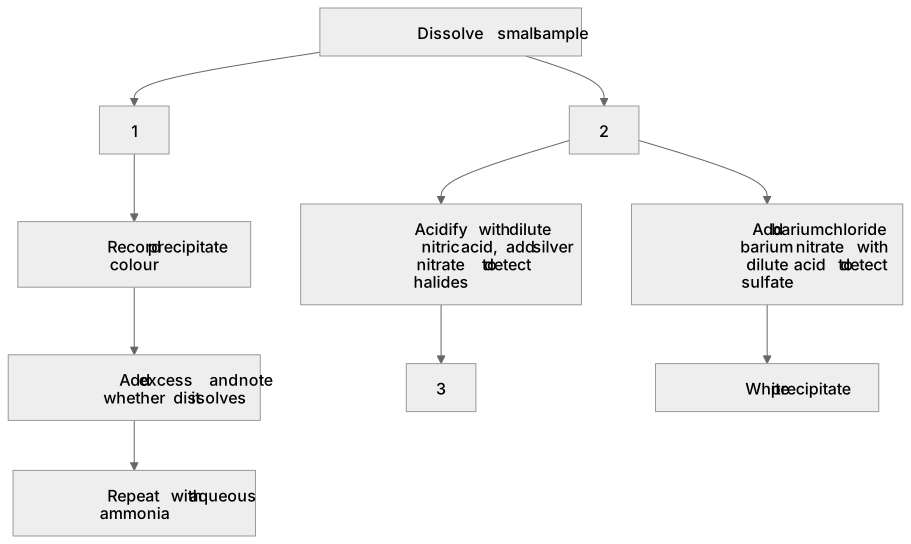
1Box 1
2Box 2
3Box 3
There is more to this lesson
The full lesson goes on to check your understanding and help you earn the marks. Create a free account to carry on, with your progress saved.
A week of Premium from your first lesson · Then the free plan continues · No card, no charge
Test your understanding of Transition elements - 5.3.2 Qualitative analysis: (a) qualitative analysis of ions on a test-tube scale: processes and techniques needed to identify the following ions in an unknown compound:
Active recall beats re-reading. Take an instant quiz now to test what you’ve learned and lock it into long-term memory.
A week of Premium from your first lesson · Then the free plan continues · No card, no charge