OCR · A-Level · Chemistry
Course version: H432 · Version from Sept 2017
(ii) cations: NH₄⁺; Cu²⁺, Fe²⁺, Fe³⁺, Mn²⁺, Cr³⁺ (see 3.1.4 a, 5.3.1 j).
Full specification wording
Transition elements - 5.3.2 Qualitative analysis: (ii) cations: NH₄⁺; Cu²⁺, Fe²⁺, Fe³⁺, Mn²⁺, Cr³⁺ (see 3.1.4 a, 5.3.1 j).
This row lists the cations whose qualitative tests you must know: ammonium (NH₄⁺) and the transition metal ions Cu²⁺, Fe²⁺, Fe³⁺, Mn²⁺ and Cr³⁺.
- Point 3 of 3
- 3 key terms
Study notes
From the teaching notes for this specification point.
The idea
This row lists the cations whose qualitative tests you must know: ammonium (NH₄⁺) and the transition metal ions Cu²⁺, Fe²⁺, Fe³⁺, Mn²⁺ and Cr³⁺. Ammonium is identified by warming with sodium hydroxide solution, releasing ammonia gas that turns damp red litmus paper blue. The metal ions are identified by adding sodium hydroxide solution and observing the hydroxide precipitate: Cu²⁺ gives a blue precipitate, Fe²⁺ a green precipitate, Fe³⁺ a reddish-brown precipitate, Mn²⁺ a pale pink precipitate and Cr³⁺ a grey-green precipitate that dissolves in excess to give a green solution. Learn each colour and whether the precipitate redissolves in excess. Write charges with superscript signs, for example NH₄⁺ and Cr³⁺.
What earns the marks
- Identifies ammonium by warming with sodium hydroxide solution and testing the evolved ammonia with damp red litmus paper turning blue.
- States the hydroxide precipitate colours: blue for Cu²⁺, green for Fe²⁺, reddish-brown for Fe³⁺, pale pink for Mn²⁺ and grey-green for Cr³⁺.
- Notes that the chromium(III) hydroxide precipitate dissolves in excess sodium hydroxide to give a green solution.
- Writes balanced ionic equations for the precipitation reactions, for example Fe³⁺(aq) + 3OH⁻(aq) → Fe(OH)₃(s).
- Uses correct superscript charges such as NH₄⁺, Cu²⁺ and Cr³⁺ throughout.
Common mistakes and how to put them right
Confuses the green Fe²⁺ precipitate with the grey-green Cr³⁺ precipitate.
Put it right: Distinguish them by the chromium precipitate dissolving in excess.
Forgets that only the chromium(III) precipitate redissolves in excess sodium hydroxide.
Put it right: State this explicitly.
Tests ammonium without warming.
Put it right: Warm the mixture so ammonia is released.
Writes charges as postfix numbers.
Put it right: Use superscript signs such as NH₄⁺ and Fe³⁺.
Exam tips
- Build a table of cation, reagent, precipitate colour and behaviour in excess.
- Quote colours precisely, since vague colour words lose credit.
- Practise balancing the precipitation equations, remembering the 3OH⁻ for Fe³⁺ and Cr³⁺.
Try the lesson
The start of the Transition elements - 5.3.2 Qualitative analysis: (ii) cations: NH₄⁺; Cu²⁺, Fe²⁺, Fe³⁺, Mn²⁺, Cr³⁺ (see 3.1.4 a, 5.3.1 j). lesson, made from teaching notes for this specification point.
Listen
This row lists the cations whose qualitative tests you must know: ammonium (NH₄⁺) and the transition metal ions Cu²⁺, Fe²⁺, Fe³⁺, Mn²⁺ and Cr³⁺. Ammonium is identified by warming with sodium hydroxide solution, releasing ammonia gas that turns damp red litmus paper blue. The metal ions are identified by adding sodium hydroxide solution and observing the hydroxide precipitate: Cu²⁺ gives a blue precipitate, Fe²⁺ a green precipitate, Fe³⁺ a reddish-brown precipitate, Mn²⁺ a pale pink precipitate and Cr³⁺ a grey-green precipitate that dissolves in excess to give a green solution. Learn each colour and whether the precipitate redissolves in excess. Write charges with superscript signs, for example NH₄⁺ and Cr³⁺. A strong answer earns marks for these points. Identifies ammonium by warming with sodium hydroxide solution and testing the evolved ammonia with damp red litmus paper turning blue. States the hydroxide precipitate colours: blue for Cu²⁺, green for Fe²⁺, reddish-brown for Fe³⁺, pale pink for Mn²⁺ and grey-green for Cr³⁺. Notes that the chromium(III) hydroxide precipitate dissolves in excess sodium hydroxide to give a green solution. Writes balanced ionic equations for the precipitation reactions, for example Fe³⁺(aq) + 3OH⁻(aq) → Fe(OH)₃(s). Exam tip: Build a table of cation, reagent, precipitate colour and behaviour in excess.
See it

Key words
Say what each word means before you turn the card.
Ammonium identification
Try answering aloud or in your head before turning the card.
Hydroxide precipitate colours
Try answering aloud or in your head before turning the card.
Ionic equations and charge notation
Try answering aloud or in your head before turning the card.
See every definition
- Ammonium identification
- Warming with sodium hydroxide solution releases ammonia gas that turns damp red litmus paper blue.
- Hydroxide precipitate colours
- Adding sodium hydroxide solution gives a blue precipitate for Cu²⁺, green for Fe²⁺, reddish-brown for Fe³⁺, pale pink for Mn²⁺ and grey-green for Cr³⁺.
- Ionic equations and charge notation
- Balanced ionic equations are written for the precipitation reactions, with charges shown as superscript signs such as NH₄⁺ and Cr³⁺.
Label the diagram
Some boxes have lost their names. Pick the right name for each number.
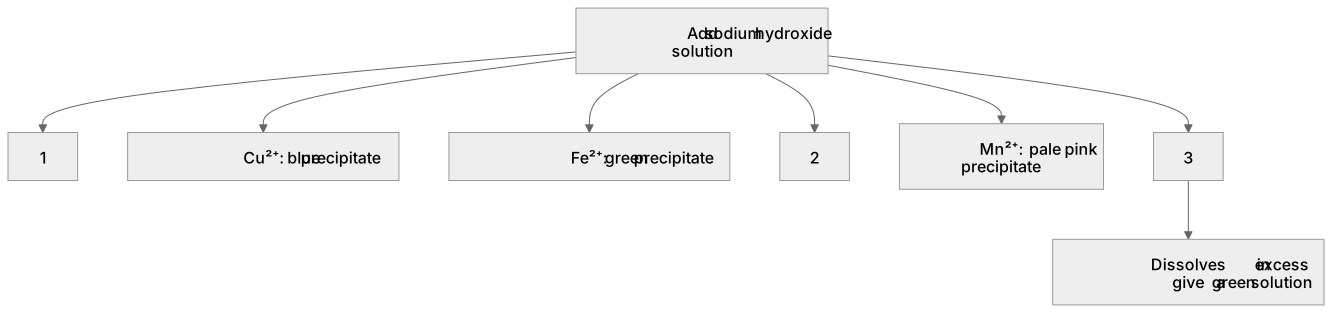
1Box 1
2Box 2
3Box 3
There is more to this lesson
The full lesson goes on to check your understanding and help you earn the marks. Create a free account to carry on, with your progress saved.
A week of Premium from your first lesson · Then the free plan continues · No card, no charge
Test your understanding of Transition elements - 5.3.2 Qualitative analysis: (ii) cations: NH₄⁺; Cu²⁺, Fe²⁺, Fe³⁺, Mn²⁺, Cr³⁺ (see 3.1.4 a, 5.3.1 j).
Active recall beats re-reading. Take an instant quiz now to test what you’ve learned and lock it into long-term memory.
A week of Premium from your first lesson · Then the free plan continues · No card, no charge