OCR · A-Level · Chemistry
Course version: H432 · Version from Sept 2017
(a) the electron configuration of atoms and ions of the d-block elements…
Full specification wording
Transition elements: (a) the electron configuration of atoms and ions of the d-block elements of Period 4 (Sc–Zn), given the atomic number and charge (see also 2.2.1 d)
For Period 4 d-block atoms (Sc–Zn), fill orbitals in order 1s, 2s, 2p, 3s, 3p, 4s, 3d, but note the two exceptions: chromium is [Ar] 3d⁵ 4s¹ and copper is [Ar] 3d¹⁰ 4s¹, because a half-filled or…
- Point 1 of 24
- 4 key terms
Study notes
From the teaching notes for this specification point.
The idea
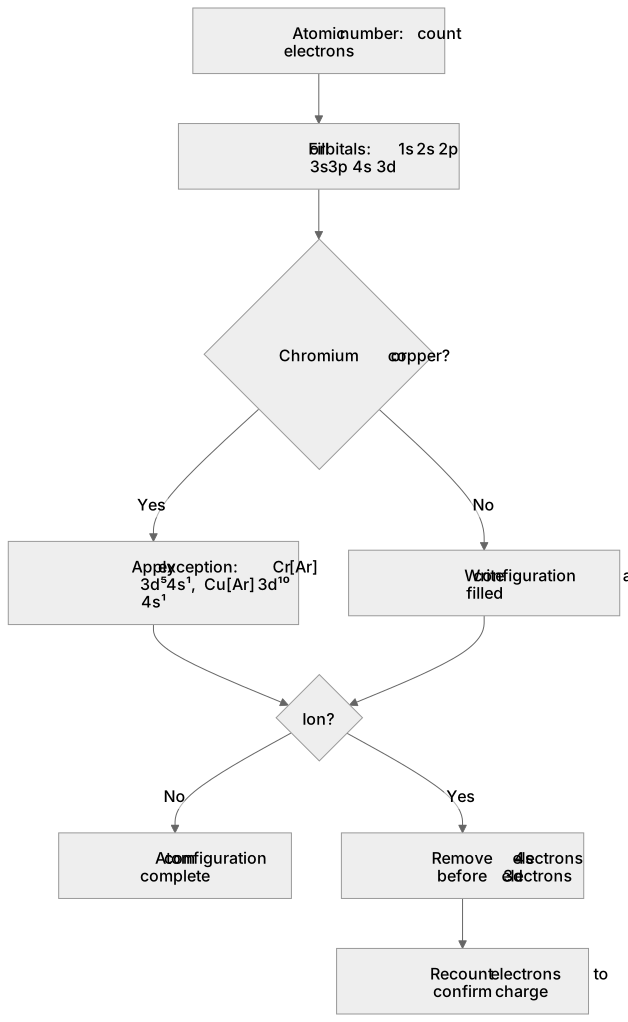
For Period 4 d-block atoms (Sc–Zn), fill orbitals in order 1s, 2s, 2p, 3s, 3p, 4s, 3d, but note the two exceptions: chromium is [Ar] 3d⁵ 4s¹ and copper is [Ar] 3d¹⁰ 4s¹, because a half-filled or full 3d subshell is more stable. For ions, remove electrons from the highest-energy occupied shell first, which for d-block cations means losing 4s electrons before 3d electrons. For example, Fe (Z = 26) is [Ar] 3d⁶ 4s², so Fe²⁺ is [Ar] 3d⁶ and Fe³⁺ is [Ar] 3d⁵. Use the atomic number to count electrons and the charge to add or remove electrons, then write the configuration.
What earns the marks
- Writes the configuration of a Period 4 d-block atom by filling orbitals in the order 1s 2s 2p 3s 3p 4s 3d, using the atomic number to count electrons.
- Applies the exceptions for chromium ([Ar] 3d⁵ 4s¹) and copper ([Ar] 3d¹⁰ 4s¹).
- Removes 4s electrons before 3d electrons when forming d-block cations, for example Fe²⁺ as [Ar] 3d⁶.
- Uses the given charge to add or remove the correct number of electrons when writing an ion configuration.
Common mistakes and how to put them right
Writes chromium or copper with a filled 4s and partly filled 3d subshell.
Put it right: Apply the exceptions [Ar] 3d⁵ 4s¹ and [Ar] 3d¹⁰ 4s¹.
Removes 3d electrons before 4s electrons when forming cations.
Put it right: Remove 4s electrons first.
Attempts to form d-block anions such as Zn⁻.
Put it right: d-block ions in this context are cations formed by losing electrons.
Exam tips
- Count total electrons from the atomic number before writing the configuration, then check the total matches.
- Memorise the Cr and Cu exceptions and apply them whenever those elements appear.
- For ions, remove 4s electrons first, then 3d, and recount to confirm the charge.
Try the lesson
The start of the Transition elements: (a) the electron configuration of atoms and ions of the d-block elements of Period 4 (Sc–Zn), given the atomic number and charge (see also 2.2.1 d) lesson, made from teaching notes for this specification point.
Listen
For Period 4 d-block atoms (Sc–Zn), fill orbitals in order 1s, 2s, 2p, 3s, 3p, 4s, 3d, but note the two exceptions: chromium is [Ar] 3d⁵ 4s¹ and copper is [Ar] 3d¹⁰ 4s¹, because a half-filled or full 3d subshell is more stable. For ions, remove electrons from the highest-energy occupied shell first, which for d-block cations means losing 4s electrons before 3d electrons. For example, Fe (Z = 26) is [Ar] 3d⁶ 4s², so Fe²⁺ is [Ar] 3d⁶ and Fe³⁺ is [Ar] 3d⁵. Use the atomic number to count electrons and the charge to add or remove electrons, then write the configuration. A strong answer earns marks for these points. Writes the configuration of a Period 4 d-block atom by filling orbitals in the order 1s 2s 2p 3s 3p 4s 3d, using the atomic number to count electrons. Applies the exceptions for chromium ([Ar] 3d⁵ 4s¹) and copper ([Ar] 3d¹⁰ 4s¹). Removes 4s electrons before 3d electrons when forming d-block cations, for example Fe²⁺ as [Ar] 3d⁶. Uses the given charge to add or remove the correct number of electrons when writing an ion configuration. Exam tip: Count total electrons from the atomic number before writing the configuration, then check the total matches.
See it
Key words
Say what each word means before you turn the card.
Electron configuration of Period 4 d-block atoms
Try answering aloud or in your head before turning the card.
Cr and Cu exceptions
Try answering aloud or in your head before turning the card.
Configuration of d-block cations
Try answering aloud or in your head before turning the card.
Using atomic number and charge
Try answering aloud or in your head before turning the card.
See every definition
- Electron configuration of Period 4 d-block atoms
- Fill orbitals in the order 1s, 2s, 2p, 3s, 3p, 4s, 3d, using the atomic number to count electrons.
- Cr and Cu exceptions
- Chromium is [Ar] 3d⁵ 4s¹ and copper is [Ar] 3d¹⁰ 4s¹, because a half-filled or full 3d subshell is more stable.
- Configuration of d-block cations
- Remove electrons from the highest-energy occupied shell first, which for d-block cations means losing 4s electrons before 3d electrons.
- Using atomic number and charge
- Use the atomic number to count electrons and the charge to add or remove electrons, then write the configuration.
Label the diagram
Some boxes have lost their names. Pick the right name for each number.
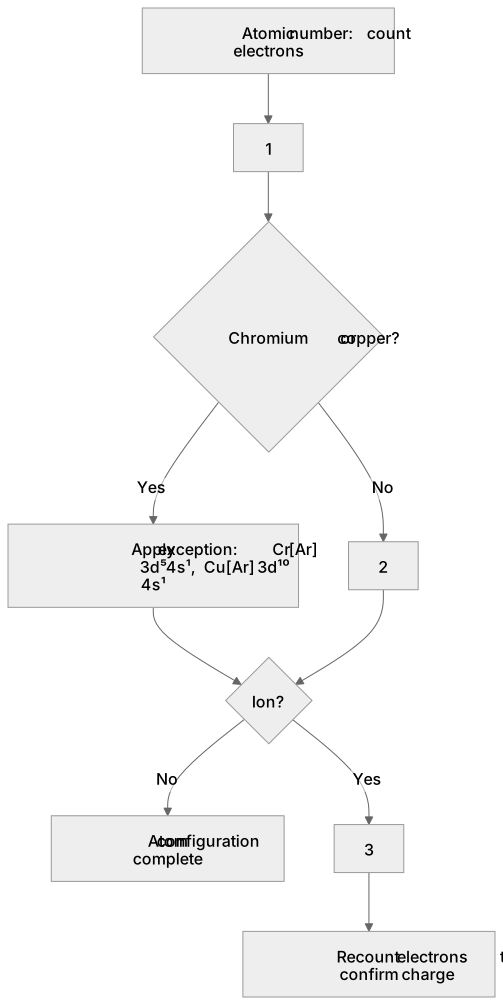
1Box 1
2Box 2
3Box 3
There is more to this lesson
The full lesson goes on to check your understanding and help you earn the marks. Create a free account to carry on, with your progress saved.
A week of Premium from your first lesson · Then the free plan continues · No card, no charge
Test your understanding of Transition elements: (a) the electron configuration of atoms and ions of the d-block elements of Period 4 (Sc–Zn), given the atomic number and charge (see also 2.2.1 d)
Active recall beats re-reading. Take an instant quiz now to test what you’ve learned and lock it into long-term memory.
A week of Premium from your first lesson · Then the free plan continues · No card, no charge