OCR · A-Level · Chemistry
Course version: H432 · Version from Sept 2017
(b) the elements Ti–Cu as transition elements i.e. d-block elements that…
Full specification wording
Transition elements: (b) the elements Ti–Cu as transition elements i.e. d-block elements that have an ion with an incomplete d-sub-shell
A transition element is defined here as a d-block element that forms at least one ion with an incomplete d-sub-shell.
- Point 2 of 24
- 2 key terms
Study notes
From the teaching notes for this specification point.
The idea
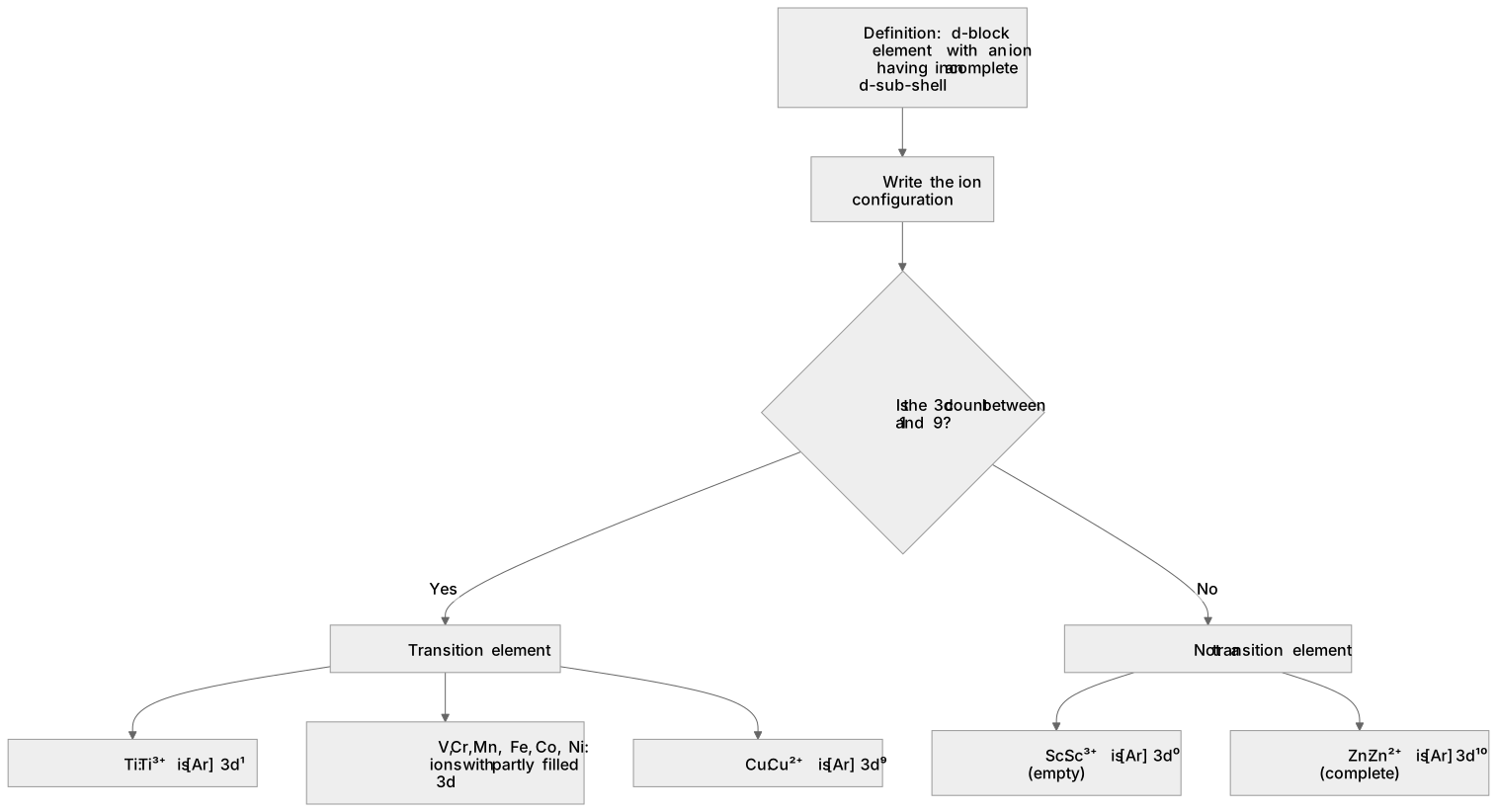
A transition element is defined here as a d-block element that forms at least one ion with an incomplete d-sub-shell. Apply the test across Ti to Cu. Titanium forms Ti³⁺ with [Ar] 3d¹, so it qualifies. Vanadium, chromium, manganese, iron, cobalt and nickel all form ions with partly filled 3d subshells. Copper forms Cu²⁺ with [Ar] 3d⁹, so it qualifies despite the full 3d¹⁰ of the Cu⁺ ion. Zinc does not qualify because Zn²⁺ is [Ar] 3d¹⁰, a complete d-sub-shell, and scandium does not qualify because Sc³⁺ is [Ar] 3d⁰, an empty d-sub-shell. The key skill is writing the ion configuration and checking whether the 3d count lies between 1 and 9.
What earns the marks
- Applies the definition by writing an ion configuration and checking whether the 3d subshell is partly filled.
- Identifies copper as a transition element because Cu²⁺ has the configuration [Ar] 3d⁹.
- Excludes zinc because Zn²⁺ has a complete 3d¹⁰ subshell.
- Excludes scandium because Sc³⁺ has an empty 3d⁰ subshell.
- Selects titanium as a transition element because Ti³⁺ has a partly filled 3d¹ subshell.
Common mistakes and how to put them right
Assumes every d-block element is a transition element.
Put it right: Apply the incomplete-d-subshell test to an actual ion.
Judges the element by its atom rather than an ion.
Put it right: Check a real ion such as Cu²⁺ or Zn²⁺.
Rejects copper because Cu⁺ is 3d¹⁰.
Put it right: Cu²⁺ is 3d⁹ and satisfies the definition.
Accepts zinc because it is in the d-block.
Put it right: Reject it because Zn²⁺ has a full 3d subshell.
Exam tips
- Write the ion configuration explicitly before deciding whether the element qualifies.
- Test the ion with the most common or specified charge rather than guessing from the block position.
- Remember the boundary cases: Sc³⁺ is 3d⁰ and Zn²⁺ is 3d¹⁰, so neither qualifies.
- Use the phrase 'incomplete d-sub-shell' in your reasoning to show the definition is applied.
Try the lesson
The start of the Transition elements: (b) the elements Ti–Cu as transition elements i.e. d-block elements that have an ion with an incomplete d-sub-shell lesson, made from teaching notes for this specification point.
Listen
A transition element is defined here as a d-block element that forms at least one ion with an incomplete d-sub-shell. Apply the test across Ti to Cu. Titanium forms Ti³⁺ with [Ar] 3d¹, so it qualifies. Vanadium, chromium, manganese, iron, cobalt and nickel all form ions with partly filled 3d subshells. Copper forms Cu²⁺ with [Ar] 3d⁹, so it qualifies despite the full 3d¹⁰ of the Cu⁺ ion. Zinc does not qualify because Zn²⁺ is [Ar] 3d¹⁰, a complete d-sub-shell, and scandium does not qualify because Sc³⁺ is [Ar] 3d⁰, an empty d-sub-shell. The key skill is writing the ion configuration and checking whether the 3d count lies between 1 and 9. A strong answer earns marks for these points. Applies the definition by writing an ion configuration and checking whether the 3d subshell is partly filled. Identifies copper as a transition element because Cu²⁺ has the configuration [Ar] 3d⁹. Excludes zinc because Zn²⁺ has a complete 3d¹⁰ subshell. Excludes scandium because Sc³⁺ has an empty 3d⁰ subshell. Exam tip: Write the ion configuration explicitly before deciding whether the element qualifies.
See it
Key words
Say what each word means before you turn the card.
Transition element
Try answering aloud or in your head before turning the card.
Boundary cases scandium and zinc
Try answering aloud or in your head before turning the card.
See every definition
- Transition element
- A d-block element that has an ion with an incomplete d-sub-shell.
- Boundary cases scandium and zinc
- Scandium does not qualify because Sc³⁺ is [Ar] 3d⁰, an empty d-sub-shell, and zinc does not qualify because Zn²⁺ is [Ar] 3d¹⁰, a complete d-sub-shell.
Label the diagram
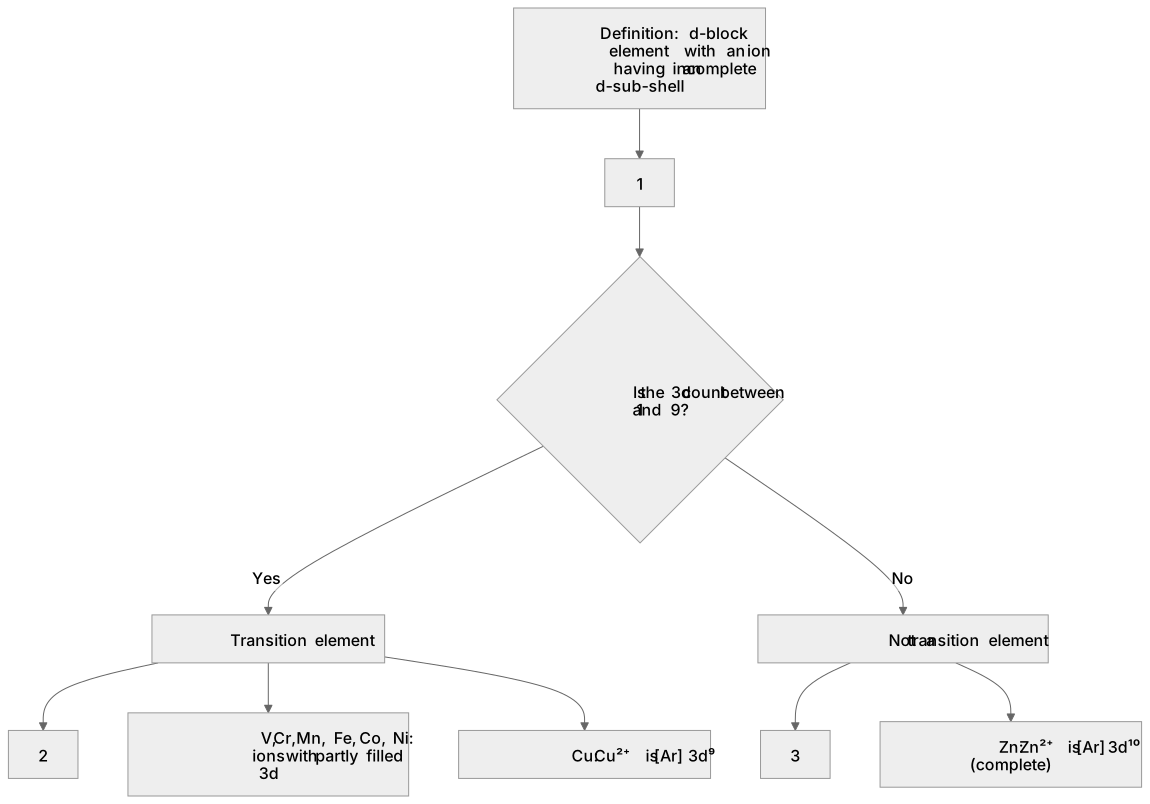
Some boxes have lost their names. Pick the right name for each number.
1Box 1
2Box 2
3Box 3
There is more to this lesson
The full lesson goes on to check your understanding and help you earn the marks. Create a free account to carry on, with your progress saved.
A week of Premium from your first lesson · Then the free plan continues · No card, no charge
Test your understanding of Transition elements: (b) the elements Ti–Cu as transition elements i.e. d-block elements that have an ion with an incomplete d-sub-shell
Active recall beats re-reading. Take an instant quiz now to test what you’ve learned and lock it into long-term memory.
A week of Premium from your first lesson · Then the free plan continues · No card, no charge