OCR · A-Level · Chemistry
Course version: H432 · Version from Sept 2017
(g) use of cis-platin as an anti-cancer drug and its action by binding to…
Full specification wording
Transition elements: (g) use of cis-platin as an anti-cancer drug and its action by binding to DNA preventing cell division
cis-Platin is a square-planar platinum(II) complex with the formula [Pt(NH₃)₂Cl₂], in which the two chloride ligands sit adjacent to each other (cis) rather than opposite (trans).
- Point 13 of 24
- 4 key terms
Study notes
From the teaching notes for this specification point.
The idea
cis-Platin is a square-planar platinum(II) complex with the formula [Pt(NH₃)₂Cl₂], in which the two chloride ligands sit adjacent to each other (cis) rather than opposite (trans). The Pt centre is a transition-metal ion and the ligands are two neutral ammonia molecules and two chloride ions, giving an overall neutral complex. In the body, the relatively low concentration of chloride means water can replace the chloride ligands in a ligand-substitution step, producing a reactive aqua species that can bind to DNA. The platinum binds to adjacent guanine bases on the same DNA strand, forming cross-links that distort the double helix. This distortion prevents the DNA from being replicated and transcribed, so the cell cannot divide and eventually dies. Because cancer cells divide rapidly, they are affected more than most normal cells, which is why cis-platin is used as an anti-cancer drug.
What earns the marks
- Identifies cis-platin as the square-planar platinum(II) complex [Pt(NH₃)₂Cl₂] with two ammonia and two chloride ligands.
- States that the two chloride ligands are adjacent (cis) in cis-platin, whereas they are opposite in the inactive trans isomer.
- Explains that chloride ligands are replaced by water in a ligand-substitution step, activating the complex to bind DNA.
- Describes the platinum binding to adjacent guanine bases on DNA, forming cross-links that distort the helix.
- Links the DNA distortion to prevention of replication and cell division, which kills the rapidly dividing cancer cells.
Common mistakes and how to put them right
Writes the formula with the two chloride ligands opposite each other.
Put it right: Place both chlorides adjacent to show the cis arrangement.
Claims the intact [Pt(NH₃)₂Cl₂] molecule binds DNA unchanged.
Put it right: Describe the ligand-substitution step in which water replaces chloride before binding.
States that cis-platin binds to the phosphate backbone rather than the bases.
Put it right: Identify the guanine bases as the binding site.
Assumes the trans isomer works equally well.
Put it right: Note that the trans isomer cannot form the same cross-links and is ineffective.
Exam tips
- Learn the structure and formula of cis-platin so you can distinguish it from the trans isomer in a multiple-choice option.
- Link each step in a chain: ligand substitution, then DNA binding, then blocked replication, then prevented cell division.
- Read every option carefully for the words cis and trans, since a single swapped word changes the correct answer.
Try the lesson
The start of the Transition elements: (g) use of cis-platin as an anti-cancer drug and its action by binding to DNA preventing cell division lesson, made from teaching notes for this specification point.
Listen
cis-Platin is a square-planar platinum(II) complex with the formula [Pt(NH₃)₂Cl₂], in which the two chloride ligands sit adjacent to each other (cis) rather than opposite (trans). The Pt centre is a transition-metal ion and the ligands are two neutral ammonia molecules and two chloride ions, giving an overall neutral complex. In the body, the relatively low concentration of chloride means water can replace the chloride ligands in a ligand-substitution step, producing a reactive aqua species that can bind to DNA. The platinum binds to adjacent guanine bases on the same DNA strand, forming cross-links that distort the double helix. This distortion prevents the DNA from being replicated and transcribed, so the cell cannot divide and eventually dies. Because cancer cells divide rapidly, they are affected more than most normal cells, which is why cis-platin is used as an anti-cancer drug. A strong answer earns marks for these points. Identifies cis-platin as the square-planar platinum(II) complex [Pt(NH₃)₂Cl₂] with two ammonia and two chloride ligands. States that the two chloride ligands are adjacent (cis) in cis-platin, whereas they are opposite in the inactive trans isomer. Explains that chloride ligands are replaced by water in a ligand-substitution step, activating the complex to bind DNA. Describes the platinum binding to adjacent guanine bases on DNA, forming cross-links that distort the helix. Exam tip: Learn the structure and formula of cis-platin so you can distinguish it from the trans isomer in a multiple-choice option.
See it
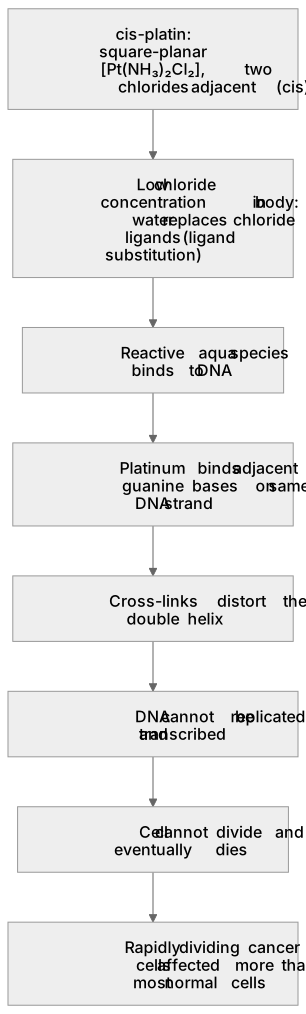
Put it in order
Put these steps in the order they happen.
- 1. Cross-links distort the double helix
- 2. Rapidly dividing cancer cells affected more than most normal cells
- 3. DNA cannot be replicated and transcribed
- 4. cis-platin: square-planar [Pt(NH₃)₂Cl₂], two chlorides adjacent (cis)
- 5. Low chloride concentration in body: water replaces chloride ligands (ligand substitution)
- 6. Cell cannot divide and eventually dies
- 7. Reactive aqua species binds to DNA
- 8. Platinum binds adjacent guanine bases on same DNA strand
Key words
Say what each word means before you turn the card.
cis-platin
Try answering aloud or in your head before turning the card.
ligand substitution
Try answering aloud or in your head before turning the card.
cross-links
Try answering aloud or in your head before turning the card.
trans isomer
Try answering aloud or in your head before turning the card.
See every definition
- cis-platin
- A square-planar platinum(II) complex with the formula [Pt(NH₃)₂Cl₂], in which the two chloride ligands sit adjacent to each other rather than opposite.
- ligand substitution
- A step in which water replaces the chloride ligands because of the relatively low concentration of chloride in the body, producing a reactive aqua species.
- cross-links
- Links formed when the platinum binds to adjacent guanine bases on the same DNA strand, distorting the double helix.
- trans isomer
- The inactive form in which the two chloride ligands are opposite each other rather than adjacent.
Label the diagram
Some boxes have lost their names. Pick the right name for each number.
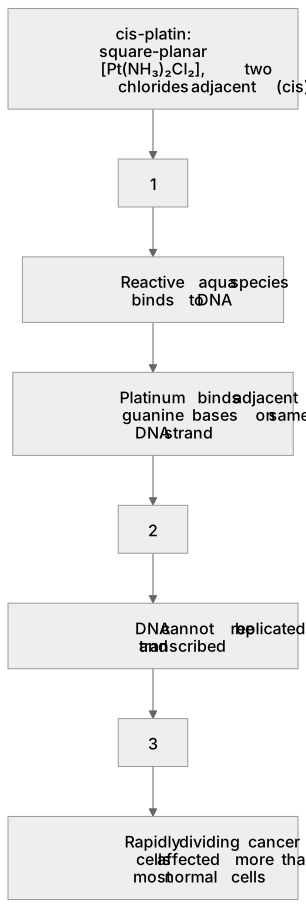
1Box 1
2Box 2
3Box 3
There is more to this lesson
The full lesson goes on to check your understanding and help you earn the marks. Create a free account to carry on, with your progress saved.
A week of Premium from your first lesson · Then the free plan continues · No card, no charge
Test your understanding of Transition elements: (g) use of cis-platin as an anti-cancer drug and its action by binding to DNA preventing cell division
Active recall beats re-reading. Take an instant quiz now to test what you’ve learned and lock it into long-term memory.
A week of Premium from your first lesson · Then the free plan continues · No card, no charge