OCR · A-Level · Chemistry
Course version: H432 · Version from Sept 2017
Transition elements: Ligand substitution
Ligand substitution is the replacement of one ligand in a complex ion by another ligand.
- Point 14 of 24
- 2 key terms
Study notes
From the teaching notes for this specification point.
The idea
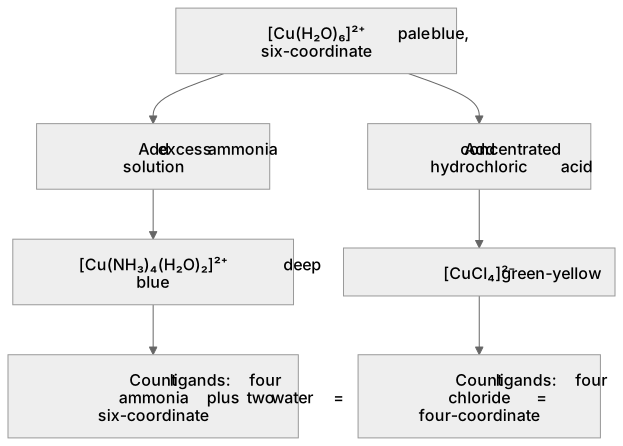
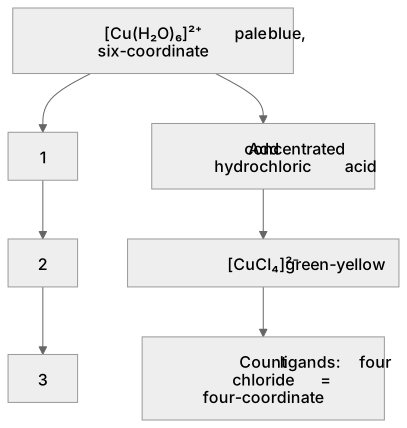
Ligand substitution is the replacement of one ligand in a complex ion by another ligand. In aqueous solution, [Cu(H₂O)₆]²⁺ is a pale blue, six-coordinate complex with water acting as a monodentate ligand. Adding excess ammonia solution replaces water ligands stepwise, giving [Cu(NH₃)₄(H₂O)₂]²⁺, a deep blue complex that is still six-coordinate because two water ligands remain. Adding concentrated hydrochloric acid to [Cu(H₂O)₆]²⁺ replaces water ligands with chloride ions, giving the green-yellow, four-coordinate [CuCl₄]²⁻. The coordination number changes only when the number of ligands bonded to the central ion changes, so compare the ligand count in the reactant and product before claiming a change.
What earns the marks
- Identifies ligand substitution as the replacement of one ligand by another in a complex ion.
- States that [Cu(H₂O)₆]²⁺ reacts with excess ammonia to form [Cu(NH₃)₄(H₂O)₂]²⁺, which remains six-coordinate.
- States that [Cu(H₂O)₆]²⁺ reacts with concentrated hydrochloric acid to form [CuCl₄]²⁻, which is four-coordinate.
- Compares coordination numbers by counting ligands in reactant and product rather than assuming a change.
- Describes the colour change from pale blue [Cu(H₂O)₆]²⁺ to deep blue with ammonia and to green-yellow with chloride.
Common mistakes and how to put them right
Claims that the coordination number falls from six to four when ammonia is added.
Put it right: Count the ligands and note that [Cu(NH₃)₄(H₂O)₂]²⁺ retains two water ligands and stays six-coordinate.
Assumes every ligand substitution changes the coordination number.
Put it right: Check the ligand count in the product before stating a change.
Treats the ammonia product as containing only ammonia ligands.
Put it right: Recognise that two water ligands remain in [Cu(NH₃)₄(H₂O)₂]²⁺.
Exam tips
- Count the ligands in each complex before writing about coordination number, and state the count explicitly.
- Link each substitution to its observable colour change so the answer shows evidence of the reaction.
- Use the correct formula and charge for each complex, checking that the overall charge balances the central ion and ligands.
Try the lesson
The start of the Transition elements: Ligand substitution lesson, made from teaching notes for this specification point.
Listen
Ligand substitution is the replacement of one ligand in a complex ion by another ligand. In aqueous solution, [Cu(H₂O)₆]²⁺ is a pale blue, six-coordinate complex with water acting as a monodentate ligand. Adding excess ammonia solution replaces water ligands stepwise, giving [Cu(NH₃)₄(H₂O)₂]²⁺, a deep blue complex that is still six-coordinate because two water ligands remain. Adding concentrated hydrochloric acid to [Cu(H₂O)₆]²⁺ replaces water ligands with chloride ions, giving the green-yellow, four-coordinate [CuCl₄]²⁻. The coordination number changes only when the number of ligands bonded to the central ion changes, so compare the ligand count in the reactant and product before claiming a change. A strong answer earns marks for these points. Identifies ligand substitution as the replacement of one ligand by another in a complex ion. States that [Cu(H₂O)₆]²⁺ reacts with excess ammonia to form [Cu(NH₃)₄(H₂O)₂]²⁺, which remains six-coordinate. States that [Cu(H₂O)₆]²⁺ reacts with concentrated hydrochloric acid to form [CuCl₄]²⁻, which is four-coordinate. Compares coordination numbers by counting ligands in reactant and product rather than assuming a change. Exam tip: Count the ligands in each complex before writing about coordination number, and state the count explicitly.
See it
Key words
Say what each word means before you turn the card.
Ligand substitution
Try answering aloud or in your head before turning the card.
Coordination number
Try answering aloud or in your head before turning the card.
See every definition
- Ligand substitution
- The replacement of one ligand in a complex ion by another ligand.
- Coordination number
- The number of ligands bonded to the central ion, which changes only when that number changes.
Label the diagram
Some boxes have lost their names. Pick the right name for each number.
1Box 1
2Box 2
3Box 3
There is more to this lesson
The full lesson goes on to check your understanding and help you earn the marks. Create a free account to carry on, with your progress saved.
A week of Premium from your first lesson · Then the free plan continues · No card, no charge
Test your understanding of Transition elements: Ligand substitution
Active recall beats re-reading. Take an instant quiz now to test what you’ve learned and lock it into long-term memory.
A week of Premium from your first lesson · Then the free plan continues · No card, no charge