OCR · A-Level · Chemistry
Course version: H432 · Version from Sept 2017
Transition elements: (i) interconversions between Fe²⁺ and Fe³⁺
Iron exists in aqueous solution mainly as pale green Fe²⁺ (iron(II), +2 oxidation state) and yellow-orange Fe³⁺ (iron(III), +3 oxidation state).
- Point 22 of 24
- 4 key terms
Study notes
From the teaching notes for this specification point.
The idea
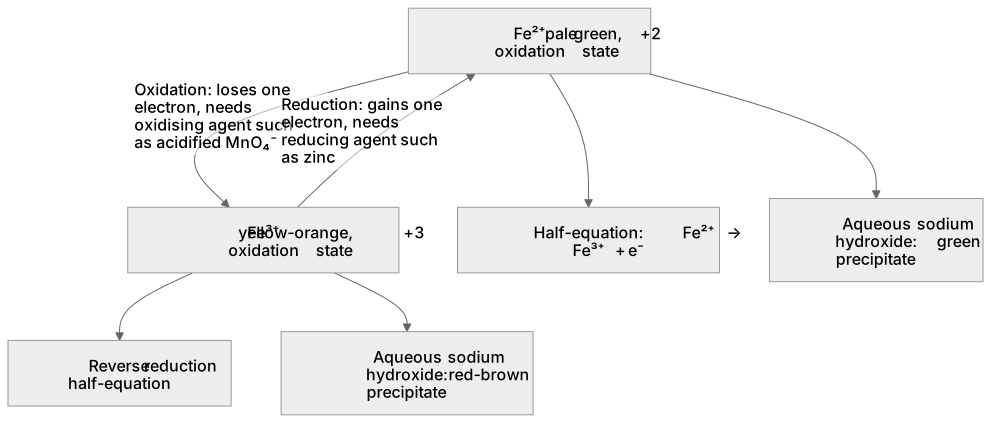
Iron exists in aqueous solution mainly as pale green Fe²⁺ (iron(II), +2 oxidation state) and yellow-orange Fe³⁺ (iron(III), +3 oxidation state). Oxidation converts Fe²⁺ to Fe³⁺ and needs an oxidising agent; reduction converts Fe³⁺ back to Fe²⁺ and needs a reducing agent. A common laboratory method uses acidified potassium manganate(VII): MnO₄⁻ oxidises Fe²⁺ to Fe³⁺ and is itself decolourised, so the purple colour fades. Adding zinc, or passing hydrogen sulfide, reduces Fe³⁺ to Fe²⁺. Aqueous sodium hydroxide gives a green precipitate with Fe²⁺ and a red-brown precipitate with Fe³⁺, which helps identify each ion. In each interconversion the oxidation state of iron changes by one, so one electron is transferred per iron ion. Write the half-equations and balance charge and atoms before combining them.
What earns the marks
- Identifies Fe²⁺ as the +2 oxidation state and Fe³⁺ as the +3 oxidation state of iron.
- States that converting Fe²⁺ to Fe³⁺ is oxidation and requires an oxidising agent such as acidified MnO₄⁻.
- States that converting Fe³⁺ to Fe²⁺ is reduction and requires a reducing agent such as zinc.
- Balances the half-equation Fe²⁺ → Fe³⁺ + e⁻ and the reverse reduction half-equation.
- Links the colour change from pale green Fe²⁺ to yellow-orange Fe³⁺ to the oxidation step.
Common mistakes and how to put them right
Reverses the direction of oxidation.
Put it right: Fe²⁺ loses an electron to become Fe³⁺.
Treats the colour change as evidence of a new element.
Put it right: Keep the point that only the oxidation state of iron changes.
Omits the electron from the half-equation.
Put it right: Include one electron per iron ion to balance charge.
Exam tips
- Write both half-equations first, then check that atoms and charges balance on each side.
- Name the oxidising or reducing agent explicitly rather than saying only that it is oxidised or reduced.
- Use the correct ion notation with superscript charges throughout your answer.
Try the lesson
The start of the Transition elements: (i) interconversions between Fe²⁺ and Fe³⁺ lesson, made from teaching notes for this specification point.
Listen
Iron exists in aqueous solution mainly as pale green Fe²⁺ (iron(II), +2 oxidation state) and yellow-orange Fe³⁺ (iron(III), +3 oxidation state). Oxidation converts Fe²⁺ to Fe³⁺ and needs an oxidising agent; reduction converts Fe³⁺ back to Fe²⁺ and needs a reducing agent. A common laboratory method uses acidified potassium manganate(VII): MnO₄⁻ oxidises Fe²⁺ to Fe³⁺ and is itself decolourised, so the purple colour fades. Adding zinc, or passing hydrogen sulfide, reduces Fe³⁺ to Fe²⁺. Aqueous sodium hydroxide gives a green precipitate with Fe²⁺ and a red-brown precipitate with Fe³⁺, which helps identify each ion. In each interconversion the oxidation state of iron changes by one, so one electron is transferred per iron ion. Write the half-equations and balance charge and atoms before combining them. A strong answer earns marks for these points. Identifies Fe²⁺ as the +2 oxidation state and Fe³⁺ as the +3 oxidation state of iron. States that converting Fe²⁺ to Fe³⁺ is oxidation and requires an oxidising agent such as acidified MnO₄⁻. States that converting Fe³⁺ to Fe²⁺ is reduction and requires a reducing agent such as zinc. Balances the half-equation Fe²⁺ → Fe³⁺ + e⁻ and the reverse reduction half-equation. Exam tip: Write both half-equations first, then check that atoms and charges balance on each side.
See it
Key words
Say what each word means before you turn the card.
Oxidation states of iron
Try answering aloud or in your head before turning the card.
Redox interconversion
Try answering aloud or in your head before turning the card.
Half-equations and electron transfer
Try answering aloud or in your head before turning the card.
Identifying ions by precipitate colour
Try answering aloud or in your head before turning the card.
See every definition
- Oxidation states of iron
- Fe²⁺ is the +2 oxidation state of iron and Fe³⁺ is the +3 oxidation state, and in each interconversion the oxidation state of iron changes by one.
- Redox interconversion
- Oxidation converts Fe²⁺ to Fe³⁺ and needs an oxidising agent, while reduction converts Fe³⁺ back to Fe²⁺ and needs a reducing agent.
- Half-equations and electron transfer
- One electron is transferred per iron ion, so the half-equation Fe²⁺ → Fe³⁺ + e⁻ and the reverse reduction half-equation are written and balanced for charge and atoms before combining them.
- Identifying ions by precipitate colour
- Aqueous sodium hydroxide gives a green precipitate with Fe²⁺ and a red-brown precipitate with Fe³⁺, which helps identify each ion.
Label the diagram
Some boxes have lost their names. Pick the right name for each number.
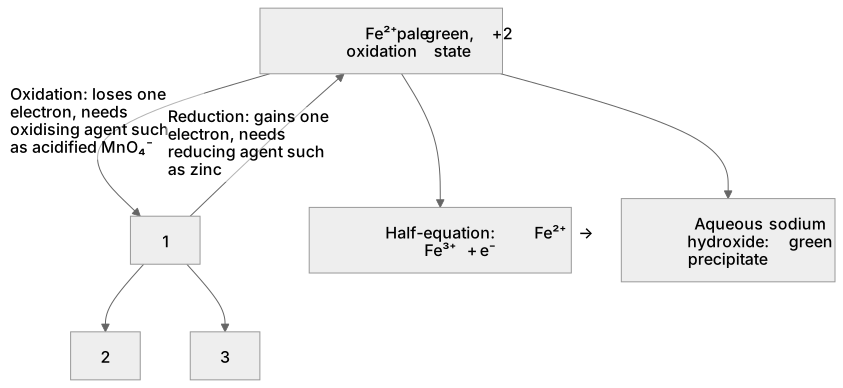
1Box 1
2Box 2
3Box 3
There is more to this lesson
The full lesson goes on to check your understanding and help you earn the marks. Create a free account to carry on, with your progress saved.
A week of Premium from your first lesson · Then the free plan continues · No card, no charge
Test your understanding of Transition elements: (i) interconversions between Fe²⁺ and Fe³⁺
Active recall beats re-reading. Take an instant quiz now to test what you’ve learned and lock it into long-term memory.
A week of Premium from your first lesson · Then the free plan continues · No card, no charge