OCR · A-Level · Chemistry
Course version: H432 · Version from Sept 2017
Transition elements: (ii) interconversions between Cr³⁺ and Cr₂O₇²⁻
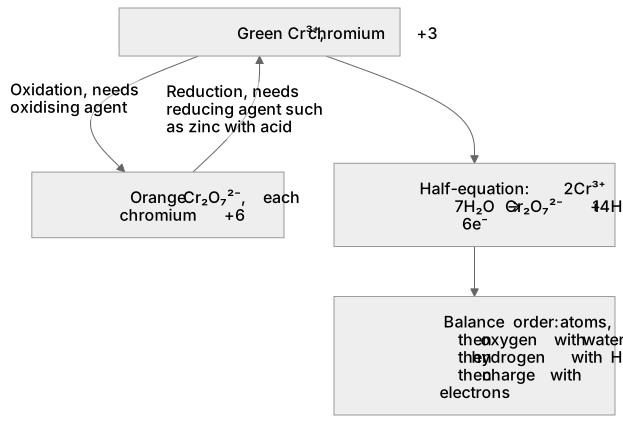
Chromium in aqueous solution appears as green Cr³⁺ (chromium(III), +3 oxidation state) and orange Cr₂O₇²⁻ (dichromate(VI), in which each chromium is +6).
- Point 23 of 24
- 4 key terms
Study notes
From the teaching notes for this specification point.
The idea
Chromium in aqueous solution appears as green Cr³⁺ (chromium(III), +3 oxidation state) and orange Cr₂O₇²⁻ (dichromate(VI), in which each chromium is +6). Oxidation converts Cr³⁺ to Cr₂O₇²⁻ and needs a strong oxidising agent, for example hydrogen peroxide in alkaline conditions followed by acidification. Reduction converts Cr₂O₇²⁻ back to Cr³⁺ and needs a reducing agent such as zinc and acid, when the orange colour turns green. The half-equation for the oxidation is 2Cr³⁺ + 7H₂O → Cr₂O₇²⁻ + 14H⁺ + 6e⁻, so six electrons are lost per dichromate ion formed. Balance atoms, then oxygen with water, then hydrogen with H⁺, then charge with electrons. Note that the chromium oxidation state rises from +3 to +6, a change of three per chromium atom.
What earns the marks
- Assigns +3 to chromium in Cr³⁺ and +6 to each chromium in Cr₂O₇²⁻.
- States that converting Cr³⁺ to Cr₂O₇²⁻ is oxidation and requires an oxidising agent.
- States that converting Cr₂O₇²⁻ to Cr³⁺ is reduction and requires a reducing agent such as zinc with acid.
- Balances the half-equation 2Cr³⁺ + 7H₂O → Cr₂O₇²⁻ + 14H⁺ + 6e⁻.
- Links the colour change from green Cr³⁺ to orange Cr₂O₇²⁻ to the oxidation step.
Common mistakes and how to put them right
Assigns +6 to chromium in Cr³⁺.
Put it right: Keep +3 for Cr³⁺ and +6 for each chromium in Cr₂O₇²⁻.
Forgets to balance oxygen with water and hydrogen with H⁺.
Put it right: Add these before placing electrons.
Uses the wrong number of electrons.
Put it right: Count six electrons per Cr₂O₇²⁻ formed because two chromium atoms each rise by three.
Exam tips
- Balance in the order chromium, oxygen with water, hydrogen with H⁺, then charge with electrons.
- Check the total charge on each side of the half-equation before finalising it.
- State the colour change explicitly to show you understand the interconversion.
Try the lesson
The start of the Transition elements: (ii) interconversions between Cr³⁺ and Cr₂O₇²⁻ lesson, made from teaching notes for this specification point.
Listen
Chromium in aqueous solution appears as green Cr³⁺ (chromium(III), +3 oxidation state) and orange Cr₂O₇²⁻ (dichromate(VI), in which each chromium is +6). Oxidation converts Cr³⁺ to Cr₂O₇²⁻ and needs a strong oxidising agent, for example hydrogen peroxide in alkaline conditions followed by acidification. Reduction converts Cr₂O₇²⁻ back to Cr³⁺ and needs a reducing agent such as zinc and acid, when the orange colour turns green. The half-equation for the oxidation is 2Cr³⁺ + 7H₂O → Cr₂O₇²⁻ + 14H⁺ + 6e⁻, so six electrons are lost per dichromate ion formed. Balance atoms, then oxygen with water, then hydrogen with H⁺, then charge with electrons. Note that the chromium oxidation state rises from +3 to +6, a change of three per chromium atom. A strong answer earns marks for these points. Assigns +3 to chromium in Cr³⁺ and +6 to each chromium in Cr₂O₇²⁻. States that converting Cr³⁺ to Cr₂O₇²⁻ is oxidation and requires an oxidising agent. States that converting Cr₂O₇²⁻ to Cr³⁺ is reduction and requires a reducing agent such as zinc with acid. Balances the half-equation 2Cr³⁺ + 7H₂O → Cr₂O₇²⁻ + 14H⁺ + 6e⁻. Exam tip: Balance in the order chromium, oxygen with water, hydrogen with H⁺, then charge with electrons.
See it
Key words
Say what each word means before you turn the card.
Oxidation states of chromium
Try answering aloud or in your head before turning the card.
Redox interconversion
Try answering aloud or in your head before turning the card.
Balancing complex half-equations
Try answering aloud or in your head before turning the card.
Colour changes of chromium species
Try answering aloud or in your head before turning the card.
See every definition
- Oxidation states of chromium
- Chromium is +3 in Cr³⁺ and +6 in each chromium of Cr₂O₇²⁻, a rise of three per chromium atom.
- Redox interconversion
- Converting Cr³⁺ to Cr₂O₇²⁻ is oxidation needing an oxidising agent, and the reverse is reduction needing a reducing agent such as zinc with acid.
- Balancing complex half-equations
- Balance atoms, then oxygen with water, then hydrogen with H⁺, then charge with electrons, giving 2Cr³⁺ + 7H₂O → Cr₂O₇²⁻ + 14H⁺ + 6e⁻.
- Colour changes of chromium species
- The green colour of Cr³⁺ turns orange as oxidation forms Cr₂O₇²⁻.
Label the diagram
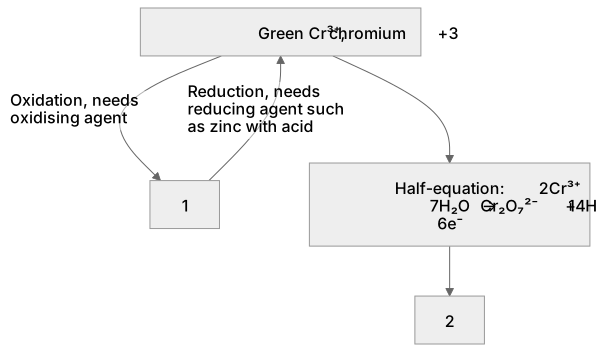
Some boxes have lost their names. Pick the right name for each number.
1Box 1
2Box 2
There is more to this lesson
The full lesson goes on to check your understanding and help you earn the marks. Create a free account to carry on, with your progress saved.
A week of Premium from your first lesson · Then the free plan continues · No card, no charge
Test your understanding of Transition elements: (ii) interconversions between Cr³⁺ and Cr₂O₇²⁻
Active recall beats re-reading. Take an instant quiz now to test what you’ve learned and lock it into long-term memory.
A week of Premium from your first lesson · Then the free plan continues · No card, no charge