OCR · A-Level · Chemistry
Course version: H432 · Version from Sept 2017
Transition elements: (ii) [Cr(NH₃)₆]³⁺ from [Cr(H₂O)₆]³⁺ (see also 5.3.1 j)
This item tests ligand substitution at a chromium(III) centre.
- Point 17 of 24
- 4 key terms
Study notes
From the teaching notes for this specification point.
The idea
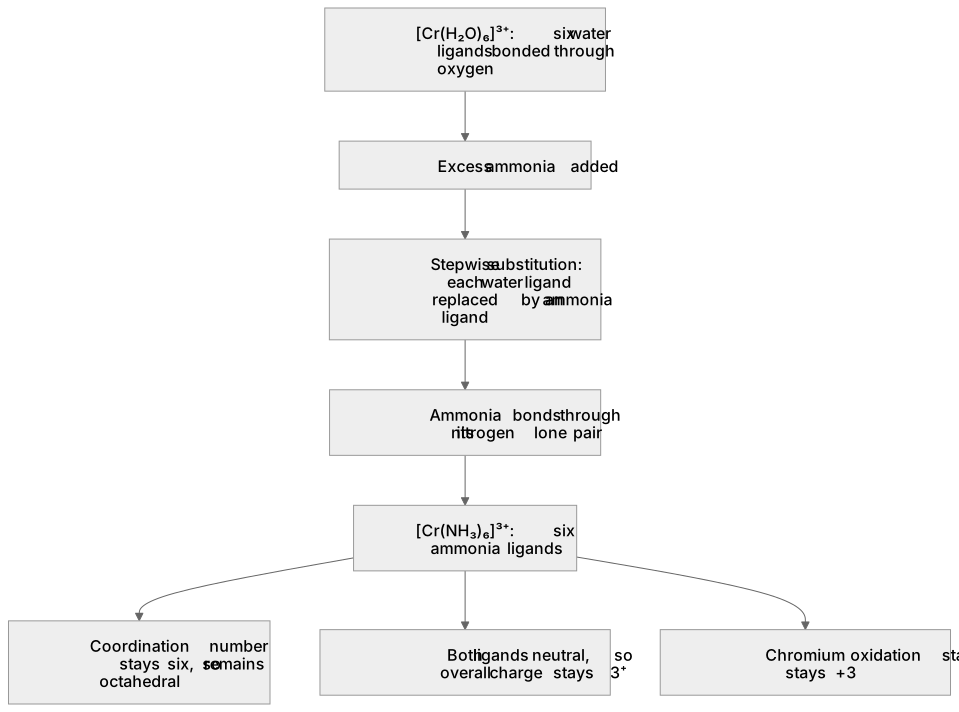
This item tests ligand substitution at a chromium(III) centre. In [Cr(H₂O)₆]³⁺ the chromium ion is surrounded by six water ligands acting as monodentate ligands through their oxygen atoms, giving an octahedral complex with an overall 3⁺ charge. When excess ammonia is added, each water ligand is replaced by an ammonia ligand, which bonds through its lone pair on nitrogen. Six substitutions give [Cr(NH₃)₆]³⁺, still octahedral and still 3⁺ because both ligands are neutral and the chromium oxidation state stays +3. The coordination number remains six, so the shape and charge are unchanged; only the identity of the ligands alters. Recognise that this is a stepwise substitution and that the metal ion's oxidation state does not change during ligand substitution.
What earns the marks
- Identifies that six water ligands in [Cr(H₂O)₆]³⁺ are each replaced by an ammonia ligand to form [Cr(NH₃)₆]³⁺.
- States that water and ammonia both act as monodentate ligands, so the coordination number stays six and the complex remains octahedral.
- Explains that both ligands are neutral, so the overall charge stays 3⁺ and the chromium oxidation state remains +3.
- Describes the substitution as replacement of ligands bonded through oxygen by ligands bonded through the nitrogen lone pair.
Common mistakes and how to put them right
Changes the coordination number when substituting ligands.
Put it right: Keep the coordination number at six because both ligands are monodentate.
Alters the overall charge of the complex.
Put it right: Keep it at 3⁺ because both water and ammonia are neutral ligands.
Changes the oxidation state of chromium during substitution.
Put it right: Keep it at +3 because ligand substitution does not change the metal's oxidation state.
Exam tips
- Count the ligands before and after to confirm the coordination number is unchanged at six.
- Check the charge by adding the metal oxidation state to the sum of ligand charges, remembering neutral ligands contribute zero.
- Link the shape to the coordination number: six monodentate ligands give an octahedral complex.
Try the lesson
The start of the Transition elements: (ii) [Cr(NH₃)₆]³⁺ from [Cr(H₂O)₆]³⁺ (see also 5.3.1 j) lesson, made from teaching notes for this specification point.
Listen
This item tests ligand substitution at a chromium(III) centre. In [Cr(H₂O)₆]³⁺ the chromium ion is surrounded by six water ligands acting as monodentate ligands through their oxygen atoms, giving an octahedral complex with an overall 3⁺ charge. When excess ammonia is added, each water ligand is replaced by an ammonia ligand, which bonds through its lone pair on nitrogen. Six substitutions give [Cr(NH₃)₆]³⁺, still octahedral and still 3⁺ because both ligands are neutral and the chromium oxidation state stays +3. The coordination number remains six, so the shape and charge are unchanged; only the identity of the ligands alters. Recognise that this is a stepwise substitution and that the metal ion's oxidation state does not change during ligand substitution. A strong answer earns marks for these points. Identifies that six water ligands in [Cr(H₂O)₆]³⁺ are each replaced by an ammonia ligand to form [Cr(NH₃)₆]³⁺. States that water and ammonia both act as monodentate ligands, so the coordination number stays six and the complex remains octahedral. Explains that both ligands are neutral, so the overall charge stays 3⁺ and the chromium oxidation state remains +3. Describes the substitution as replacement of ligands bonded through oxygen by ligands bonded through the nitrogen lone pair. Exam tip: Count the ligands before and after to confirm the coordination number is unchanged at six.
See it
Key words
Say what each word means before you turn the card.
Ligand substitution
Try answering aloud or in your head before turning the card.
Monodentate ligands
Try answering aloud or in your head before turning the card.
Octahedral complexes
Try answering aloud or in your head before turning the card.
Oxidation state and overall charge
Try answering aloud or in your head before turning the card.
See every definition
- Ligand substitution
- A reaction in which the ligands bonded to a metal ion are replaced by other ligands, occurring stepwise, and the metal ion's oxidation state does not change.
- Monodentate ligands
- Water and ammonia both act as these, bonding through a single atom, so the coordination number stays six and the complex remains octahedral.
- Octahedral complexes
- Complexes in which six monodentate ligands surround the metal ion, giving a shape that is unchanged when water ligands are replaced by ammonia ligands.
- Oxidation state and overall charge
- Both ligands are neutral, so the overall charge stays 3⁺ and the chromium oxidation state remains +3 during ligand substitution.
Label the diagram
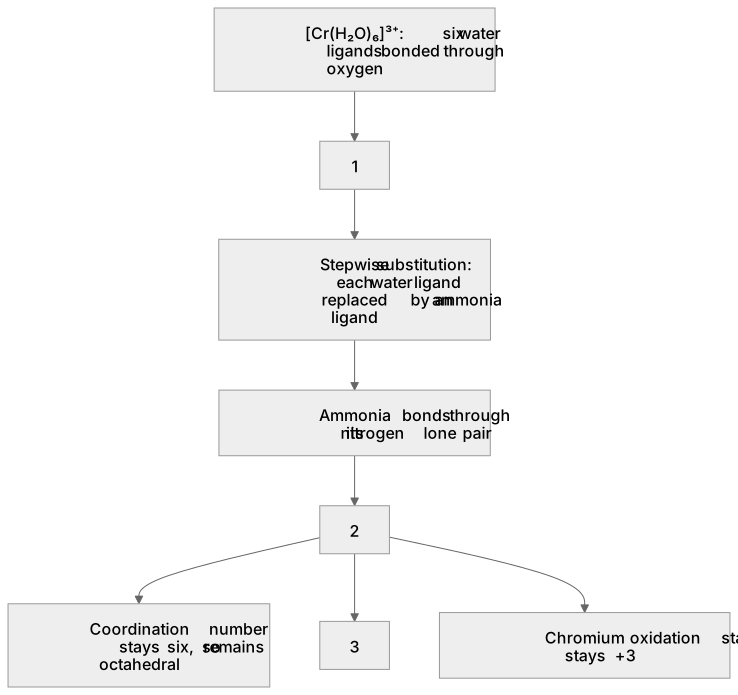
Some boxes have lost their names. Pick the right name for each number.
1Box 1
2Box 2
3Box 3
There is more to this lesson
The full lesson goes on to check your understanding and help you earn the marks. Create a free account to carry on, with your progress saved.
A week of Premium from your first lesson · Then the free plan continues · No card, no charge
Test your understanding of Transition elements: (ii) [Cr(NH₃)₆]³⁺ from [Cr(H₂O)₆]³⁺ (see also 5.3.1 j)
Active recall beats re-reading. Take an instant quiz now to test what you’ve learned and lock it into long-term memory.
A week of Premium from your first lesson · Then the free plan continues · No card, no charge