OCR · A-Level · Chemistry
Course version: H432 · Version from Sept 2017
Transition elements: (i) [Cu(NH₃)₄(H₂O)₂]²⁺ and [CuCl₄]²⁻ from [Cu(H₂O)₆]²⁺
Starting from the pale blue complex [Cu(H₂O)₆]²⁺, two ligand substitutions are required.
- Point 16 of 24
- 4 key terms
Study notes
From the teaching notes for this specification point.
The idea
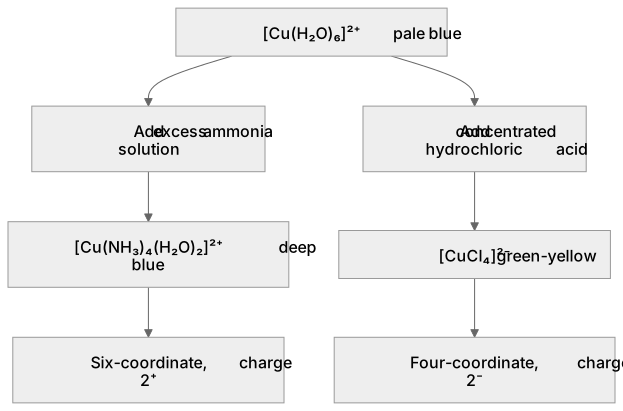
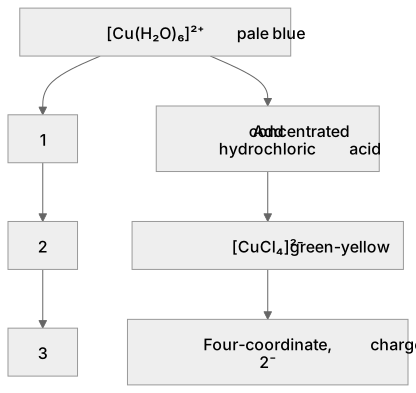
Starting from the pale blue complex [Cu(H₂O)₆]²⁺, two ligand substitutions are required. Adding excess ammonia solution replaces four water ligands, giving [Cu(NH₃)₄(H₂O)₂]²⁺, a deep blue complex that is six-coordinate because two water ligands remain. Adding concentrated hydrochloric acid replaces the water ligands with chloride ions, giving [CuCl₄]²⁻, a green-yellow complex that is four-coordinate. Check the overall charge of each product: [Cu(NH₃)₄(H₂O)₂]²⁺ carries a 2⁺ charge, while [CuCl₄]²⁻ carries a 2⁻ charge because four chloride ligands each contribute 1⁻ around a Cu²⁺ centre.
What earns the marks
- Writes [Cu(NH₃)₄(H₂O)₂]²⁺ as the product of reacting [Cu(H₂O)₆]²⁺ with excess ammonia.
- Writes [CuCl₄]²⁻ as the product of reacting [Cu(H₂O)₆]²⁺ with concentrated hydrochloric acid.
- States that [Cu(NH₃)₄(H₂O)₂]²⁺ is six-coordinate and [CuCl₄]²⁻ is four-coordinate.
- Calculates the overall charge of [CuCl₄]²⁻ as 2⁻ from a Cu²⁺ centre and four chloride ligands.
- Describes the colour changes from pale blue to deep blue with ammonia and to green-yellow with chloride.
Common mistakes and how to put them right
States that both product complexes carry a 2⁺ charge.
Put it right: Calculate the charge of [CuCl₄]²⁻ from a Cu²⁺ centre and four 1⁻ ligands to obtain 2⁻.
Writes the ammonia product as four-coordinate.
Put it right: Recognise that two water ligands remain, giving six-coordinate [Cu(NH₃)₄(H₂O)₂]²⁺.
Omits the charge on the complex ion.
Put it right: Include the overall charge in every formula written.
Exam tips
- Balance the charge of each complex by adding the oxidation state of the central ion to the charges of all ligands.
- State the coordination number alongside each formula to show understanding of the structure.
- Match each product to its colour so the answer links formula, structure and observation.
Try the lesson
The start of the Transition elements: (i) [Cu(NH₃)₄(H₂O)₂]²⁺ and [CuCl₄]²⁻ from [Cu(H₂O)₆]²⁺ lesson, made from teaching notes for this specification point.
Listen
Starting from the pale blue complex [Cu(H₂O)₆]²⁺, two ligand substitutions are required. Adding excess ammonia solution replaces four water ligands, giving [Cu(NH₃)₄(H₂O)₂]²⁺, a deep blue complex that is six-coordinate because two water ligands remain. Adding concentrated hydrochloric acid replaces the water ligands with chloride ions, giving [CuCl₄]²⁻, a green-yellow complex that is four-coordinate. Check the overall charge of each product: [Cu(NH₃)₄(H₂O)₂]²⁺ carries a 2⁺ charge, while [CuCl₄]²⁻ carries a 2⁻ charge because four chloride ligands each contribute 1⁻ around a Cu²⁺ centre. A strong answer earns marks for these points. Writes [Cu(NH₃)₄(H₂O)₂]²⁺ as the product of reacting [Cu(H₂O)₆]²⁺ with excess ammonia. Writes [CuCl₄]²⁻ as the product of reacting [Cu(H₂O)₆]²⁺ with concentrated hydrochloric acid. States that [Cu(NH₃)₄(H₂O)₂]²⁺ is six-coordinate and [CuCl₄]²⁻ is four-coordinate. Calculates the overall charge of [CuCl₄]²⁻ as 2⁻ from a Cu²⁺ centre and four chloride ligands. Exam tip: Balance the charge of each complex by adding the oxidation state of the central ion to the charges of all ligands.
See it
Key words
Say what each word means before you turn the card.
Formation of copper(II) ammine and chloride complexes
Try answering aloud or in your head before turning the card.
Overall charge of complex ions
Try answering aloud or in your head before turning the card.
Coordination number of copper(II) complexes
Try answering aloud or in your head before turning the card.
Colour changes in ligand substitution
Try answering aloud or in your head before turning the card.
See every definition
- Formation of copper(II) ammine and chloride complexes
- [Cu(NH₃)₄(H₂O)₂]²⁺ forms from [Cu(H₂O)₆]²⁺ with excess ammonia, and [CuCl₄]²⁻ forms from [Cu(H₂O)₆]²⁺ with concentrated hydrochloric acid.
- Overall charge of complex ions
- Found by adding the oxidation state of the central ion to the charges of all ligands, giving 2⁺ for [Cu(NH₃)₄(H₂O)₂]²⁺ and 2⁻ for [CuCl₄]²⁻.
- Coordination number of copper(II) complexes
- [Cu(NH₃)₄(H₂O)₂]²⁺ is six-coordinate because two water ligands remain, while [CuCl₄]²⁻ is four-coordinate.
- Colour changes in ligand substitution
- The pale blue [Cu(H₂O)₆]²⁺ becomes deep blue with ammonia and green-yellow with chloride.
Label the diagram
Some boxes have lost their names. Pick the right name for each number.
1Box 1
2Box 2
3Box 3
There is more to this lesson
The full lesson goes on to check your understanding and help you earn the marks. Create a free account to carry on, with your progress saved.
A week of Premium from your first lesson · Then the free plan continues · No card, no charge
Test your understanding of Transition elements: (i) [Cu(NH₃)₄(H₂O)₂]²⁺ and [CuCl₄]²⁻ from [Cu(H₂O)₆]²⁺
Active recall beats re-reading. Take an instant quiz now to test what you’ve learned and lock it into long-term memory.
A week of Premium from your first lesson · Then the free plan continues · No card, no charge