OCR · A-Level · Chemistry
Course version: H432 · Version from Sept 2017
(ii) the formation of coloured ions (see also 5.3.1 h, j–k)
Full specification wording
Transition elements: (ii) the formation of coloured ions (see also 5.3.1 h, j–k)
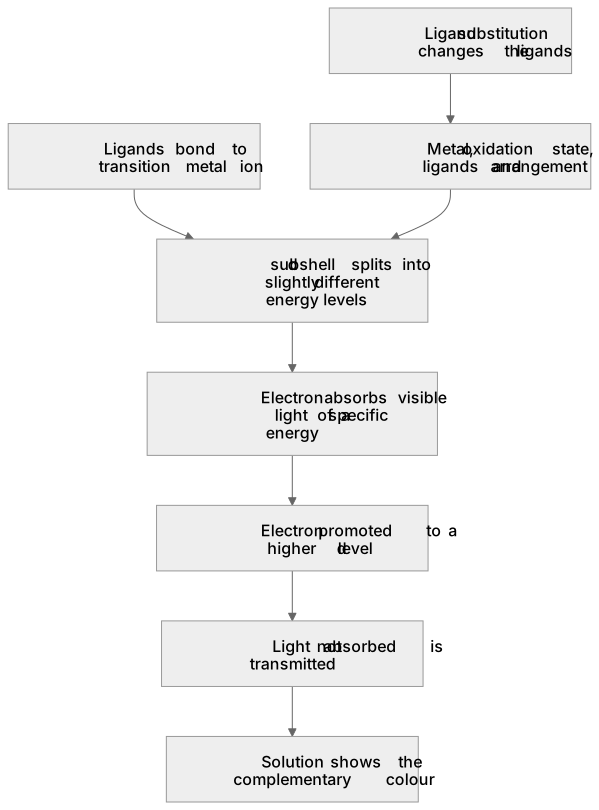
Transition metal ions often form coloured solutions because the d subshell splits into slightly different energy levels when ligands bond to the ion.
- Point 4 of 24
- 4 key terms
Study notes
From the teaching notes for this specification point.
The idea
Transition metal ions often form coloured solutions because the d subshell splits into slightly different energy levels when ligands bond to the ion. An electron absorbs visible light of one energy and is promoted to a higher d level; the light not absorbed is transmitted, so the solution shows the complementary colour. For example, hydrated copper(II) ions appear blue because red-orange light is absorbed. The size of the splitting, and so the colour, depends on the metal, its oxidation state, the identity of the ligands and their arrangement. Changing the ligand set, as when water is replaced by ammonia or chloride, changes the splitting and therefore the observed colour. This links to the ligand substitution and complex ion work in 5.3.1 h, j–k.
What earns the marks
- States that the d subshell splits into energy levels of slightly different energy when ligands bond to the transition metal ion.
- Explains that an electron absorbs visible light of a specific energy and is promoted to a higher d level.
- Identifies that the colour observed is the complementary colour of the light absorbed.
- Recognises that the colour depends on the metal, its oxidation state and the ligands present.
Common mistakes and how to put them right
Claims that the colour arises from electrons being emitted by the ion.
Put it right by explaining that light is absorbed and an electron is promoted between split d levels.
Assumes every transition metal ion is coloured regardless of context.
Put it right by noting that colour depends on the splitting and the ligands present.
Treats the observed colour as the same as the light absorbed.
Put it right by stating that the observed colour is complementary to the absorbed light.
Exam tips
- Link the colour directly to absorption and promotion of an electron between split d levels rather than describing colour alone.
- Use a named example such as hydrated copper(II) appearing blue to anchor the explanation.
- When a colour change follows ligand substitution, attribute it to the change in splitting caused by the new ligands.
Try the lesson
The start of the Transition elements: (ii) the formation of coloured ions (see also 5.3.1 h, j–k) lesson, made from teaching notes for this specification point.
Listen
Transition metal ions often form coloured solutions because the d subshell splits into slightly different energy levels when ligands bond to the ion. An electron absorbs visible light of one energy and is promoted to a higher d level; the light not absorbed is transmitted, so the solution shows the complementary colour. For example, hydrated copper(II) ions appear blue because red-orange light is absorbed. The size of the splitting, and so the colour, depends on the metal, its oxidation state, the identity of the ligands and their arrangement. Changing the ligand set, as when water is replaced by ammonia or chloride, changes the splitting and therefore the observed colour. This links to the ligand substitution and complex ion work in 5.3.1 h, j–k. A strong answer earns marks for these points. States that the d subshell splits into energy levels of slightly different energy when ligands bond to the transition metal ion. Explains that an electron absorbs visible light of a specific energy and is promoted to a higher d level. Identifies that the colour observed is the complementary colour of the light absorbed. Recognises that the colour depends on the metal, its oxidation state and the ligands present. A common slip: Claims that the colour arises from electrons being emitted by the ion. Instead, explaining that light is absorbed and an electron is promoted between split d levels. Exam tip: Link the colour directly to absorption and promotion of an electron between split d levels rather than describing colour alone.
See it
Key words
Say what each word means before you turn the card.
d subshell splitting by ligands
Try answering aloud or in your head before turning the card.
Absorption of visible light and electron promotion
Try answering aloud or in your head before turning the card.
Complementary colour observed
Try answering aloud or in your head before turning the card.
Dependence of colour on metal, oxidation state and ligands
Try answering aloud or in your head before turning the card.
See every definition
- d subshell splitting by ligands
- The d subshell splits into slightly different energy levels when ligands bond to the transition metal ion.
- Absorption of visible light and electron promotion
- An electron absorbs visible light of a specific energy and is promoted to a higher d level.
- Complementary colour observed
- The light not absorbed is transmitted, so the solution shows the complementary colour of the light absorbed.
- Dependence of colour on metal, oxidation state and ligands
- The size of the splitting, and so the colour, depends on the metal, its oxidation state, the identity of the ligands and their arrangement.
Label the diagram
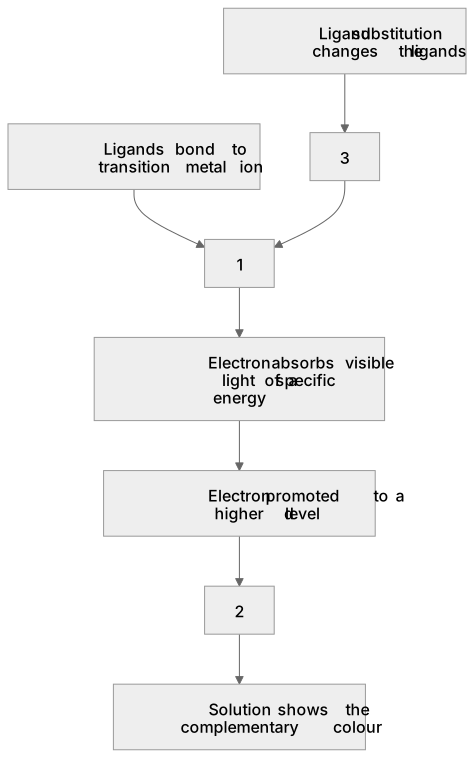
Some boxes have lost their names. Pick the right name for each number.
1Box 1
2Box 2
3Box 3
There is more to this lesson
The full lesson goes on to check your understanding and help you earn the marks. Create a free account to carry on, with your progress saved.
A week of Premium from your first lesson · Then the free plan continues · No card, no charge
Test your understanding of Transition elements: (ii) the formation of coloured ions (see also 5.3.1 h, j–k)
Active recall beats re-reading. Take an instant quiz now to test what you’ve learned and lock it into long-term memory.
A week of Premium from your first lesson · Then the free plan continues · No card, no charge