OCR · A-Level · Chemistry
Course version: H432 · Version from Sept 2017
(iii) the catalytic behaviour of the elements and their compounds and…
Full specification wording
Transition elements: (iii) the catalytic behaviour of the elements and their compounds and their importance in the manufacture of chemicals by industry (see 3.2.2 d)
Transition metals and their compounds act as catalysts because they can change oxidation state and provide a surface or intermediate species that lowers the activation energy of a reaction.
- Point 5 of 24
- 4 key terms
Study notes
From the teaching notes for this specification point.
The idea
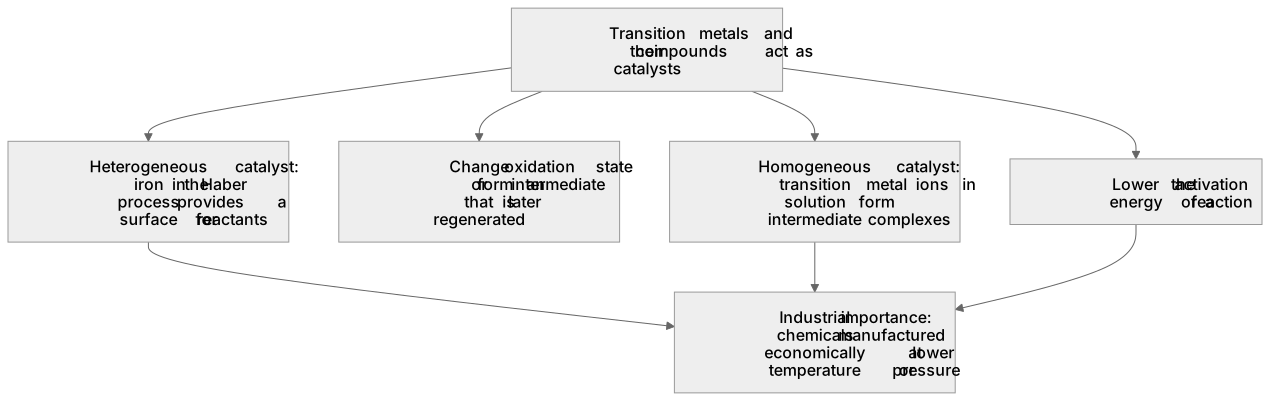
Transition metals and their compounds act as catalysts because they can change oxidation state and provide a surface or intermediate species that lowers the activation energy of a reaction. Heterogeneous catalysts, such as iron in the Haber process for making ammonia, provide a surface on which reactant molecules adsorb, weaken their bonds and react. Homogeneous catalysts, such as transition metal ions in solution, form intermediate complexes that react further and regenerate the catalyst. Their industrial importance lies in increasing reaction rates so that chemicals such as ammonia, sulfuric acid and methanol can be manufactured economically at lower temperatures and pressures. This links to the rate and catalysis work in 3.2.2 d.
What earns the marks
- States that transition metals and their compounds act as catalysts by lowering the activation energy of a reaction.
- Explains that a transition metal can change oxidation state or form an intermediate that is later regenerated.
- Describes a heterogeneous catalyst such as iron in the Haber process providing a surface for reactants.
- Explains the industrial importance of catalysis in manufacturing chemicals economically at lower temperature or pressure.
Common mistakes and how to put them right
Claims that a catalyst is used up during the reaction.
Put it right by stating that the catalyst is regenerated and can be recovered.
Describes catalysis only as speeding up a reaction without explaining the lowered activation energy.
Put it right by linking the rate increase to a lower activation energy.
Names an industrial catalyst without saying what it catalyses.
Put it right by pairing the catalyst with the process and the chemical manufactured.
Exam tips
- Name a specific industrial process and its catalyst, such as iron in the Haber process, to make the answer concrete.
- Explain the mechanism briefly, for example surface adsorption for a heterogeneous catalyst or intermediate formation for a homogeneous one.
- State clearly why industry values catalysis, such as enabling economical manufacture at lower temperature or pressure.
Try the lesson
The start of the Transition elements: (iii) the catalytic behaviour of the elements and their compounds and their importance in the manufacture of chemicals by industry (see 3.2.2 d) lesson, made from teaching notes for this specification point.
Listen
Transition metals and their compounds act as catalysts because they can change oxidation state and provide a surface or intermediate species that lowers the activation energy of a reaction. Heterogeneous catalysts, such as iron in the Haber process for making ammonia, provide a surface on which reactant molecules adsorb, weaken their bonds and react. Homogeneous catalysts, such as transition metal ions in solution, form intermediate complexes that react further and regenerate the catalyst. Their industrial importance lies in increasing reaction rates so that chemicals such as ammonia, sulfuric acid and methanol can be manufactured economically at lower temperatures and pressures. This links to the rate and catalysis work in 3.2.2 d. A strong answer earns marks for these points. States that transition metals and their compounds act as catalysts by lowering the activation energy of a reaction. Explains that a transition metal can change oxidation state or form an intermediate that is later regenerated. Describes a heterogeneous catalyst such as iron in the Haber process providing a surface for reactants. Explains the industrial importance of catalysis in manufacturing chemicals economically at lower temperature or pressure. A common slip: Claims that a catalyst is used up during the reaction. Instead, stating that the catalyst is regenerated and can be recovered. Exam tip: Name a specific industrial process and its catalyst, such as iron in the Haber process, to make the answer concrete.
See it
Key words
Say what each word means before you turn the card.
Catalytic behaviour of transition metals and their compounds
Try answering aloud or in your head before turning the card.
Lowering activation energy
Try answering aloud or in your head before turning the card.
Heterogeneous and homogeneous catalysis
Try answering aloud or in your head before turning the card.
Industrial importance in manufacturing chemicals
Try answering aloud or in your head before turning the card.
See every definition
- Catalytic behaviour of transition metals and their compounds
- Transition metals and their compounds act as catalysts because they can change oxidation state and provide a surface or intermediate species that lowers the activation energy of a reaction.
- Lowering activation energy
- A surface or intermediate species provided by the catalyst lowers the activation energy of a reaction.
- Heterogeneous and homogeneous catalysis
- Heterogeneous catalysts provide a surface on which reactant molecules adsorb, weaken their bonds and react, while homogeneous catalysts form intermediate complexes that react further and regenerate the catalyst.
- Industrial importance in manufacturing chemicals
- Catalysis increases reaction rates so that chemicals such as ammonia, sulfuric acid and methanol can be manufactured economically at lower temperatures and pressures.
Label the diagram
Some boxes have lost their names. Pick the right name for each number.
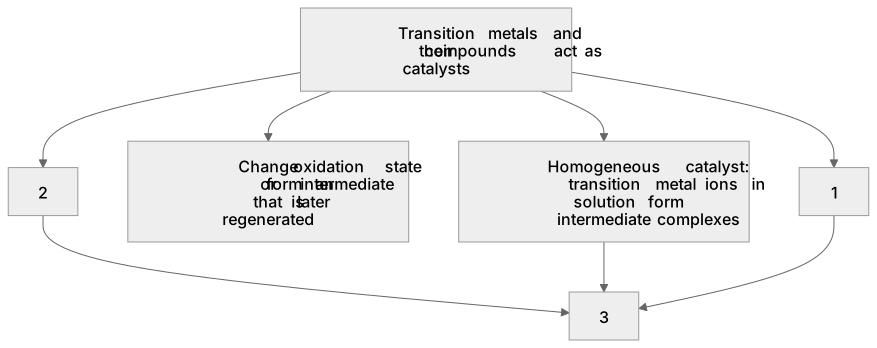
1Box 1
2Box 2
3Box 3
There is more to this lesson
The full lesson goes on to check your understanding and help you earn the marks. Create a free account to carry on, with your progress saved.
A week of Premium from your first lesson · Then the free plan continues · No card, no charge
Test your understanding of Transition elements: (iii) the catalytic behaviour of the elements and their compounds and their importance in the manufacture of chemicals by industry (see 3.2.2 d)
Active recall beats re-reading. Take an instant quiz now to test what you’ve learned and lock it into long-term memory.
A week of Premium from your first lesson · Then the free plan continues · No card, no charge