OCR · A-Level · Chemistry
Course version: H432 · Version from Sept 2017
(a) use of appropriate apparatus to record a range of measurements (to…
Full specification wording
Use of apparatus and techniques: (a) use of appropriate apparatus to record a range of measurements (to include mass, time, volume of liquids and gases, temperature)
For each, match the instrument to the size and precision of the reading.
- Point 1 of 17
- 3 key terms
Study notes
From the teaching notes for this specification point.
The idea
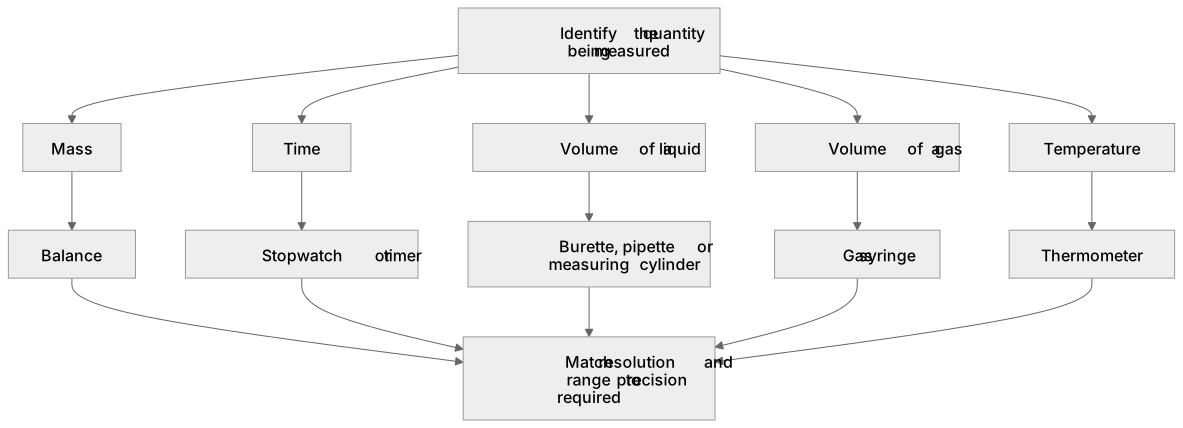
For each, match the instrument to the size and precision of the reading. A balance records mass, with the choice of balance depending on the precision needed. A stopwatch or timer records time, started and stopped at defined events. A burette, pipette or measuring cylinder records the volume of a liquid, chosen by the precision required. A gas syringe records the volume of a gas collected. A thermometer records temperature, read at eye level with the scale fully immersed where appropriate. In a multiple-choice question, identify the quantity being measured, then select the apparatus whose range and resolution suit it, rejecting options that measure a different quantity or give insufficient precision.
What earns the marks
- Identifies the quantity being measured and selects apparatus designed to record that quantity.
- Matches the resolution and range of the chosen instrument to the precision the measurement requires.
- Distinguishes apparatus for liquid volume from apparatus for gas volume and selects accordingly.
- Reads instruments correctly, for example at eye level and with the scale appropriately positioned.
Common mistakes and how to put them right
Selects a measuring cylinder for gas volume.
Put it right: Choose a gas syringe or equivalent apparatus designed to collect and measure a gas.
Chooses a balance or thermometer without regard to the precision needed.
Put it right: Match the instrument's resolution to the required accuracy.
Reads a scale from an angle or with the instrument wrongly positioned.
Put it right: Read at eye level and position the instrument as the technique requires.
Exam tips
- Name the quantity first, then eliminate options that measure a different quantity.
- Compare the resolution of the remaining options and keep the one that matches the precision stated or implied.
- Check that the apparatus can cover the full range of the expected reading, not just a typical value.
Try the lesson
The start of the Use of apparatus and techniques: (a) use of appropriate apparatus to record a range of measurements (to include mass, time, volume of liquids and gases, temperature) lesson, made from teaching notes for this specification point.
Listen
For each, match the instrument to the size and precision of the reading. A balance records mass, with the choice of balance depending on the precision needed. A stopwatch or timer records time, started and stopped at defined events. A burette, pipette or measuring cylinder records the volume of a liquid, chosen by the precision required. A gas syringe records the volume of a gas collected. A thermometer records temperature, read at eye level with the scale fully immersed where appropriate. In a multiple-choice question, identify the quantity being measured, then select the apparatus whose range and resolution suit it, rejecting options that measure a different quantity or give insufficient precision. A strong answer earns marks for these points. Identifies the quantity being measured and selects apparatus designed to record that quantity. Matches the resolution and range of the chosen instrument to the precision the measurement requires. Distinguishes apparatus for liquid volume from apparatus for gas volume and selects accordingly. Reads instruments correctly, for example at eye level and with the scale appropriately positioned. A common slip: Selects a measuring cylinder for gas volume. Instead, choose a gas syringe or equivalent apparatus designed to collect and measure a gas. Exam tip: Name the quantity first, then eliminate options that measure a different quantity.
See it
Key words
Say what each word means before you turn the card.
Matching apparatus to the quantity measured
Try answering aloud or in your head before turning the card.
Precision and resolution of instruments
Try answering aloud or in your head before turning the card.
Correct reading technique for scales
Try answering aloud or in your head before turning the card.
See every definition
- Matching apparatus to the quantity measured
- Identifying the quantity being measured and selecting apparatus designed to record that quantity, such as a balance for mass or a gas syringe for the volume of a gas.
- Precision and resolution of instruments
- Matching the resolution and range of the chosen instrument to the precision the measurement requires, and checking that the apparatus can cover the full range of the expected reading.
- Correct reading technique for scales
- Reading instruments correctly, for example at eye level and with the scale appropriately positioned, so that a reliable measurement is obtained.
Label the diagram
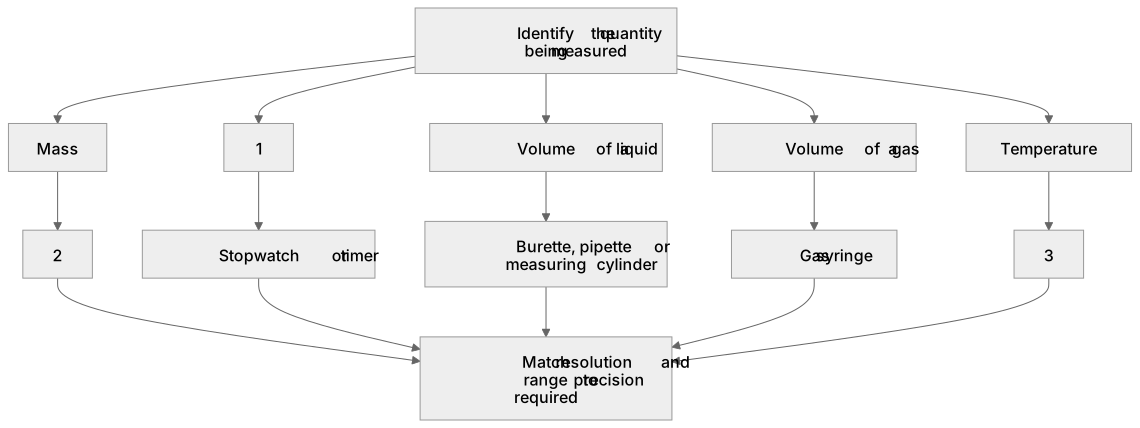
Some boxes have lost their names. Pick the right name for each number.
1Box 1
2Box 2
3Box 3
There is more to this lesson
The full lesson goes on to check your understanding and help you earn the marks. Create a free account to carry on, with your progress saved.
A week of Premium from your first lesson · Then the free plan continues · No card, no charge
Test your understanding of Use of apparatus and techniques: (a) use of appropriate apparatus to record a range of measurements (to include mass, time, volume of liquids and gases, temperature)
Active recall beats re-reading. Take an instant quiz now to test what you’ve learned and lock it into long-term memory.
A week of Premium from your first lesson · Then the free plan continues · No card, no charge