OCR · A-Level · Chemistry
Course version: H432 · Version from Sept 2017
Use of apparatus and techniques: (i) titration, using burette and pipette
A titration uses a pipette to deliver one accurately known volume of the solution being analysed into a conical flask, and a burette to add the other solution in measured, variable volumes until…
- Point 4 of 17
- 4 key terms
Study notes
From the teaching notes for this specification point.
The idea
A titration uses a pipette to deliver one accurately known volume of the solution being analysed into a conical flask, and a burette to add the other solution in measured, variable volumes until the end-point is reached. You rinse the pipette with the solution it will deliver and the burette with the solution it will contain, then fill the burette, remove air from the jet and record the initial reading at eye level against the bottom of the meniscus. You add the titrant with swirling, slowing near the end-point as the indicator colour changes, and record the final reading. The titre is the difference between final and initial readings. Repeating to obtain concordant titres improves reliability. Questions test your understanding of apparatus choice, rinsing, reading the meniscus and calculating from the titre.
What earns the marks
- States that the pipette delivers a fixed accurate volume while the burette delivers variable measured volumes.
- Explains that the burette is rinsed with the solution it will contain so the added solution is not diluted.
- Describes reading the burette at eye level against the bottom of the meniscus to avoid parallax error.
- Calculates the titre as the difference between the final and initial burette readings.
- Explains that concordant titres from repeat runs improve the reliability of the result.
Common mistakes and how to put them right
Rinses the burette with water instead of the solution it will contain.
Put it right: Rinse with the solution to avoid diluting the titrant.
Reads the top of the meniscus or at an angle.
Put it right: Read the bottom of the meniscus at eye level.
Uses the burette to deliver the fixed volume into the flask.
Put it right: Use the pipette for the fixed volume and the burette for the variable addition.
Exam tips
- Learn the rinsing rule for each piece of apparatus and be ready to explain the reason.
- Practise calculating a titre from a pair of burette readings, remembering to subtract the initial reading.
- When asked why repeats are done, link concordant titres to reliability of the mean.
Try the lesson
The start of the Use of apparatus and techniques: (i) titration, using burette and pipette lesson, made from teaching notes for this specification point.
Listen
A titration uses a pipette to deliver one accurately known volume of the solution being analysed into a conical flask, and a burette to add the other solution in measured, variable volumes until the end-point is reached. You rinse the pipette with the solution it will deliver and the burette with the solution it will contain, then fill the burette, remove air from the jet and record the initial reading at eye level against the bottom of the meniscus. You add the titrant with swirling, slowing near the end-point as the indicator colour changes, and record the final reading. The titre is the difference between final and initial readings. Repeating to obtain concordant titres improves reliability. Questions test your understanding of apparatus choice, rinsing, reading the meniscus and calculating from the titre. A strong answer earns marks for these points. States that the pipette delivers a fixed accurate volume while the burette delivers variable measured volumes. Explains that the burette is rinsed with the solution it will contain so the added solution is not diluted. Describes reading the burette at eye level against the bottom of the meniscus to avoid parallax error. Calculates the titre as the difference between the final and initial burette readings. Exam tip: Learn the rinsing rule for each piece of apparatus and be ready to explain the reason.
See it
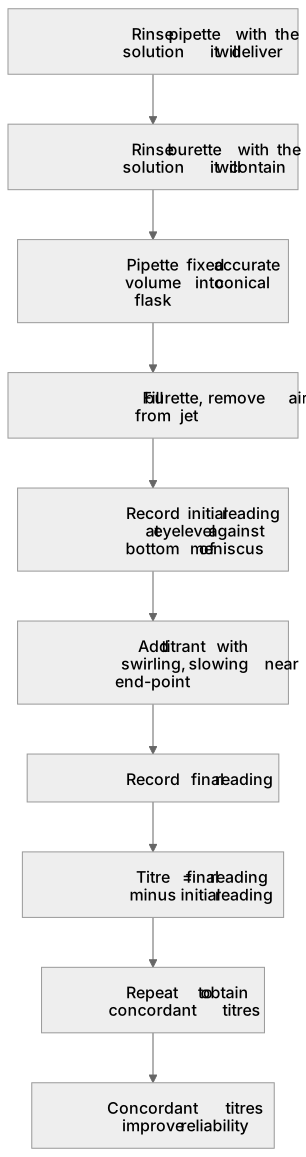
Key words
Say what each word means before you turn the card.
Apparatus choice in titration
Try answering aloud or in your head before turning the card.
Rinsing and avoiding contamination
Try answering aloud or in your head before turning the card.
Accurate reading of the meniscus
Try answering aloud or in your head before turning the card.
Calculating and interpreting the titre
Try answering aloud or in your head before turning the card.
See every definition
- Apparatus choice in titration
- A pipette delivers a fixed accurate volume while a burette delivers variable measured volumes.
- Rinsing and avoiding contamination
- The burette is rinsed with the solution it will contain so the added solution is not diluted.
- Accurate reading of the meniscus
- The burette is read at eye level against the bottom of the meniscus to avoid parallax error.
- Calculating and interpreting the titre
- The titre is the difference between the final and initial burette readings, and concordant titres from repeat runs improve the reliability of the result.
Label the diagram
Some boxes have lost their names. Pick the right name for each number.
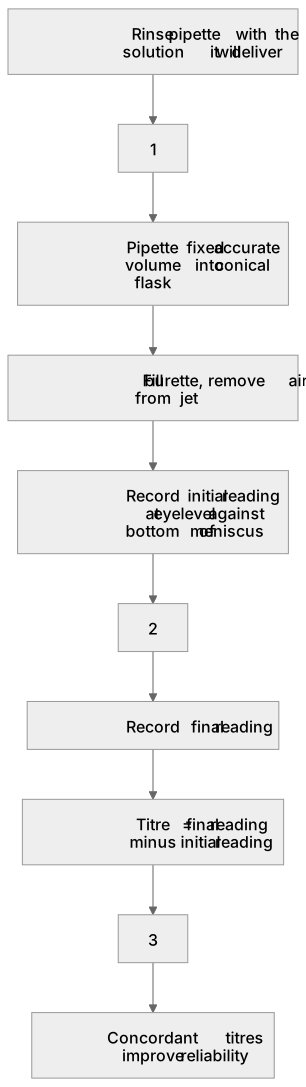
1Box 1
2Box 2
3Box 3
There is more to this lesson
The full lesson goes on to check your understanding and help you earn the marks. Create a free account to carry on, with your progress saved.
A week of Premium from your first lesson · Then the free plan continues · No card, no charge
Test your understanding of Use of apparatus and techniques: (i) titration, using burette and pipette
Active recall beats re-reading. Take an instant quiz now to test what you’ve learned and lock it into long-term memory.
A week of Premium from your first lesson · Then the free plan continues · No card, no charge