OCR · A-Level · Chemistry
Course version: H432 · Version from Sept 2017
(c) measurement of pH using pH charts, or pH meter, or pH probe on a data…
Full specification wording
Use of apparatus and techniques: (c) measurement of pH using pH charts, or pH meter, or pH probe on a data logger
This technique covers three ways of measuring pH.
- Point 3 of 17
- 4 key terms
Study notes
From the teaching notes for this specification point.
The idea
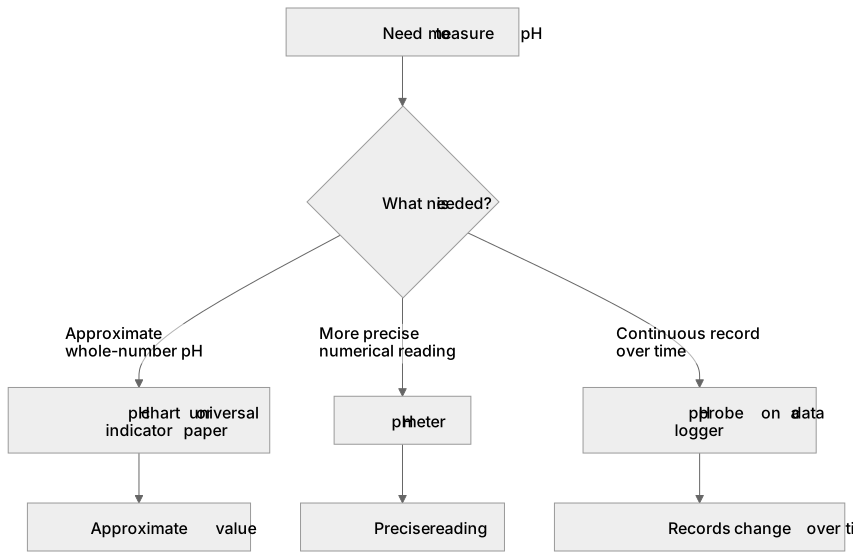
This technique covers three ways of measuring pH. A pH chart or universal indicator paper is compared against a colour scale to give an approximate pH, typically to the nearest whole number. A pH meter gives a numerical reading from an electrode dipped into the solution and is more precise than indicator paper. A pH probe connected to a data logger records pH continuously and can log changes over time, for example during a titration or when monitoring a reaction. The choice depends on the precision needed and whether a single reading or a continuous record is required. Assessment asks you to select the appropriate method for a described purpose and to recognise the trade-off between convenience, precision and continuous monitoring.
What earns the marks
- Selects a pH chart or universal indicator paper when only an approximate, whole-number pH is needed.
- Chooses a pH meter when a more precise numerical pH reading is required.
- Identifies a pH probe on a data logger as suitable for recording pH continuously or monitoring change over time.
- Explains that indicator-based charts give approximate values while meters and probes give more precise readings.
- Matches the method to the purpose, such as a single reading versus a continuous record during a reaction.
Common mistakes and how to put them right
Claims a pH chart gives a precise decimal value.
Put it right: Recognise that it gives only an approximate whole-number pH.
Chooses a data-logger probe when only a single approximate reading is needed.
Put it right: Select the simpler method that meets the purpose.
Assumes a pH meter needs no calibration.
Put it right: Recognise that meters and probes are calibrated with buffer solutions before use.
Exam tips
- Identify whether the task needs an approximate value, a precise value or a continuous record before choosing.
- Name the specific method (pH chart, pH meter or pH probe on a data logger) rather than saying only 'measure the pH'.
- State the reason for the choice, linking precision or continuous monitoring to the purpose.
Try the lesson
The start of the Use of apparatus and techniques: (c) measurement of pH using pH charts, or pH meter, or pH probe on a data logger lesson, made from teaching notes for this specification point.
Listen
This technique covers three ways of measuring pH. A pH chart or universal indicator paper is compared against a colour scale to give an approximate pH, typically to the nearest whole number. A pH meter gives a numerical reading from an electrode dipped into the solution and is more precise than indicator paper. A pH probe connected to a data logger records pH continuously and can log changes over time, for example during a titration or when monitoring a reaction. The choice depends on the precision needed and whether a single reading or a continuous record is required. Assessment asks you to select the appropriate method for a described purpose and to recognise the trade-off between convenience, precision and continuous monitoring. A strong answer earns marks for these points. Selects a pH chart or universal indicator paper when only an approximate, whole-number pH is needed. Chooses a pH meter when a more precise numerical pH reading is required. Identifies a pH probe on a data logger as suitable for recording pH continuously or monitoring change over time. Explains that indicator-based charts give approximate values while meters and probes give more precise readings. Exam tip: Identify whether the task needs an approximate value, a precise value or a continuous record before choosing.
See it
Key words
Say what each word means before you turn the card.
Measuring pH
Try answering aloud or in your head before turning the card.
Precision of measurement
Try answering aloud or in your head before turning the card.
Continuous monitoring with data loggers
Try answering aloud or in your head before turning the card.
Selecting apparatus for a purpose
Try answering aloud or in your head before turning the card.
See every definition
- Measuring pH
- Carried out using a pH chart, or a pH meter, or a pH probe on a data logger.
- Precision of measurement
- Indicator-based charts give approximate values while meters and probes give more precise readings.
- Continuous monitoring with data loggers
- A pH probe connected to a data logger records pH continuously and can log changes over time.
- Selecting apparatus for a purpose
- The choice depends on the precision needed and whether a single reading or a continuous record is required.
There is more to this lesson
The full lesson goes on to check your understanding and help you earn the marks. Create a free account to carry on, with your progress saved.
A week of Premium from your first lesson · Then the free plan continues · No card, no charge
Test your understanding of Use of apparatus and techniques: (c) measurement of pH using pH charts, or pH meter, or pH probe on a data logger
Active recall beats re-reading. Take an instant quiz now to test what you’ve learned and lock it into long-term memory.
A week of Premium from your first lesson · Then the free plan continues · No card, no charge