Pearson Edexcel · GCSE · Combined Science
Motion and forces
Master the fundamental difference between scalar and vector quantities. This foundational topic is critical because mixing up distance and displacement, or speed and velocity, is the most common way candidates lose marks in the Motion and Forces exam.
- 5 min read
- 3 worked examples
- 5 practice questions
- 6 key terms
Study Notes

Overview
Welcome to one of the most foundational topics in GCSE Combined Science: Scalars and Vectors.
Every physical quantity you will encounter in physics—from the energy in a battery to the gravitational pull of a black hole—falls into one of these two categories. Understanding the difference is not just about learning definitions; it is the key to unlocking the entire Motion and Forces topic. If you can confidently distinguish between a scalar and a vector, you will avoid the most common traps examiners set in calculation questions.
In this guide, we will explore exactly what these terms mean, look at the classic examples examiners expect you to know, and dive deep into the crucial differences between distance/displacement and speed/velocity.
Listen to the companion podcast below to reinforce your learning:
Key Concepts
Concept 1: Scalar Quantities
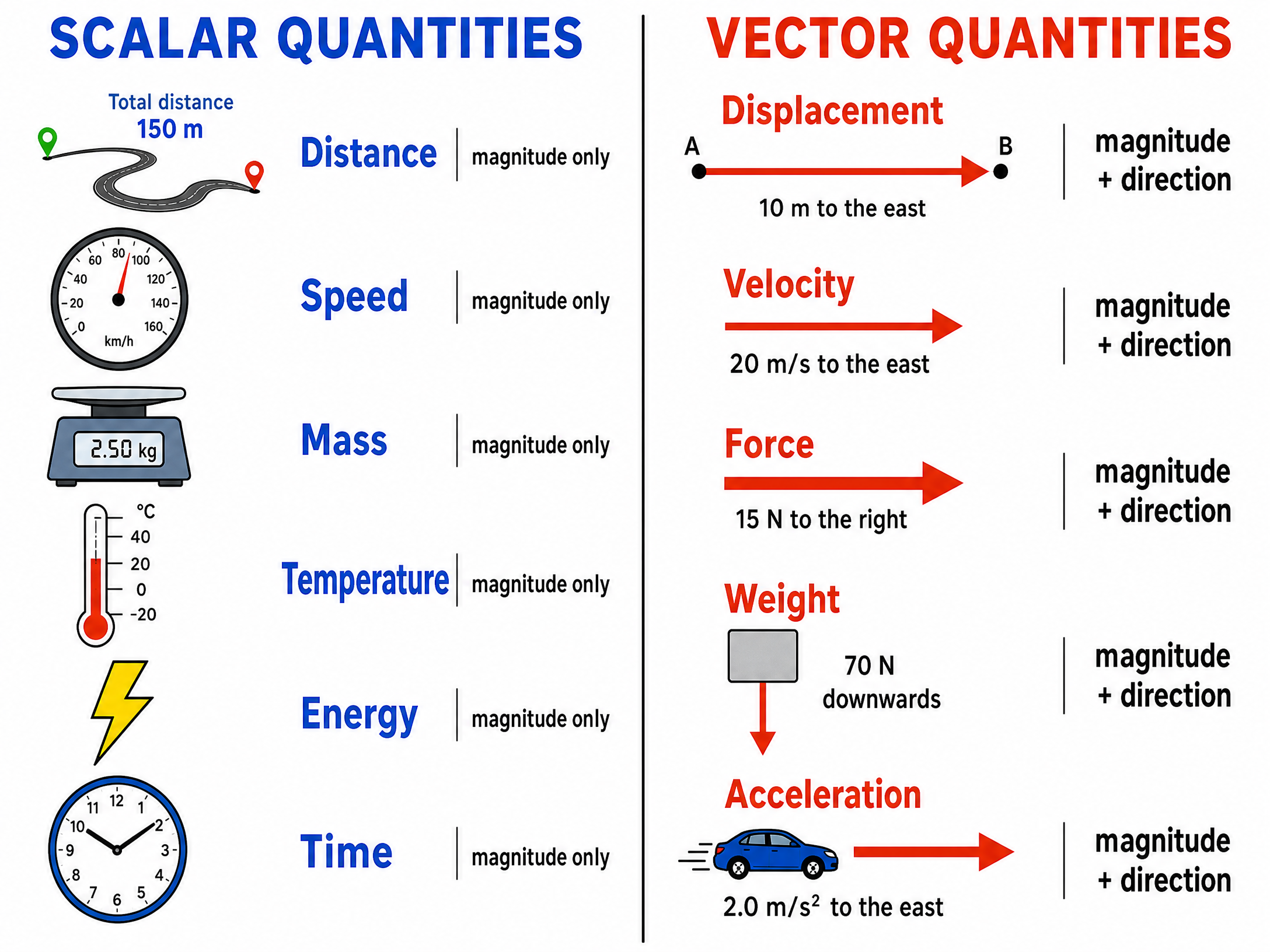
A scalar quantity is a physical quantity that has magnitude only.
Magnitude simply means 'size' or 'amount'—a numerical value. Scalars do not have a direction. Think about checking the temperature outside. If the thermometer reads 20°C, you have all the information you need. It would make no sense to say "the temperature is 20°C pointing North." Temperature is a pure scalar.
Common Scalar Quantities you must memorise:
- Distance: How far an object has travelled in total.
- Speed: How fast an object is moving.
- Mass: The amount of matter in an object (measured in kg).
- Time: Measured in seconds.
- Energy: The capacity to do work (measured in Joules).
Concept 2: Vector Quantities
A vector quantity is a physical quantity that has both magnitude AND direction.
Vectors give you the complete picture of a situation. If you apply a force to a heavy box to move it across a room, knowing you applied 50 Newtons of force (the magnitude) isn't enough. Did you push it forwards, pull it backwards, or lift it upwards? The direction is just as important as the size of the force.
Common Vector Quantities you must memorise:
- Displacement: The straight-line distance from start to finish, in a specific direction.
- Velocity: Speed in a stated direction.
- Force: A push or a pull acting in a specific direction.
- Weight: The force of gravity acting downwards on an object.
- Acceleration: The rate of change of velocity.

Concept 3: Distance vs. Displacement
This is a classic examiner favourite.
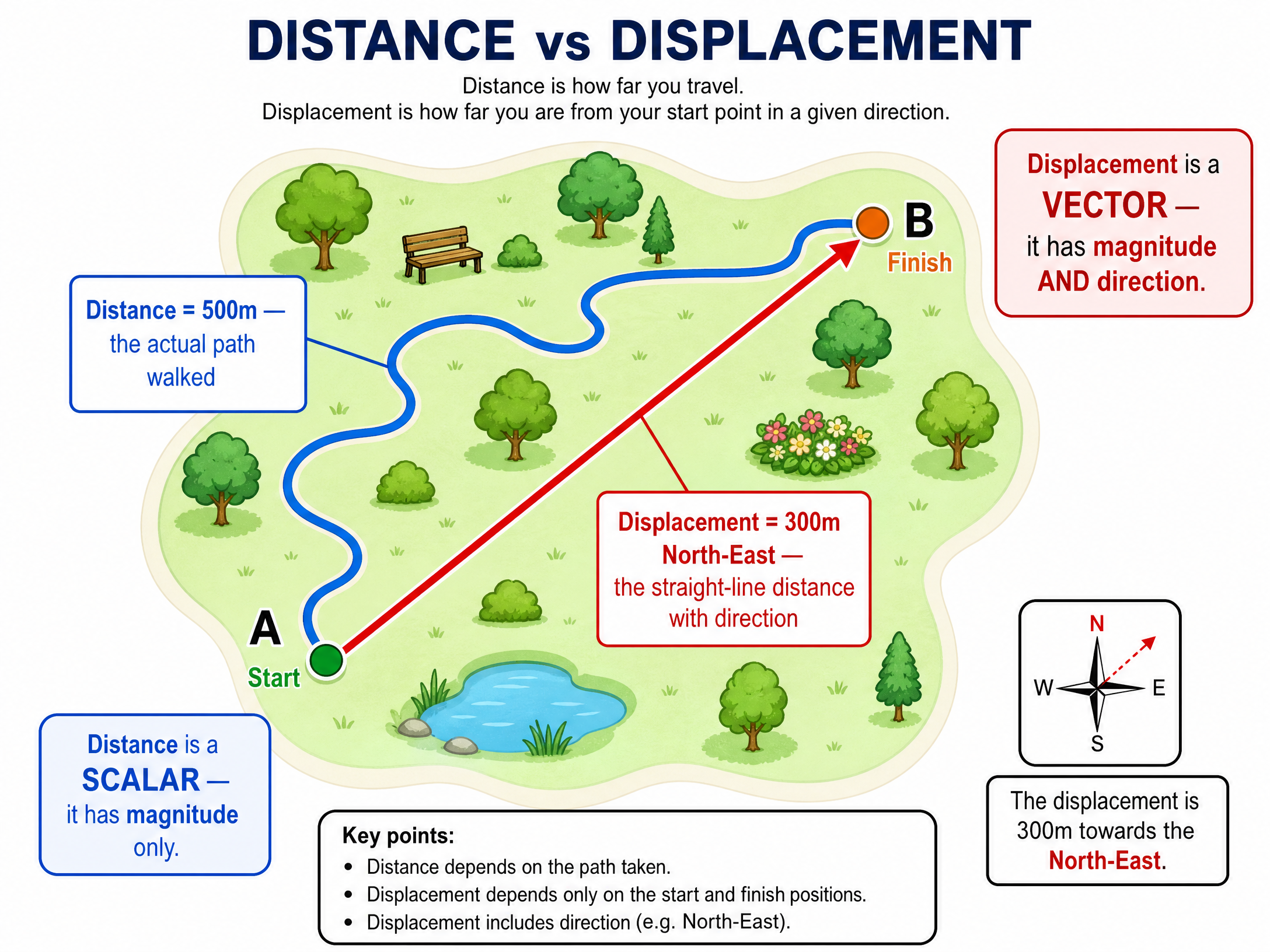
Distance is a scalar. It measures the total length of the path an object has taken, regardless of the route. If you walk 400m around a running track, your distance travelled is 400m.
Displacement is a vector. It measures the straight-line distance from the starting point to the finishing point, and it MUST include a direction. If you walk exactly one lap around that 400m track and end up exactly where you started, your displacement is 0m. Why? Because the straight-line distance between your start point and finish point is zero!

Concept 4: Speed vs. Velocity
Similarly, candidates often confuse speed and velocity.
Speed is a scalar. It tells you how fast an object is moving (e.g., 30 m/s). It does not care about direction.
Velocity is a vector. It is speed in a given direction (e.g., 30 m/s North).
The Circle Trap: An object moving in a circle at a constant speed has a constantly changing velocity. This is because its direction of motion is constantly changing as it goes around the curve. Because its velocity is changing, the object is technically accelerating, even though its speed is constant. Examiners love testing this concept!
Mathematical/Scientific Relationships
When calculating these quantities, the equations are closely related:
- Speed = Distance ÷ Time (Scalar calculation)
- Velocity = Displacement ÷ Time (Vector calculation)
When adding scalars together, you simply use standard arithmetic (e.g., 5kg + 3kg = 8kg).
When adding vectors together (like forces), you must account for direction. If a 10N force pushes right, and a 5N force pushes left, the resultant force is 5N to the right.
Practical Applications
Understanding vectors is crucial for navigation. Airplane pilots and ship captains cannot rely on speed and distance alone; they must use velocity and displacement to ensure they arrive at their exact destination, factoring in vector forces like wind and ocean currents.
Visual Resources
2 diagrams and illustrations
Interactive Diagrams
2 interactive diagrams to visualise key concepts
Conceptual Flow Outline
Classification of Physical Quantities
Conceptual Flow Outline
The Circular Motion Trap: Why constant speed can still mean acceleration.
Worked Examples
3 worked examples — open one to explore the question and available guidance.
Practice Questions
Test your understanding — click to reveal model answers
State one difference between a scalar quantity and a vector quantity. (1 mark)
Hint: Think about what vectors have that scalars do not.
A student states: 'My mass is 60 kg downwards.' Explain why this statement is incorrect in physics. (2 marks)
Hint: Think about the difference between mass and weight, and whether they are scalars or vectors.
An athlete runs exactly one lap of a 400 m circular track in 50 seconds. Calculate their average speed and state their final displacement. (3 marks)
Hint: Speed is distance divided by time. Displacement is the straight-line distance from start to finish.
A car travels at a steady speed of 20 m/s around a roundabout. Explain why the velocity of the car is not constant. (2 marks)
Hint: Remember that velocity is a vector. What happens to the car's direction as it goes around the roundabout?
Two tugboats are pulling a ship. Tugboat A pulls with a force of 5000 N due North. Tugboat B pulls with a force of 5000 N due South. Explain why the resultant force on the ship is zero. (2 marks)
Hint: Force is a vector. How do vectors acting in opposite directions combine?