Pearson Edexcel · GCSE · Combined Science
Plant structures and their functions
Master the fundamentals of plant biology with this comprehensive guide to photosynthesis, plant structures, and transport systems. Understanding these interconnected processes is crucial for achieving top marks in GCSE Combined Science, as examiners frequently test your ability to link structure to function and explain limiting factors.
- 5 min read
- 3 worked examples
- 5 practice questions
- 6 key terms
Study Notes
Overview

This topic covers the essential processes that keep plants alive and functioning: photosynthesis, and the transport of water, minerals, and sugars. In Combined Science, examiners want to see that you understand not just what happens, but why it happens and how different structures are adapted for their roles. This topic connects heavily to bioenergetics (respiration), cellular structure, and ecology. You can expect a mix of short-answer recall questions, calculation questions (especially involving the inverse square law), and longer 6-mark extended response questions requiring you to explain limiting factors or compare transport vessels.
Listen to the companion podcast for a complete audio review:
Key Concepts
Concept 1: Photosynthesis
Photosynthesis is the process by which plants and algae convert light energy into chemical energy stored in glucose. It is an endothermic reaction, meaning it takes in energy from the surroundings (in the form of light).
The reaction takes place inside the chloroplasts, which contain a green pigment called chlorophyll that absorbs the light. The reactants are carbon dioxide (which diffuses into the leaf through the stomata) and water (which is absorbed by the roots and transported up the xylem).
Example: The word equation is: Carbon dioxide + Water \rightarrow Glucose + Oxygen. The balanced symbol equation is: 6CO_2 + 6H_2O \rightarrow C_6H_{12}O_6 + 6O_2.
Concept 2: Limiting Factors

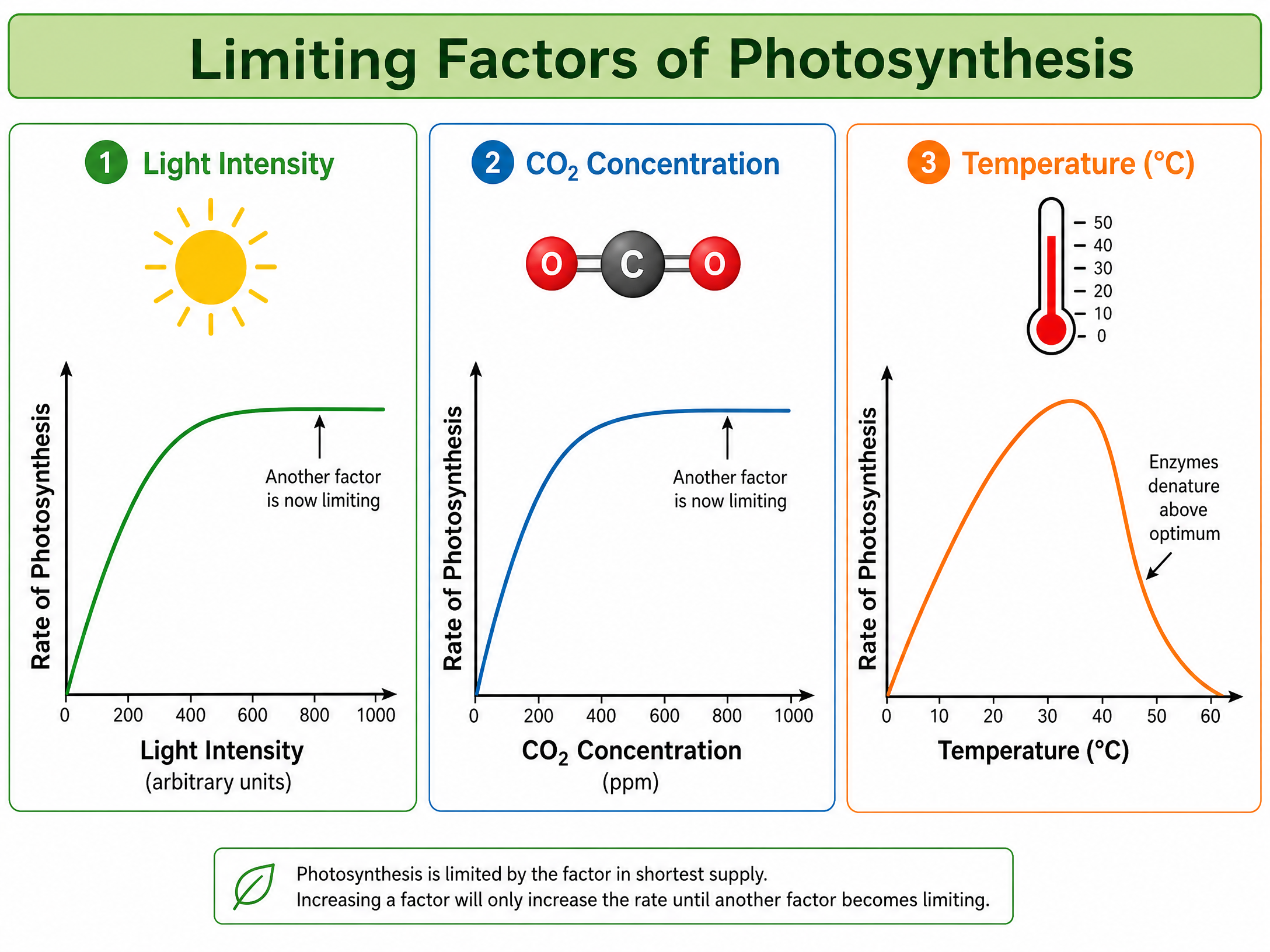
The rate of photosynthesis is determined by the factor that is in shortest supply. There are three main limiting factors: light intensity, carbon dioxide concentration, and temperature.
- Light Intensity & CO_2: As these increase, the rate of photosynthesis increases proportionally, until another factor becomes limiting (causing the graph to plateau).
- Temperature: As temperature increases, the rate increases because enzymes have more kinetic energy. However, if the temperature exceeds the optimum (usually around 35-40^\circ C), the enzymes denature, their active sites change shape, and the rate drops sharply.
Concept 3: Plant Transport Systems (Xylem and Phloem)

Plants require two distinct transport systems to move substances around.
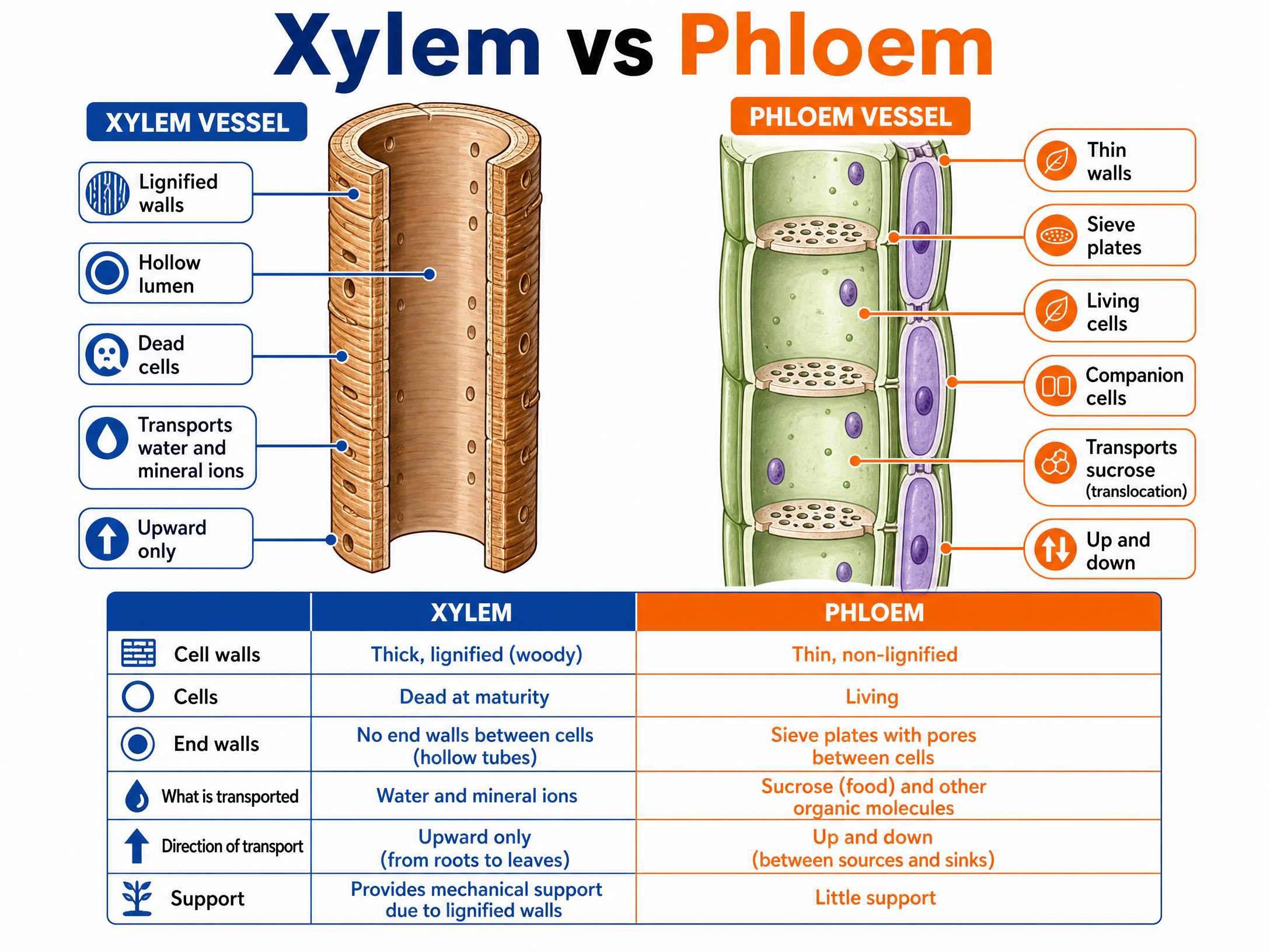
- Xylem: Transports water and dissolved mineral ions from the roots to the leaves. Xylem vessels are made of dead cells with no end walls, forming a continuous hollow tube. Their walls are strengthened with lignin, providing support. Transport is one-way (upwards).
- Phloem: Transports dissolved sugars (sucrose) from the leaves (where they are made) to the rest of the plant for immediate use or storage. This process is called translocation. Phloem is made of living cells with pores in their end walls (sieve plates). Transport occurs in both directions.
Concept 4: Transpiration and Root Hair Cells

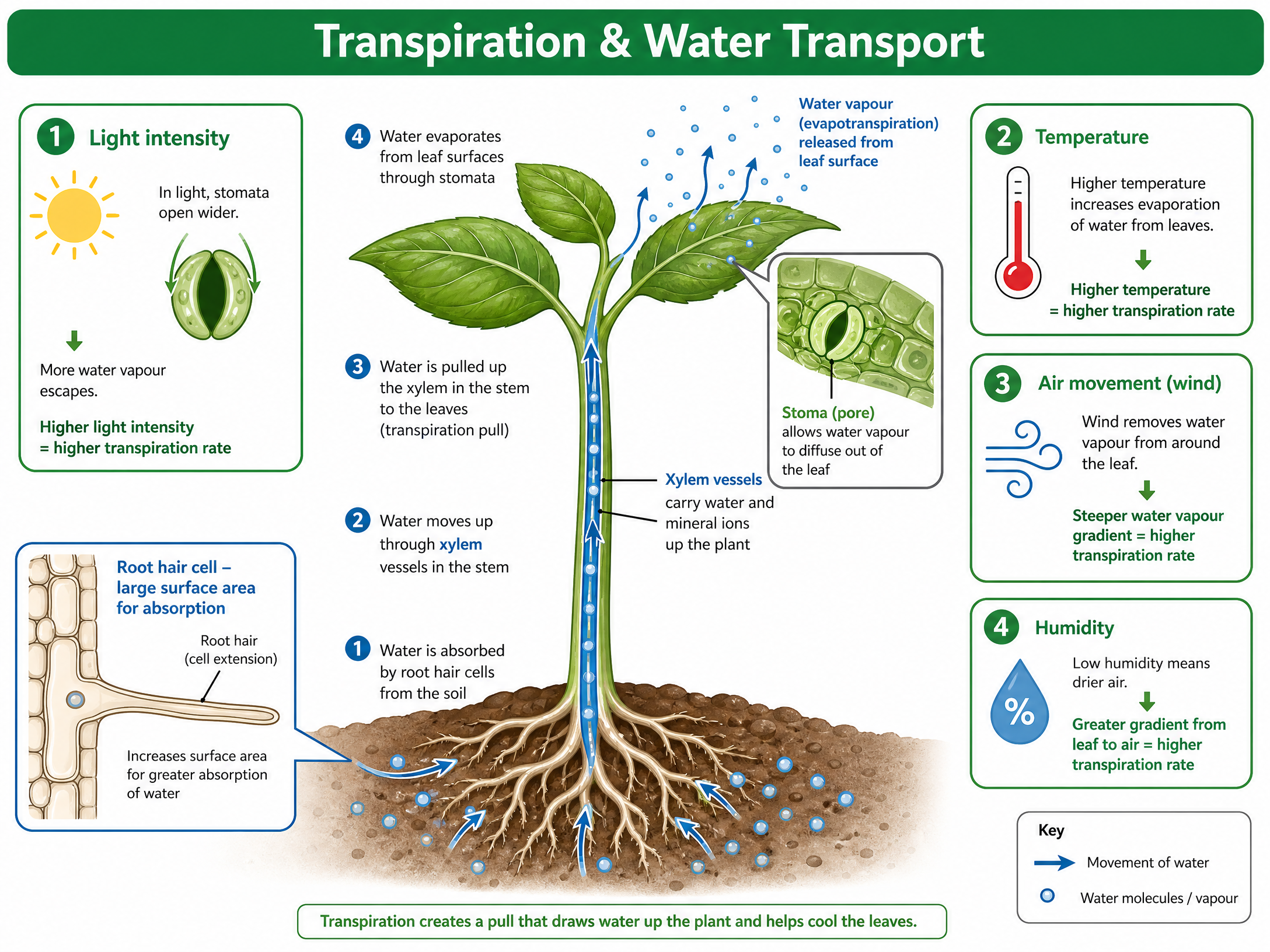
Water is absorbed from the soil by root hair cells. These cells have a long projection that greatly increases their surface area, allowing for maximum absorption of water by osmosis and mineral ions by active transport (requiring energy from mitochondria).
Transpiration is the loss of water vapour from the leaves. Water evaporates from the cells inside the leaf and diffuses out through the stomata. This creates a slight shortage of water in the leaf, drawing more water up the xylem from the roots in a continuous column known as the transpiration stream.
Transpiration rate is increased by:
- Higher light intensity (stomata open wider)
- Higher temperature (water evaporates faster)
- Increased air movement/wind (blows water vapour away, maintaining a steep concentration gradient)
- Lower humidity (drier air increases the concentration gradient)
Mathematical/Scientific Relationships
The Inverse Square LawWhen investigating the effect of light intensity on photosynthesis, distance is a key variable. Light intensity is inversely proportional to the square of the distance from the light source.
\text{Light Intensity} \propto \frac{1}{d^2}
If you double the distance (d \times 2), the light intensity drops to a quarter (\frac{1}{2^2} = \frac{1}{4}). If you halve the distance, the light intensity increases by a factor of four.
Practical Applications
Understanding limiting factors is crucial in commercial greenhouses. Farmers use artificial lighting, heaters, and paraffin heaters (which release CO_2 as they burn) to ensure photosynthesis occurs at the maximum possible rate. By controlling these factors, they maximize their crop yield and profit, though they must balance the cost of heating/lighting against the extra revenue from the larger crop.
Visual Resources
3 diagrams and illustrations
Interactive Diagrams
2 interactive diagrams to visualise key concepts
Conceptual Flow Outline
The Transpiration Stream: Path of water through a plant
Conceptual Flow Outline
Factors affecting the rate of photosynthesis
Worked Examples
3 worked examples — open one to explore the question and available guidance.
Practice Questions
Test your understanding — click to reveal model answers
State the word equation for photosynthesis. [2 marks]
Hint: What gas goes in? What gas comes out?
Describe how a root hair cell is adapted for its function. [2 marks]
Hint: Think about surface area and energy.
Explain why the rate of transpiration increases on a windy day. [3 marks]
Hint: What happens to the water vapour that has just exited the leaf?
A farmer wants to increase the yield of his tomatoes in a greenhouse. He increases the temperature from 20°C to 25°C, but the rate of photosynthesis does not increase. Explain why. [2 marks]
Hint: Think about limiting factors.
Describe the process of translocation. [3 marks]
Hint: What is moving, where is it moving through, and where does it go?