Study Notes
Overview
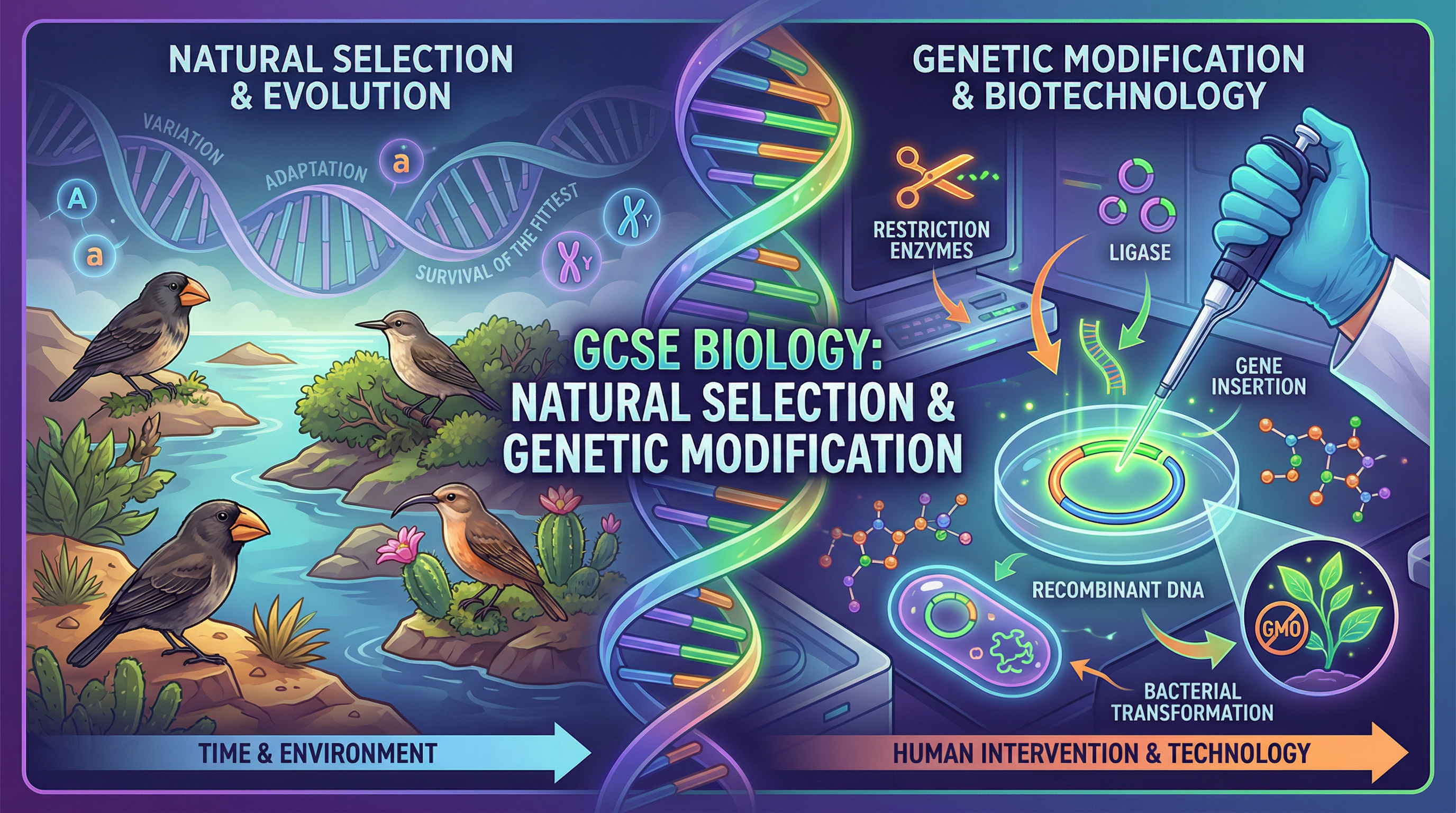
Welcome to your deep dive into Natural Selection and Genetic Modification (Edexcel Topic 1.3). This topic is central to biology, explaining both the history of life on Earth and the future of biotechnology. Examiners love this topic because it tests your ability to apply concepts to new situations and requires precise scientific language. You'll encounter everything from 6-mark essay questions on evolution to detailed process descriptions for genetic engineering. This guide will equip you with the knowledge and exam technique to tackle them confidently.
Key Concepts
Concept 1: Darwin's Theory of Natural Selection
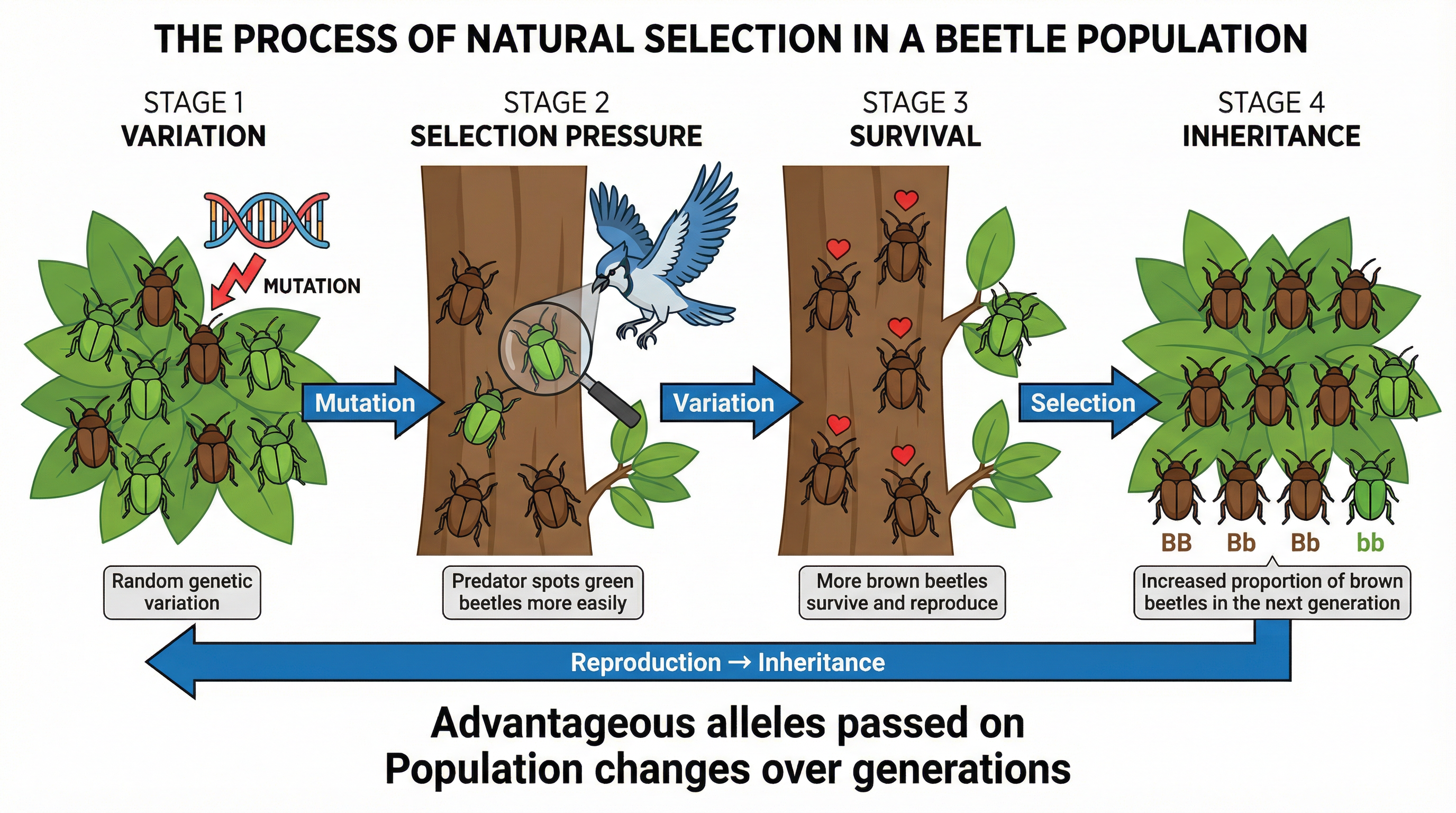
Natural selection is the process by which populations of organisms evolve over generations. It is driven by genetic variation and environmental pressures. The core idea is often summarised as 'survival of the fittest', but it's more nuanced than that. It means that individuals with characteristics best suited to their environment are more likely to survive, reproduce, and pass on their advantageous genes (alleles) to the next generation.
The Process:
- Mutation & Variation: Random mutations in DNA lead to genetic variation within a population. For example, some rabbits in a population may have alleles for thicker fur.
- Competition: Organisms produce more offspring than can survive, leading to competition for resources like food, water, and mates.
- Selection Pressure: The environment exerts a 'selection pressure'. In a cold environment, rabbits with thicker fur are better insulated and more likely to survive.
- Survival & Reproduction: Those with advantageous phenotypes (the observable characteristics) survive and reproduce more successfully.
- Inheritance: They pass the advantageous alleles (e.g., for thick fur) to their offspring.
- Adaptation: Over many generations, the frequency of these advantageous alleles increases in the population, and the population becomes better adapted to its environment.
Concept 2: Genetic Modification (Higher Tier)
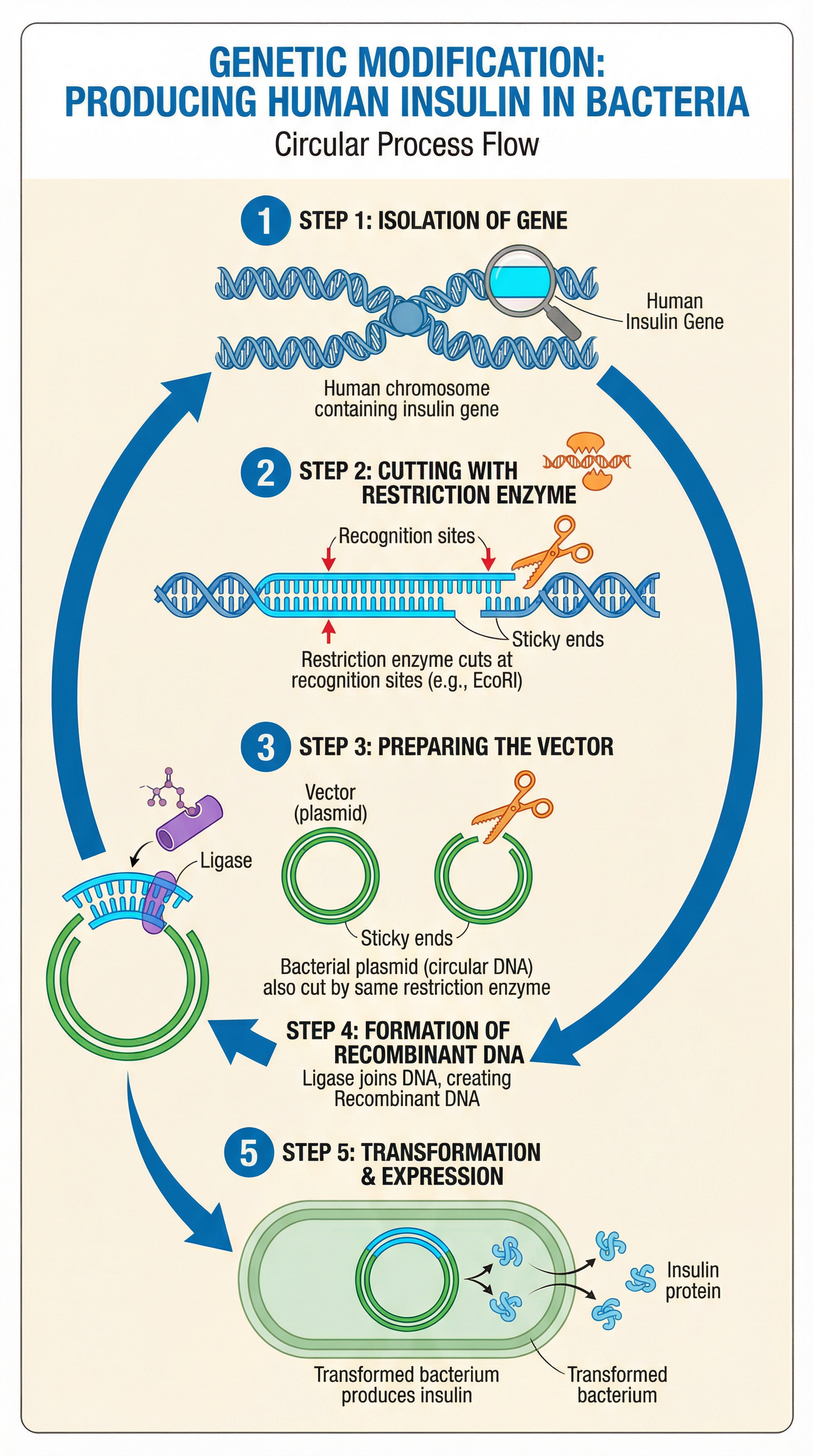
Genetic modification (GM) is the direct manipulation of an organism's genes using biotechnology. It involves transferring a gene from one species to another to give it a desired characteristic. This is a powerful tool with many applications, from medicine to agriculture.
The Process (e.g., producing human insulin in bacteria):
- Isolation: The desired gene (e.g., the human insulin gene) is identified and isolated from human DNA.
- Cutting: A restriction enzyme is used to cut the gene out, leaving specific unpaired sequences called 'sticky ends'.
- Vector Preparation: The same restriction enzyme is used to cut open a vector, which is a carrier for the gene. This is often a bacterial plasmid (a small, circular piece of DNA).
- Ligation: A ligase enzyme is used to join the isolated gene into the plasmid. The sticky ends of the gene and plasmid are complementary, allowing them to join together. This creates recombinant DNA.
- Transformation: The recombinant plasmid is inserted into a host organism, usually a bacterium. The bacterium is now 'transformed'.
- Replication & Production: The transformed bacteria are grown in large numbers. They reproduce rapidly, and as they do, they express the inserted gene, producing the desired protein (e.g., human insulin).
Mathematical/Scientific Relationships
There are no specific mathematical formulas in this topic. However, you may be asked to interpret data related to population changes over time, such as calculating percentage changes in the frequency of an allele or analysing graphs showing the growth of bacterial populations.
Practical Applications
- Antibiotic Resistance: A key real-world example of natural selection. Bacteria with random mutations that confer resistance to an antibiotic survive when the antibiotic is used, reproduce, and create a resistant population.
- Selective Breeding: Humans have used artificial selection for thousands of years to produce crops with higher yields or domestic animals with desirable traits (e.g., docile nature, high milk production). This is like natural selection, but humans are the selection pressure.
- GM Crops: Creating crops that are resistant to herbicides, pests, or drought. For example, 'Bt corn' produces a bacterial toxin that kills insect pests.
- Gene Therapy: The potential to treat genetic disorders by replacing faulty alleles with working ones. This is a developing area of medicine.