Pearson Edexcel · GCSE · Combined Science
Particle model
Master the fundamentals of thermal physics by understanding how particles behave when heated. This topic is crucial for the exam, featuring high-mark calculation questions on specific heat capacity and essential graph interpretation skills for changes of state.
- 5 min read
- 3 worked examples
- 5 practice questions
- 6 key terms
Study Notes

Overview
The Particle Model is a foundational concept in GCSE Combined Science. It explains the physical properties of matter by looking at the arrangement and movement of the tiny particles that make up everything around us. In this topic, we focus on thermal energy transfer: what happens when we heat substances up, and what happens when they change state (like ice melting into water).
This topic is incredibly important because it bridges theoretical physics with practical applications. You will be tested on your ability to apply mathematical formulas (like the specific heat capacity equation), interpret experimental data, and explain phenomena using the particle model. Examiners frequently use this topic to test your graphing skills and your understanding of required practicals.
Key Concepts
Concept 1: The Particle Model of Matter
All matter is made of particles. In a solid (like ice), particles are arranged in a regular, repeating lattice. They are held closely together by strong intermolecular forces and can only vibrate around fixed positions. In a liquid (like water), the particles are still close together, but the forces between them are weaker, allowing them to move around and slide past each other.
When you heat a substance, you are transferring thermal energy to it. This increases the kinetic energy of its particles, making them move or vibrate faster, which we measure as an increase in temperature.
Concept 2: Specific Heat Capacity ($c$)
Different materials require different amounts of energy to heat up. Specific Heat Capacity is defined as the amount of energy required to raise the temperature of 1 kg of a substance by 1 °C.
Water has a very high specific heat capacity (4200 \text{ J/kg}^{\circ}\text{C}). This means it takes a lot of energy to heat water up, but it also stores that heat well and cools down slowly. This is why water is used in central heating systems!
Example: If you want to heat 2 kg of water from 20 °C to 100 °C (to boil it for pasta), you need a massive amount of energy: Q = 2 \times 4200 \times 80 = 672,000 \text{ J}.
Concept 3: Changing State (Melting)
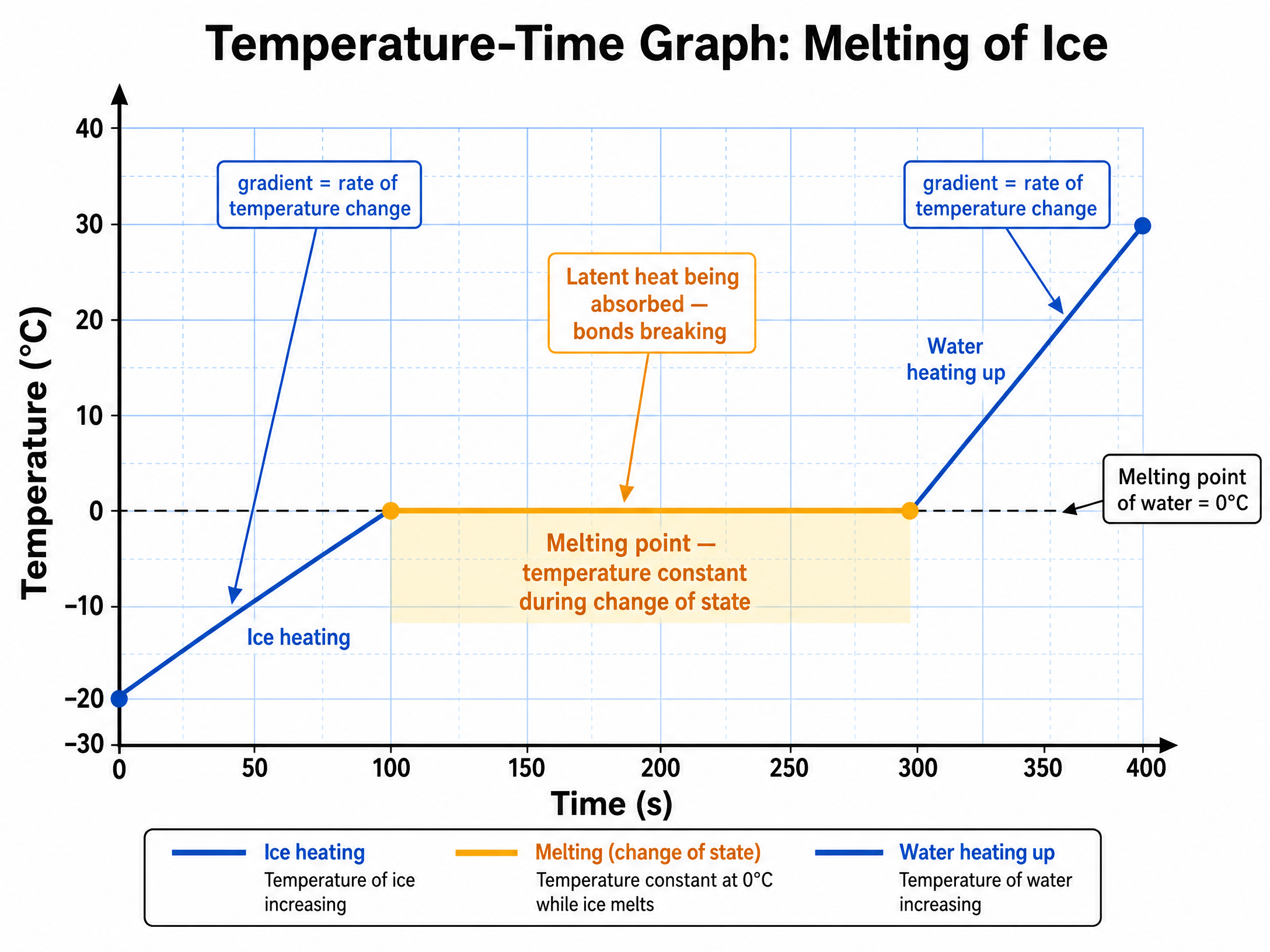
When you heat a solid like ice, its temperature rises until it hits its melting point (0 ^{\circ}\text{C} for water). At this exact temperature, something counter-intuitive happens: you keep adding heat, but the temperature stops rising.
Why does this work? Because the thermal energy is no longer being used to increase the kinetic energy of the particles. Instead, the energy is being used to break the intermolecular bonds holding the solid lattice together. This energy is known as latent heat. Only when all the ice has melted into liquid water will the temperature begin to rise again.
Mathematical/Scientific Relationships
The Specific Heat Capacity Equation
\Delta E = m \times c \times \Delta \theta
(Note: This is often written as Q = mc\Delta T)
- \Delta E (or Q) = Change in thermal energy, measured in Joules (J)
- m = Mass, measured in kilograms (kg) — CRITICAL: Always convert grams to kg!
- c = Specific heat capacity, measured in Joules per kilogram per degree Celsius (\text{J/kg}^{\circ}\text{C})
- \Delta \theta (or \Delta T) = Temperature change, measured in degrees Celsius (^{\circ}\text{C})
Must memorise? Check your specific exam board, but it is highly recommended you memorise this equation as it frequently appears in 3-5 mark calculation questions.
Required Practical: Measuring Specific Heat Capacity

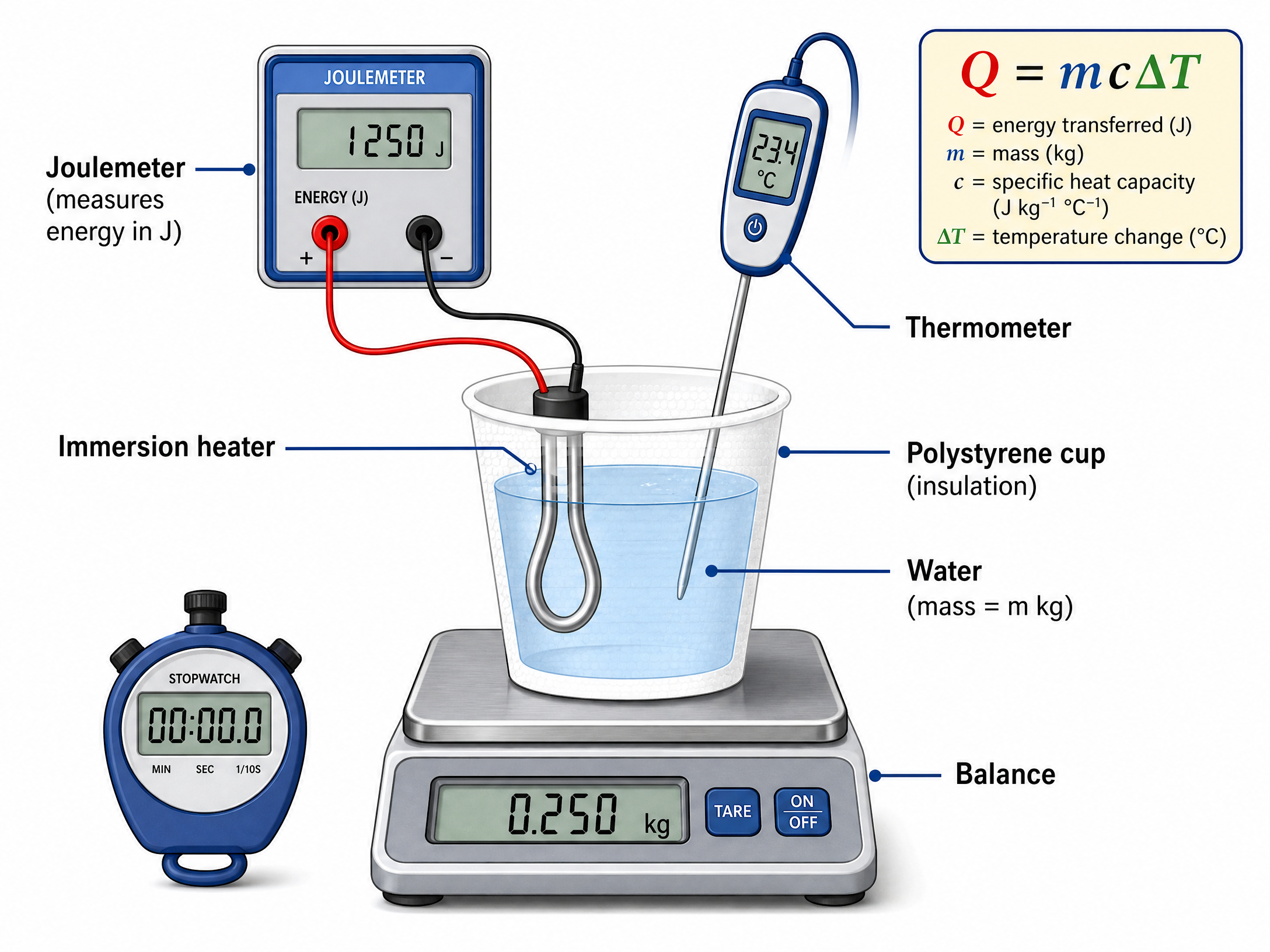
In this core practical, you determine the specific heat capacity of water (or a metal block).
- Measure the mass (m) of the water using a top-pan balance. (Remember to subtract the mass of the empty cup!).
- Place an immersion heater and a thermometer into the water.
- Record the initial temperature.
- Turn on the power supply and start a stopwatch.
- A joulemeter measures the total energy (\Delta E) supplied to the heater.
- After a set time (e.g., 10 minutes), record the final temperature and calculate the temperature change (\Delta \theta).
- Rearrange the equation to find c: c = \frac{\Delta E}{m \times \Delta \theta}
**Common Errors in the Practical:**The biggest issue is heat loss to the surroundings. Not all the energy from the heater goes into the water; some escapes into the air or heats the cup. Because \Delta E (energy supplied) is higher than the energy actually absorbed by the water, your calculated value for c will be higher than the true value. We use a polystyrene cup and a lid to insulate the water and reduce this error.
Interpreting Temperature-Time Graphs

Examiners love testing your ability to read these graphs.
- Sloping sections: The substance is in a single state (solid, liquid, or gas). The temperature is changing because the kinetic energy of the particles is increasing.
- Flat (horizontal) sections: The substance is changing state (melting or boiling). The temperature remains constant because the energy is being used to overcome intermolecular forces, not to increase kinetic energy.
Listen to the Podcast
Need to revise on the go? Listen to our 10-minute deep dive into this topic:
Visual Resources
2 diagrams and illustrations
Interactive Diagrams
2 interactive diagrams to visualise key concepts
Conceptual Flow Outline
Flowchart showing the energy transfers during the heating and melting of ice.
Conceptual Flow Outline
Concept map showing why heat loss causes errors in the Specific Heat Capacity practical.
Worked Examples
3 worked examples — open one to explore the question and available guidance.
Practice Questions
Test your understanding — click to reveal model answers
State the units for specific heat capacity.
Hint: Think about the equation: energy per mass per temperature.
An iron block has a mass of 2.0 kg. Its specific heat capacity is 450 J/kg°C. Calculate the energy needed to heat the block from 20 °C to 50 °C.
Hint: Calculate the temperature change first, then use Q = mcΔT.
A student uses a 50W heater to heat a metal block for 10 minutes. The temperature rises by 15°C. The mass of the block is 1 kg. Calculate the specific heat capacity of the block.
Hint: You need to calculate the total energy first using Energy = Power × Time. Remember time must be in seconds!
Describe the movement and arrangement of particles in a solid.
Hint: Think about a block of ice.
A student plots a temperature-time graph for heating ice. Explain why the graph is horizontal at 0°C.
Hint: What is the heat energy doing if it isn't raising the temperature?