Pearson Edexcel · GCSE · Combined Science
Waves
Master the fundamental properties of waves, from the oscillation of particles to the calculation of wave speed. This topic is essential for understanding everything from sound and light to seismic activity, and is heavily tested on the equation sheet.
- 4 min read
- 3 worked examples
- 5 practice questions
- 6 key terms
Study Notes

Overview
Welcome to Topic 4: Waves. This topic is a cornerstone of Combined Science, exploring how energy and information travel across the universe without the transfer of matter. From the light hitting your eyes to the sound of your favourite podcast (listen below!), waves are everywhere.
Understanding waves is crucial because it bridges the gap between simple motion and complex phenomena like the electromagnetic spectrum and radioactivity. Examiners love testing this topic because it combines visual interpretation (reading wave diagrams) with mathematical skills (applying the wave speed equation). You can expect questions asking you to label diagrams, calculate frequencies, and explain what happens when a wave crosses a boundary.
Key Concepts
Concept 1: The Nature of Waves
A wave is a disturbance that transfers energy and information from one place to another. The most important rule to remember for your exam is that waves do not transfer matter.
Think of a buoy floating on the sea. As a water wave passes, the buoy bobs up and down, but it doesn't travel towards the shore with the wave. The water particles are just oscillating (vibrating) around a fixed equilibrium position. It is the energy that travels towards the shore.
Concept 2: Transverse vs Longitudinal Waves
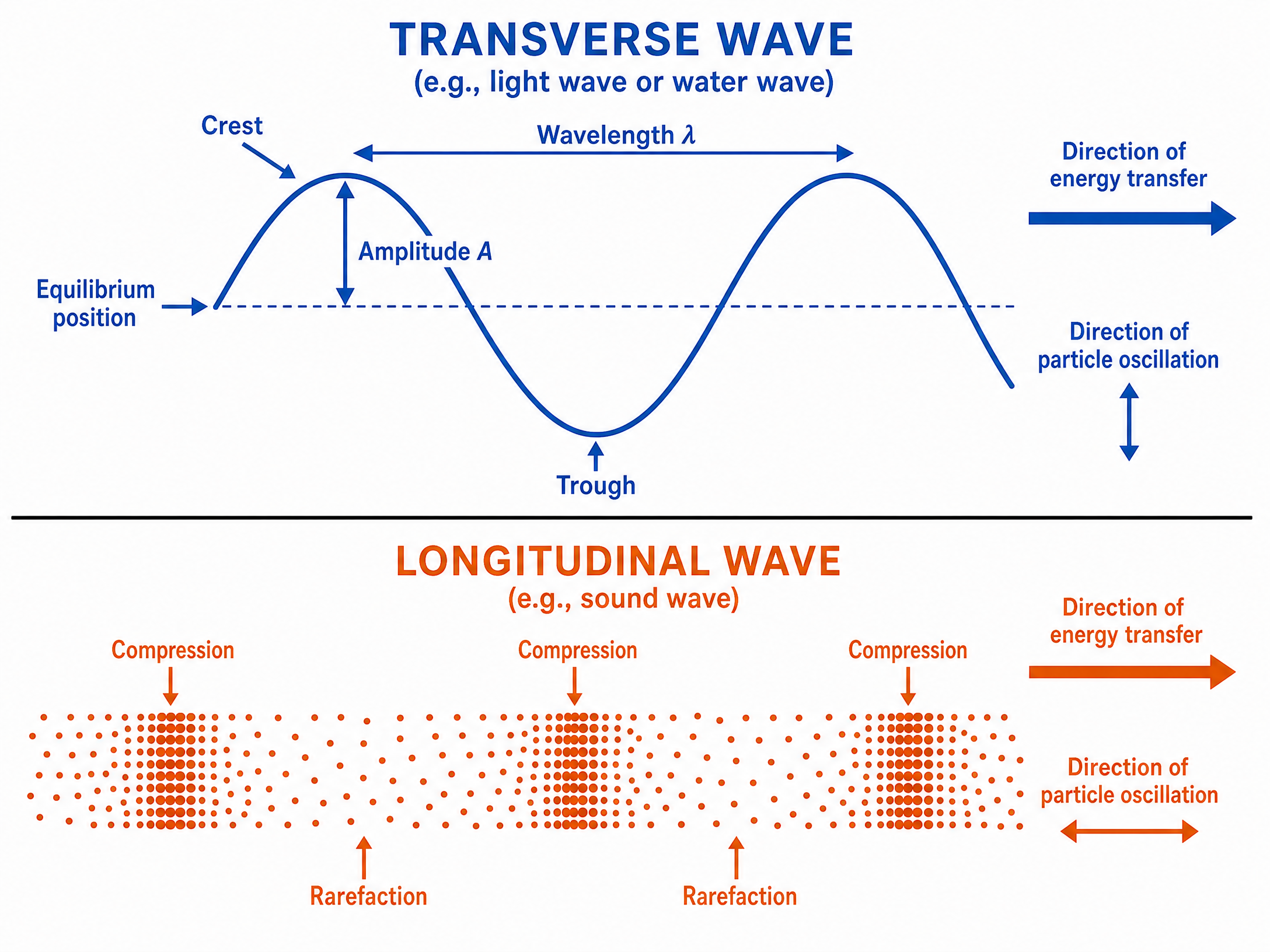
Waves are categorised into two main types based on how their particles oscillate relative to the direction of energy transfer.

Transverse WavesIn a transverse wave, the particles oscillate perpendicular (at right angles) to the direction of energy transfer. If the wave moves horizontally, the particles move vertically up and down.
- Examples: Light waves, all electromagnetic waves, ripples on water, seismic S-waves.
Longitudinal WavesIn a longitudinal wave, the particles oscillate parallel (in the same direction) to the direction of energy transfer. This creates regions where particles are squashed together (compressions) and regions where they are spread apart (rarefactions).
- Examples: Sound waves, ultrasound, seismic P-waves.
Concept 3: Wave Behaviour at Boundaries
When a wave reaches a boundary between two different materials (media), several things can happen:
- Absorption: The wave's energy is taken in by the material (e.g., curtains absorbing sound).
- Transmission: The wave passes through the material (e.g., light through a window).
- Reflection: The wave bounces back (e.g., an echo or a mirror).
- Refraction: The wave changes speed and direction as it crosses the boundary.
Crucial Exam Point on Refraction: When a wave refracts, its speed changes because the new medium has a different density. Because the speed changes, the wavelength must also change. However, the frequency remains constant. The source of the wave hasn't changed, so the number of waves produced per second stays the same.
Mathematical/Scientific Relationships

The Wave Speed Equation (Must Memorise)
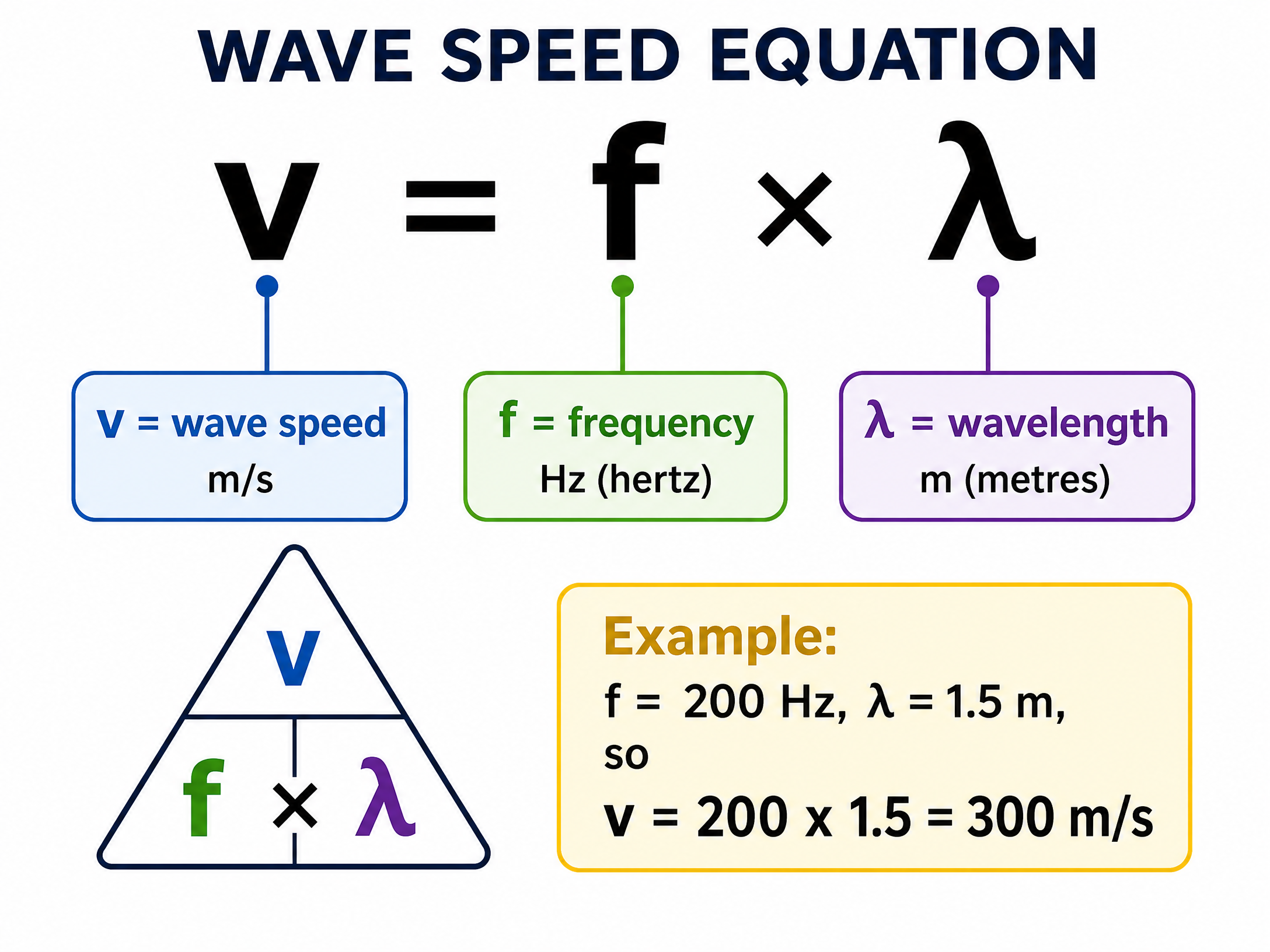
v = f \times \lambda
- v = wave speed in metres per second (m/s)
- f = frequency in hertz (Hz)
- \lambda = wavelength in metres (m)
This equation links the speed of the wave to how many waves pass per second and how long each wave is. You must be able to rearrange this equation.
- To find frequency: f = \frac{v}{\lambda}
- To find wavelength: \lambda = \frac{v}{f}
The Distance-Time Equation (Must Memorise)
v = \frac{x}{t}
- v = wave speed in metres per second (m/s)
- x = distance in metres (m)
- t = time in seconds (s)
Use this equation when you are given the total distance a wave has travelled (like a sound wave echoing off a wall) and the time it took.
Period and Frequency (Must Memorise)
T = \frac{1}{f}
- T = period in seconds (s)
- f = frequency in hertz (Hz)
Practical Applications
Understanding waves allows us to use ultrasound for medical imaging (longitudinal waves reflecting off boundaries inside the body) and to design earthquake-resistant buildings by studying seismic P-waves and S-waves.
Visual Resources
2 diagrams and illustrations
Interactive Diagrams
2 interactive diagrams to visualise key concepts
Conceptual Flow Outline
Flowchart showing the process of refraction at a boundary.
Conceptual Flow Outline
Concept map comparing wave types and their oscillation relative to energy transfer.
Worked Examples
3 worked examples — open one to explore the question and available guidance.
Practice Questions
Test your understanding — click to reveal model answers
A radio station broadcasts at a frequency of 100 MHz. The speed of radio waves is 300,000,000 m/s. Calculate the wavelength of the radio waves. (4 marks)
Hint: Check your units! What does the 'M' in MHz stand for?
Explain why a sound wave cannot travel through a vacuum. (2 marks)
Hint: Think about what a sound wave actually is and what it needs to oscillate.
A light wave travels from air into a glass block. State what happens to the speed, frequency, and wavelength of the light wave. (3 marks)
Hint: Which property is determined entirely by the source of the wave?
A wave has a period of 0.04 seconds. Calculate its frequency. (2 marks)
Hint: Use the equation relating period and frequency.
Figure 1 shows a ripple tank used to investigate water waves. Describe how the student could determine the frequency of the ripples. (3 marks)
Hint: How do you define frequency? How can you measure that practically without losing count?