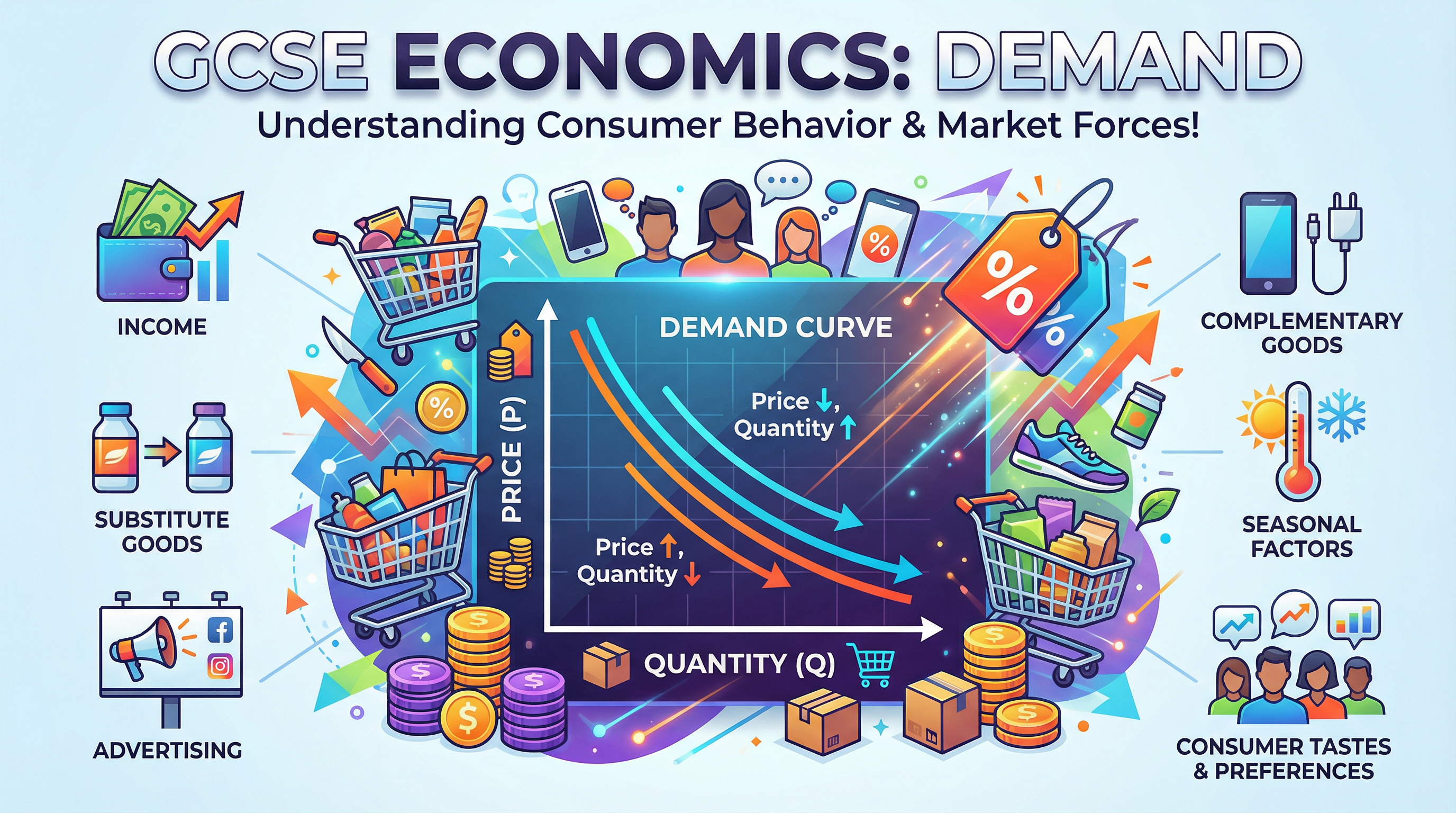
Demand — Edexcel GCSE study guide illustration

    Demand

    Edexcel
    GCSE
    Economics

    Unlock the secrets of consumer behaviour with this deep dive into the economic concept of Demand. This guide is laser-focused on the Edexcel GCSE specification, providing the essential knowledge, diagrams, and exam technique needed to distinguish your 'movements' from your 'shifts' and secure top marks.

    4
    Min Read
    3
    Examples
    5
    Questions
    6
    Key Terms
    🎙 Podcast Episode
    Demand
    0:00-0:00

    Study Notes

    An overview of the key concepts related to Demand.

    Overview

    Welcome to the essential Edexcel GCSE Economics guide on Demand. This topic is a cornerstone of microeconomics, exploring how consumers make decisions and how markets function. Examiners expect candidates to demonstrate a precise understanding of the difference between a change in price causing a 'movement along' the demand curve and a non-price factor causing a 'shift' of the entire curve. This guide will equip you with the core knowledge, from the fundamental Law of Demand to the analytical tool of Price Elasticity of Demand (PED). You will learn how to draw and interpret demand-related diagrams accurately, apply your knowledge to real-world case studies, and construct evaluative arguments that access the highest mark bands. Mastering demand is not just about learning definitions; it's about understanding the dynamic forces that shape the economy around you.

    The Law of Demand and the Demand Curve

    What it is: The Law of Demand states that, ceteris paribus (meaning 'all other things being equal'), as the price of a good or service falls, the quantity demanded will increase, and vice versa. This inverse relationship is fundamental to all market analysis.

    Why it matters: This concept is the building block for understanding how markets work. It is represented visually by the demand curve, a downward-sloping line on a graph. Marks are consistently awarded for drawing this diagram correctly, with 'Price' on the vertical (Y) axis and 'Quantity' on the horizontal (X) axis. Forgetting to label your axes is a common mistake that instantly loses marks.

    Movements vs. Shifts: The Critical Distinction

    This is the area where candidates most often lose marks. A clear understanding here is essential for a high grade.

    Movements Along the Demand Curve

    What happens: A change in the price of the good itself causes a movement along the existing demand curve. A price decrease leads to an extension or expansion in quantity demanded (a move down the curve). A price increase leads to a contraction in quantity demanded (a move up the curve).

    Examiner Language: Use the phrase 'change in quantity demanded' when describing a movement.
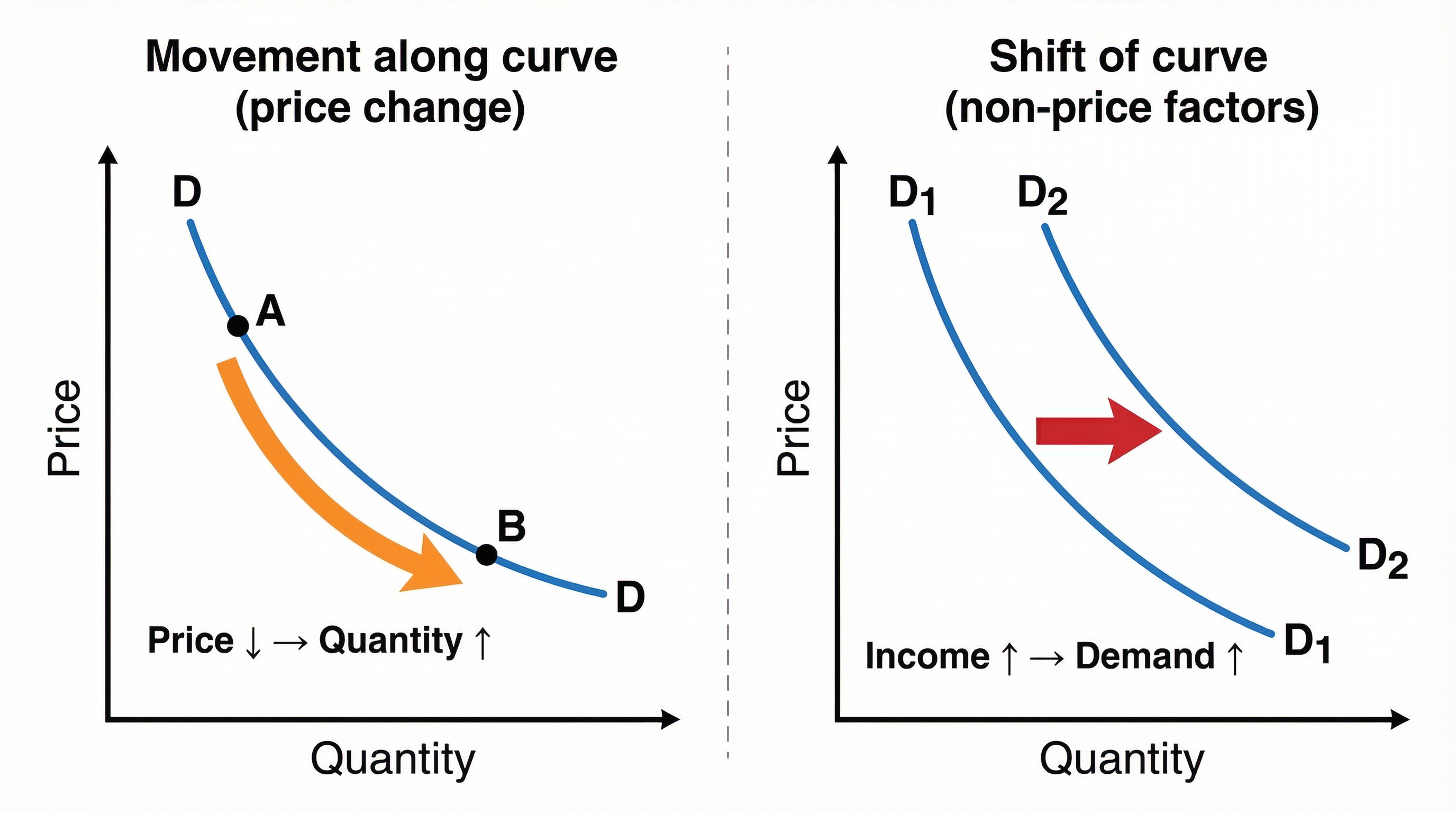
    A movement is caused by a price change; a shift is caused by a non-price factor.

    Shifts of the Demand Curve

    What happens: A change in any factor other than price that affects demand will cause the entire demand curve to shift to a new position. A shift to the right indicates an increase in demand at every price. A shift to the left indicates a decrease in demand at every price.

    Examiner Language: Use the phrase 'change in demand' when describing a shift.

    Specific Knowledge: You must know the non-price factors that cause shifts. The mnemonic PASIFIC is an excellent memory hook for this.
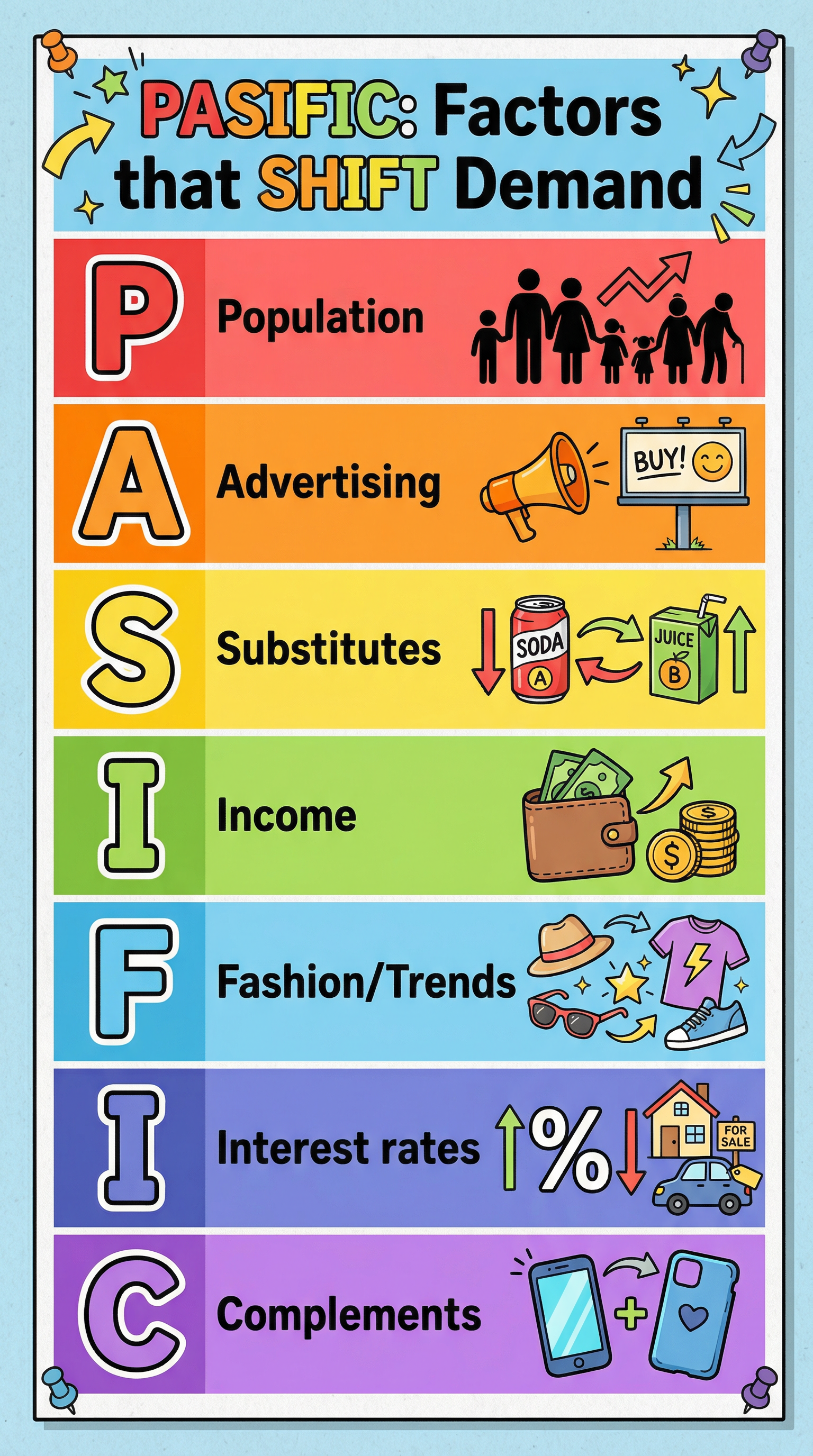
    Use PASIFIC to remember the key non-price determinants of demand.

    Price Elasticity of Demand (PED)

    What it is: PED measures the responsiveness of quantity demanded to a change in price. It's a crucial tool for firms making pricing decisions and for governments considering taxes.

    The Formula: You must state the formula to gain method marks.
    PED = % Change in Quantity Demanded / % Change in Price

    Interpreting the Values:

    • PED > 1 (Elastic): Quantity demanded is very responsive to price changes (e.g., luxury goods, items with many substitutes).
    • PED < 1 (Inelastic): Quantity demanded is not very responsive to price changes (e.g., necessities, addictive goods).
    • PED = 1 (Unit Elastic): Quantity demanded changes by the exact same percentage as the price.
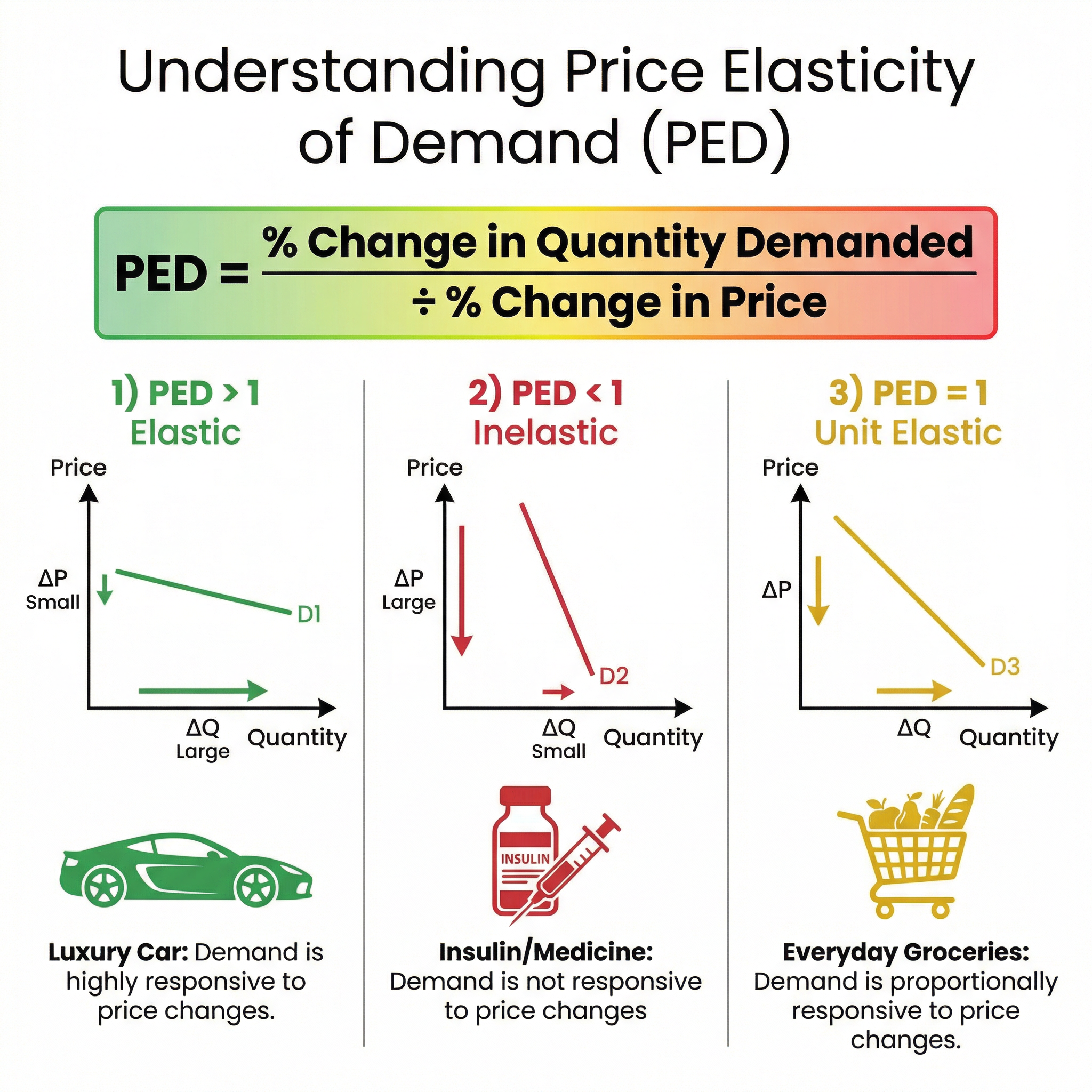
    Understanding whether demand is elastic, inelastic, or unit elastic.

    Podcast: Mastering Demand

    For an in-depth audio breakdown of these concepts, exam tips, and a quick-fire quiz, listen to our dedicated podcast episode.

    Listen to our expert tutor break down the topic of Demand.

    Worked Examples

    3 detailed examples with solutions and examiner commentary

    Practice Questions

    Test your understanding — click to reveal model answers

    Q1

    Explain, with the aid of a diagram, the effect of a fall in the price of tea on the market for coffee. (9 marks)

    9 marks
    standard

    Hint: First, identify the relationship between tea and coffee. Then, consider how this affects the demand for coffee and show it on a diagram.

    Q2

    A business reduces the price of its product from £50 to £40, and its weekly sales rise from 1,000 to 1,500 units. Is the demand for this product price elastic or inelastic? You must show your calculations. (4 marks)

    4 marks
    standard

    Hint: Use the PED formula. Calculate the percentage change in quantity and the percentage change in price first.

    Q3

    Explain two factors that could cause an increase in demand for UK holidays. (6 marks)

    6 marks
    easy

    Hint: Think about the PASIFIC mnemonic. Pick two factors and explain how they would lead to a rightward shift in the demand curve.

    Q4

    Using a diagram, explain the difference between a contraction in demand and a decrease in demand. (6 marks)

    6 marks
    hard

    Hint: This question tests the core 'movement vs. shift' distinction. Be precise with your language and diagrams.

    Q5

    Evaluate the likely price elasticity of demand for cigarettes. (12 marks)

    12 marks
    hard

    Hint: Consider the factors that determine PED: Number of substitutes, necessity vs luxury, and addictiveness.

    Key Terms

    Essential vocabulary to know

    More Economics Study Guides

    View all

    Unemployment

    Edexcel
    GCSE

    This guide provides a comprehensive, exam-focused breakdown of Unemployment for Edexcel GCSE Economics. It covers the essential definitions, types, measurements, and impacts that are crucial for achieving top marks, supported by multi-modal assets to deepen understanding.

    Application of Economic Theory to Real-World Scenarios

    Edexcel
    GCSE

    This study guide for Edexcel GCSE Economics (1EC0) focuses on the critical skill of applying economic theory to real-world scenarios. It provides a comprehensive toolkit to help students move beyond generic definitions and develop the deep, contextual analysis required to achieve top marks.

    Economic Growth

    OCR
    GCSE

    This study guide provides a comprehensive overview of Economic Growth for OCR GCSE Economics. It is designed to be exam-focused, helping students understand key concepts, develop analytical skills, and secure maximum marks by mastering the content and exam techniques required by examiners.

    Essay Writing and Structured Answers

    OCR
    GCSE

    Master the art of high-scoring essays for OCR GCSE Economics. This guide breaks down the techniques examiners want to see, from nailing Assessment Objectives to building powerful analytical arguments, ensuring you can turn your economic knowledge into top marks.

    Government Policies to Correct Market Failure

    OCR
    GCSE

    Master OCR GCSE Economics with this guide to government policies and market failure. Learn how taxes, subsidies, and regulations are used to correct market failures, and gain the skills to analyse and evaluate their effectiveness in exam conditions.

    Monetary Policy (Interest Rates, Quantitative Easing)

    OCR
    GCSE

    This study guide delves into the critical role of Monetary Policy in the UK economy, as required by the OCR GCSE Economics specification. It explores how the Bank of England uses interest rates and Quantitative Easing to manage inflation, providing you with the essential knowledge and analytical skills to excel in your exams.