OCR · GCSE · Economics
Demand and Factors Influencing Demand
Master the core principles of demand for your OCR GCSE Economics exam. This guide breaks down the crucial distinction between movements along the demand curve and shifts of the curve, equipping you with the analytical skills and specific knowledge needed to secure top marks.
- 4 min read
- 3 worked examples
- 3 practice questions
- 9 key terms
Study Notes

Overview
In OCR GCSE Economics (J205), understanding demand is not just about knowing definitions; it's about applying economic principles to real-world scenarios. This topic explores the fundamental relationship between the price of a good and the quantity consumers are willing and able to buy. Examiners expect candidates to precisely differentiate between a movement along the demand curve, caused exclusively by a change in the good's own price, and a shift of the entire curve, caused by a change in any other factor. A firm grasp of the 'ceteris paribus' assumption is essential for isolating these effects. This guide will provide the logical chains of reasoning and diagrammatic accuracy required to analyse market behaviour and impress examiners.
The Law of Demand
The Law of Demand states that there is an inverse relationship between the price of a good and the quantity demanded, assuming 'ceteris paribus' (all other factors remain constant).
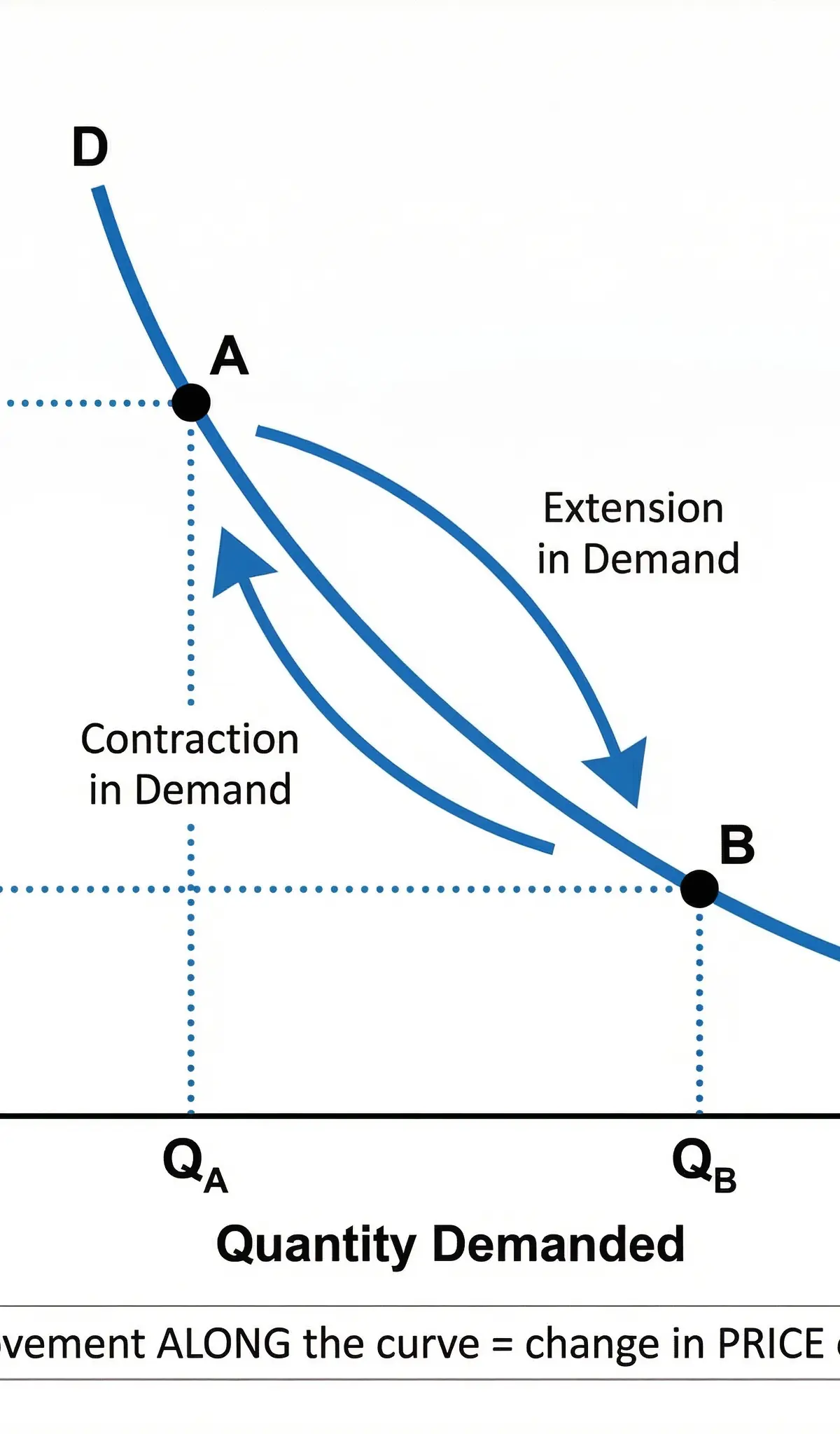
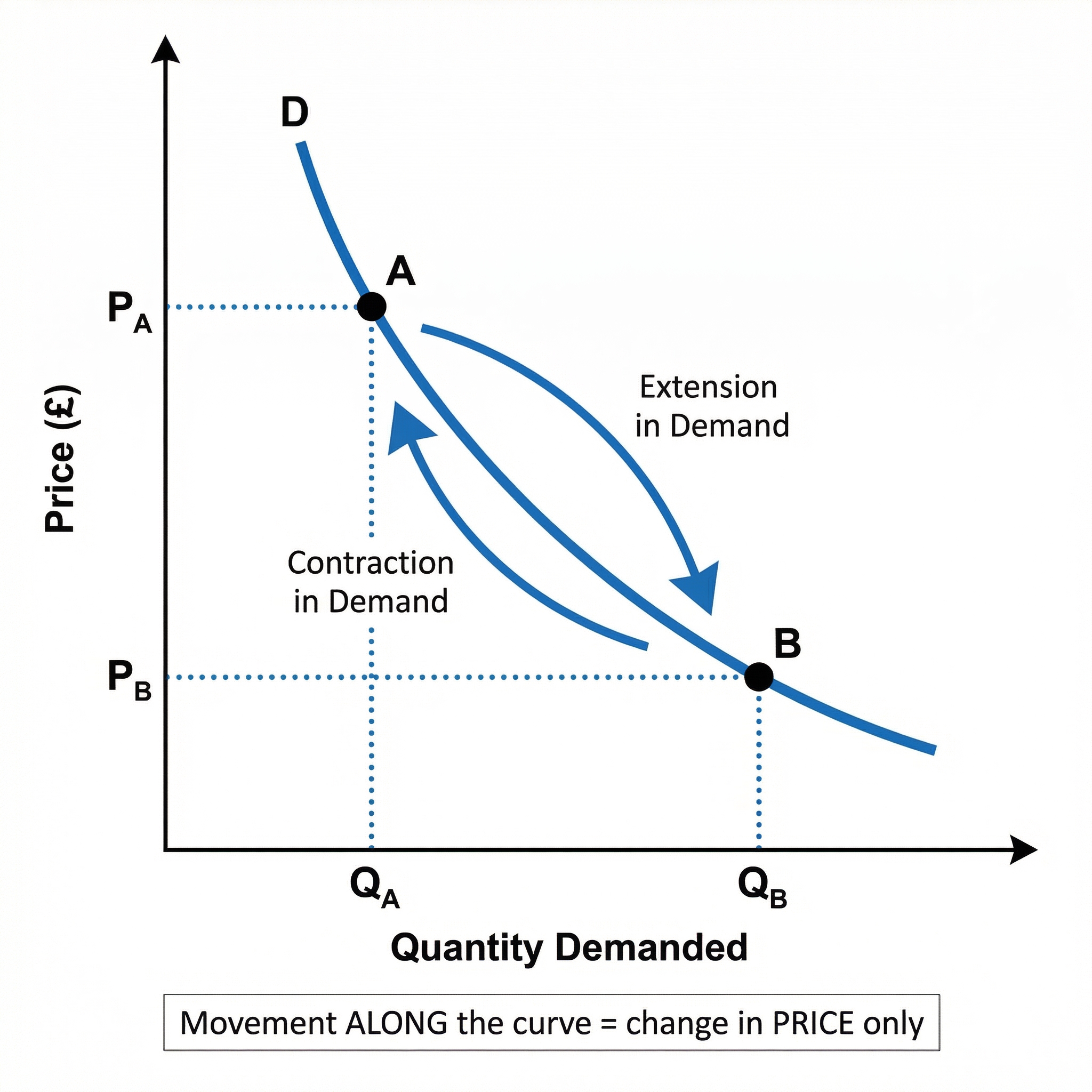
- When price increases, quantity demanded decreases. This is called a contraction of demand.
- When price decreases, quantity demanded increases. This is called an extension of demand.
This relationship is shown by a downward-sloping demand curve. Any change in the price of the good itself results in a movement along this curve.
Factors Causing a Shift in Demand
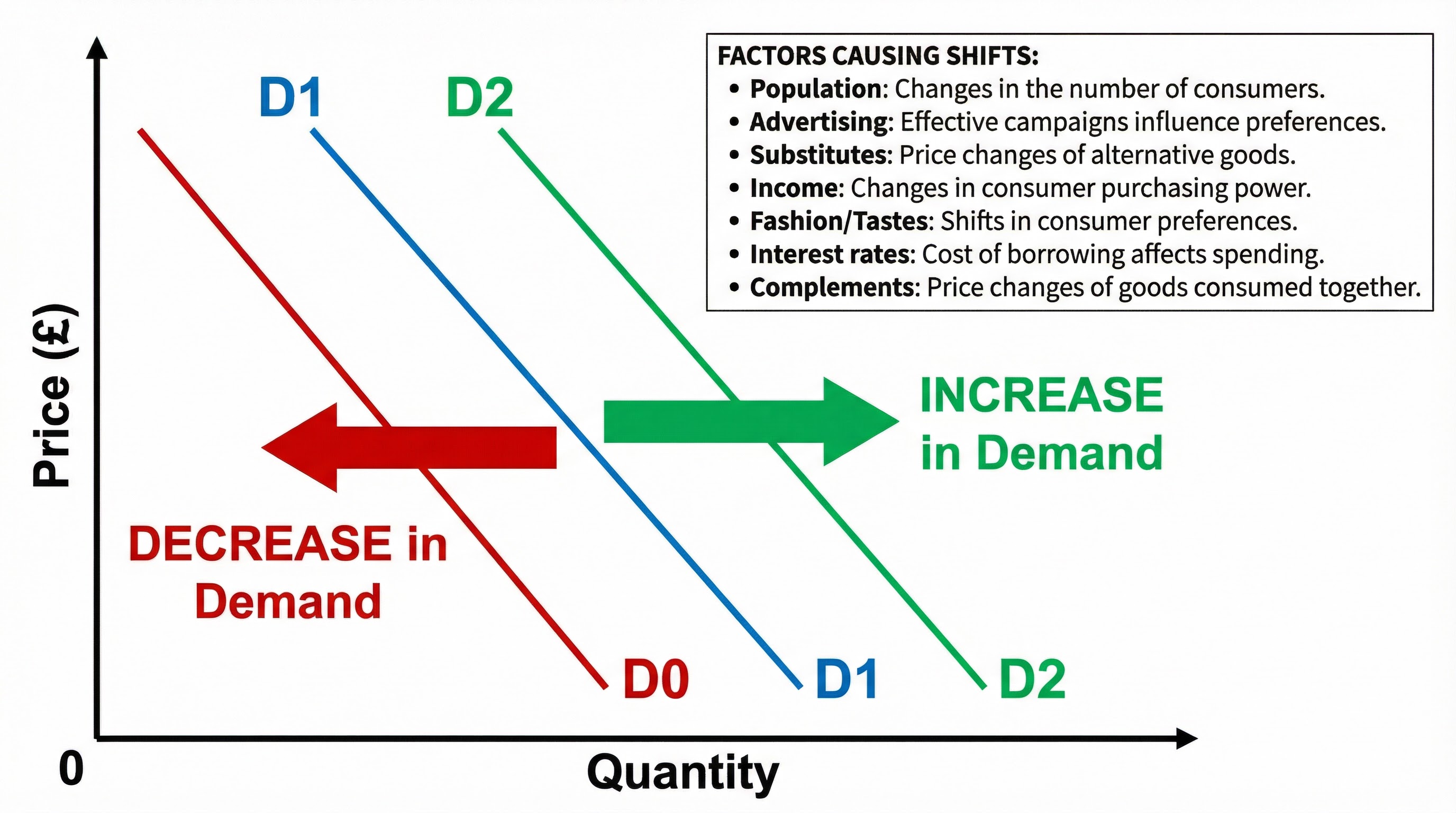
A change in any factor other than price will cause the entire demand curve to shift. An increase in demand is a shift to the right (more is demanded at every price). A decrease in demand is a shift to the left (less is demanded at every price).

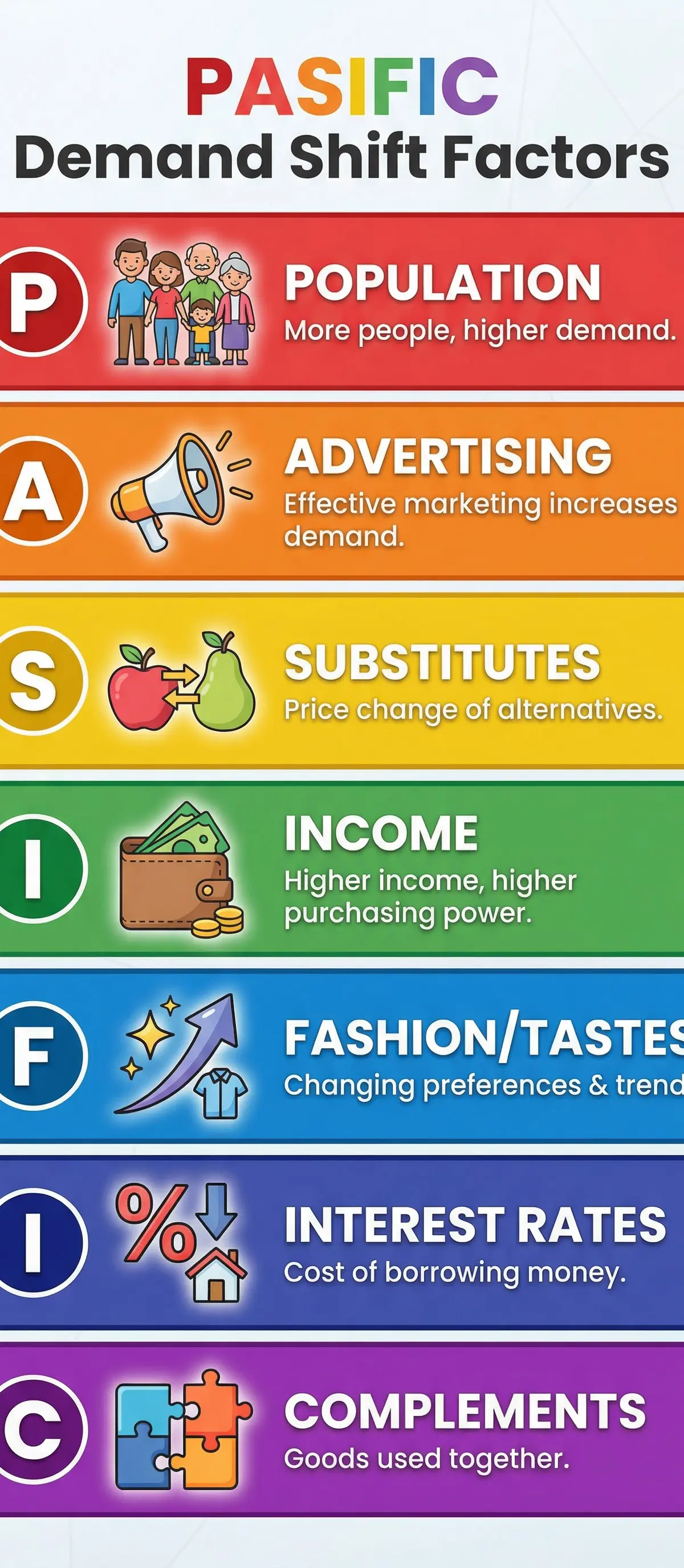
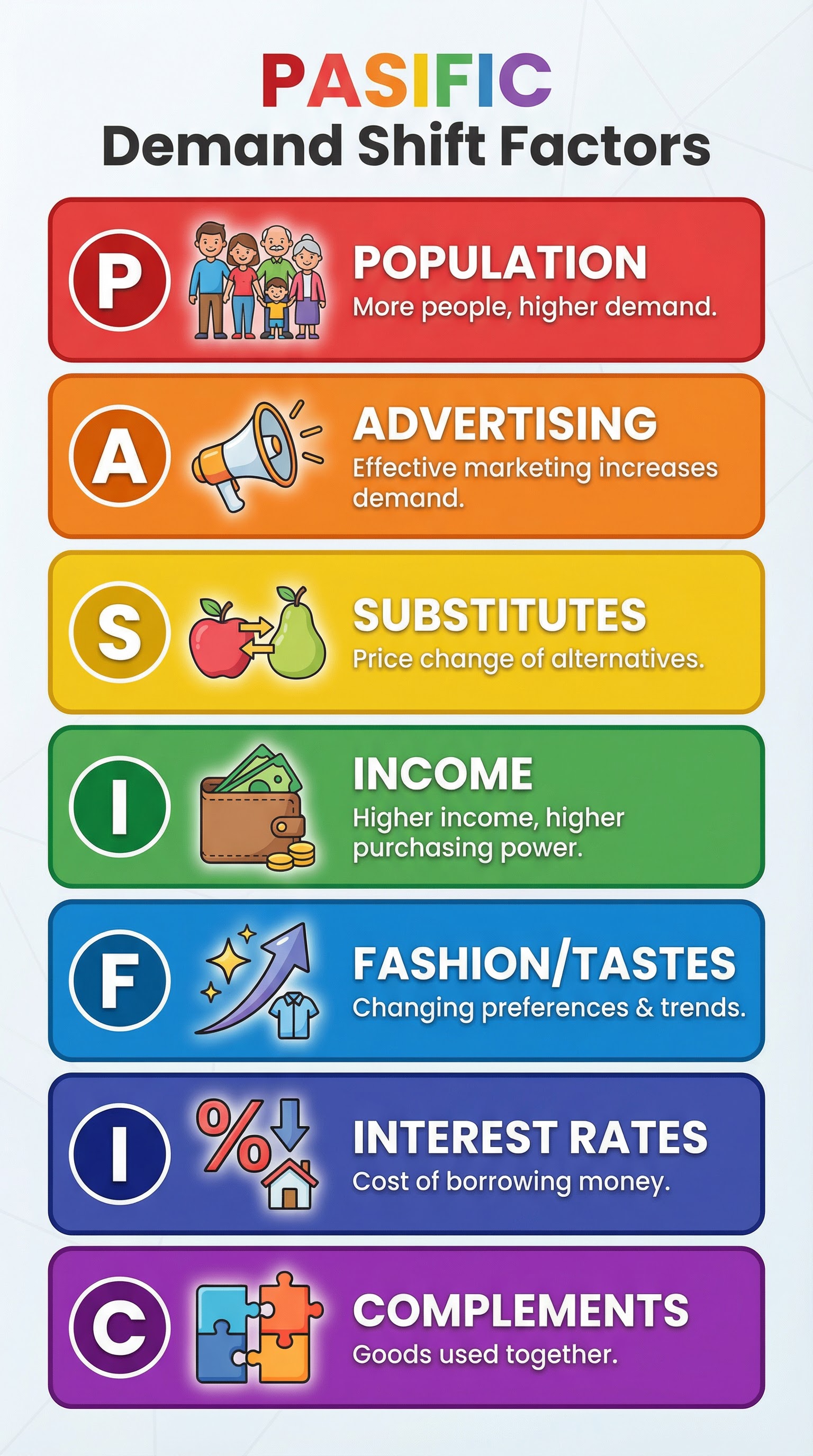
To remember these factors, use the acronym PASIFIC:
- Population: A growing population increases the number of consumers, shifting demand right.
- Advertising: Effective marketing campaigns can increase consumer desire for a product, shifting demand right.
- Substitutes: These are alternative products. If the price of a substitute (e.g., Pepsi) rises, demand for the original good (e.g., Coca-Cola) will increase (shift right).
- Income: For normal goods, as income rises, people can afford more, so demand shifts right. For inferior goods (e.g., budget brands), as income rises, demand shifts left as consumers switch to higher-quality alternatives.
- Fashion & Tastes: Trends and changing consumer preferences can significantly impact demand. For example, increased health consciousness has decreased demand for sugary drinks.
- Interest Rates: A fall in interest rates makes borrowing cheaper, increasing demand for expensive items bought on credit (e.g., cars, houses).
- Complements: These are goods used together (e.g., printers and ink cartridges). If the price of a complement falls, demand for the related good will increase (shift right).
Worked Examples
3 worked examples — open one to explore the question and available guidance.
Practice Questions
Test your understanding — click to reveal model answers
Explain, using a diagram, how a fall in the price of cinema tickets might affect the quantity demanded. (6 marks)
Hint: Is this a movement or a shift? Remember to use the correct terminology for a price decrease.
Explain two factors that could cause a decrease in the demand for holidays abroad. (8 marks)
Hint: Use the PASIFIC acronym to identify two non-price factors and build a chain of reasoning for each.
Evaluate whether a rise in income is the most important factor influencing the demand for new cars. (12 marks)
Hint: Analyse why income is important, but then evaluate its importance relative to other factors from PASIFIC. Consider the type of car.
Test your understanding of Demand and Factors Influencing Demand
Active recall beats re-reading. Take an instant quiz now to test what you’ve learned and lock it into long-term memory.
7 days Premium · Then free forever · No card, no charge