OCR · GCSE · Economics
Unemployment and its Causes
This study guide provides a comprehensive analysis of unemployment and its causes, a core topic for OCR GCSE Economics (J205). It is designed to equip candidates with the precise knowledge and analytical skills required to achieve high marks, focusing on measurement methods, the four main types of unemployment, and the crucial concept of derived demand for labour.
- 8 min read
- 3 worked examples
- 5 practice questions
- 8 key terms
Study Notes

Overview
Unemployment is a central theme in macroeconomics and a topic that examiners frequently test. For the OCR GCSE Economics specification (J205), a thorough understanding of unemployment is not just about knowing the definition; it requires candidates to differentiate between the two key UK measures, analyse the causes and consequences of the four main types of unemployment, and apply the concept of derived demand for labour in their explanations. This guide will break down these complex areas, providing clear explanations, worked examples, and examiner insights to help you move beyond simple descriptions and into the high-level analysis that secures top grades. We will explore the real-world impact of unemployment on individuals, firms, and the government, ensuring you have the specific knowledge needed to support your arguments in the exam.
Measuring Unemployment
Examiners award significant credit for candidates who can clearly distinguish between the two primary methods used to measure unemployment in the UK. Understanding their differences, and why they produce different figures, is crucial for AO2 application marks.
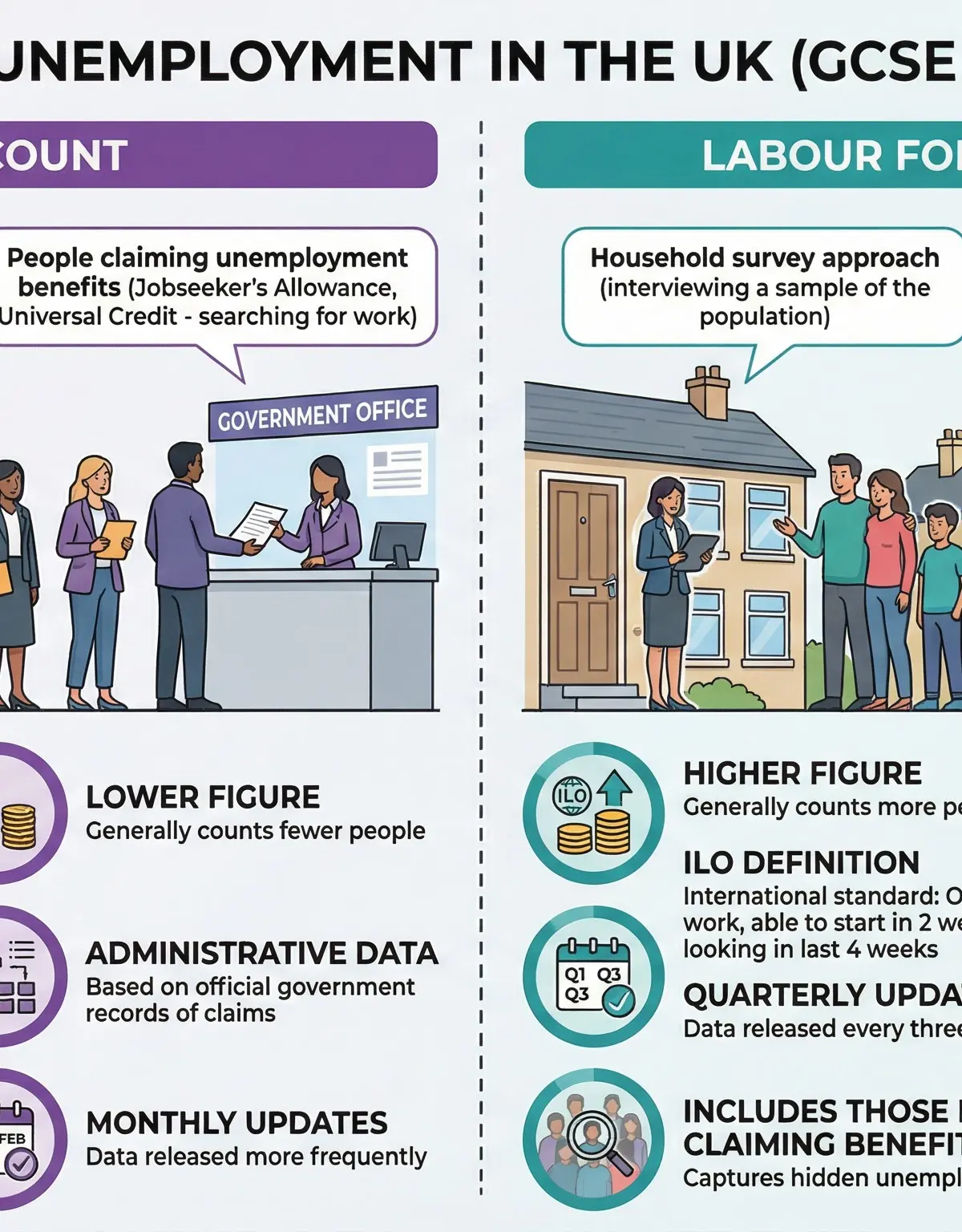
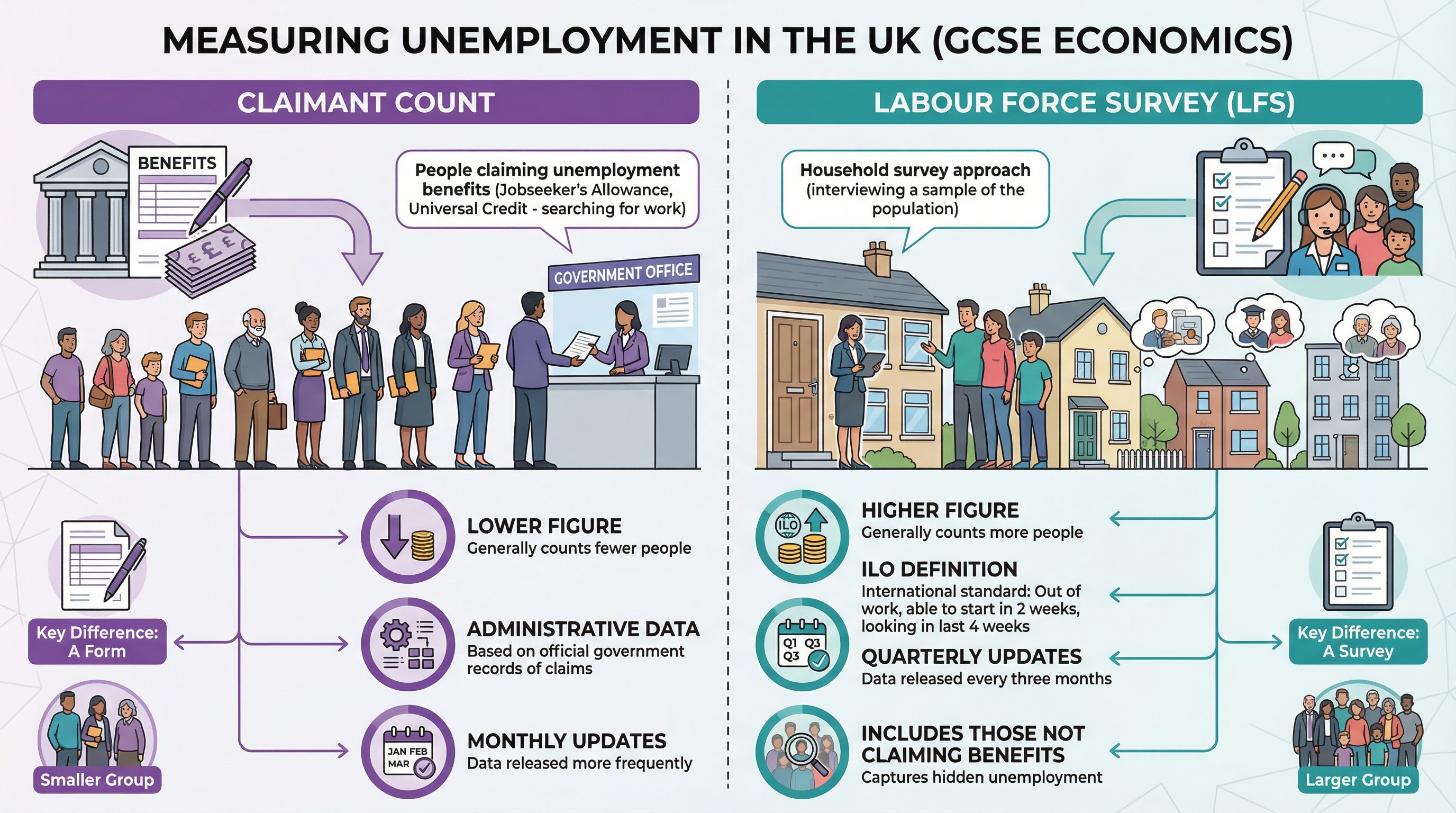
The Claimant Count
What it is: The Claimant Count is a measure of everyone who is claiming unemployment-related benefits. Historically, this was the Jobseeker's Allowance (JSA), but it now includes individuals who are required to seek work as part of their Universal Credit claim.
How it works: It is an administrative measure, meaning it is based on the records of who is receiving benefits from the government. This makes it quick and cheap to collect, with data released monthly.
Limitations: The Claimant Count typically produces a lower figure for unemployment than the Labour Force Survey. This is because some people who are unemployed do not claim benefits. They might be ineligible, not know they are eligible, or feel there is a stigma attached to claiming. Therefore, it can understate the true level of unemployment.
The Labour Force Survey (LFS)
What it is: The LFS is a quarterly survey of households in the UK, conducted by the Office for National Statistics (ONS). It is the official measure of unemployment in the UK and is used for international comparisons.
How it works: It uses the International Labour Organisation (ILO) definition of unemployment. To be counted as unemployed, an individual must be:
- Willing to work.
- Able to start work within two weeks.
- Actively seeking work in the last four weeks.
Strengths: The LFS is considered more accurate than the Claimant Count because it captures people who are unemployed but not claiming benefits. This is why the LFS figure is usually higher. However, as it is a survey, it is subject to sampling errors and is more expensive and slower to compile than the Claimant Count.
The Four Types of Unemployment
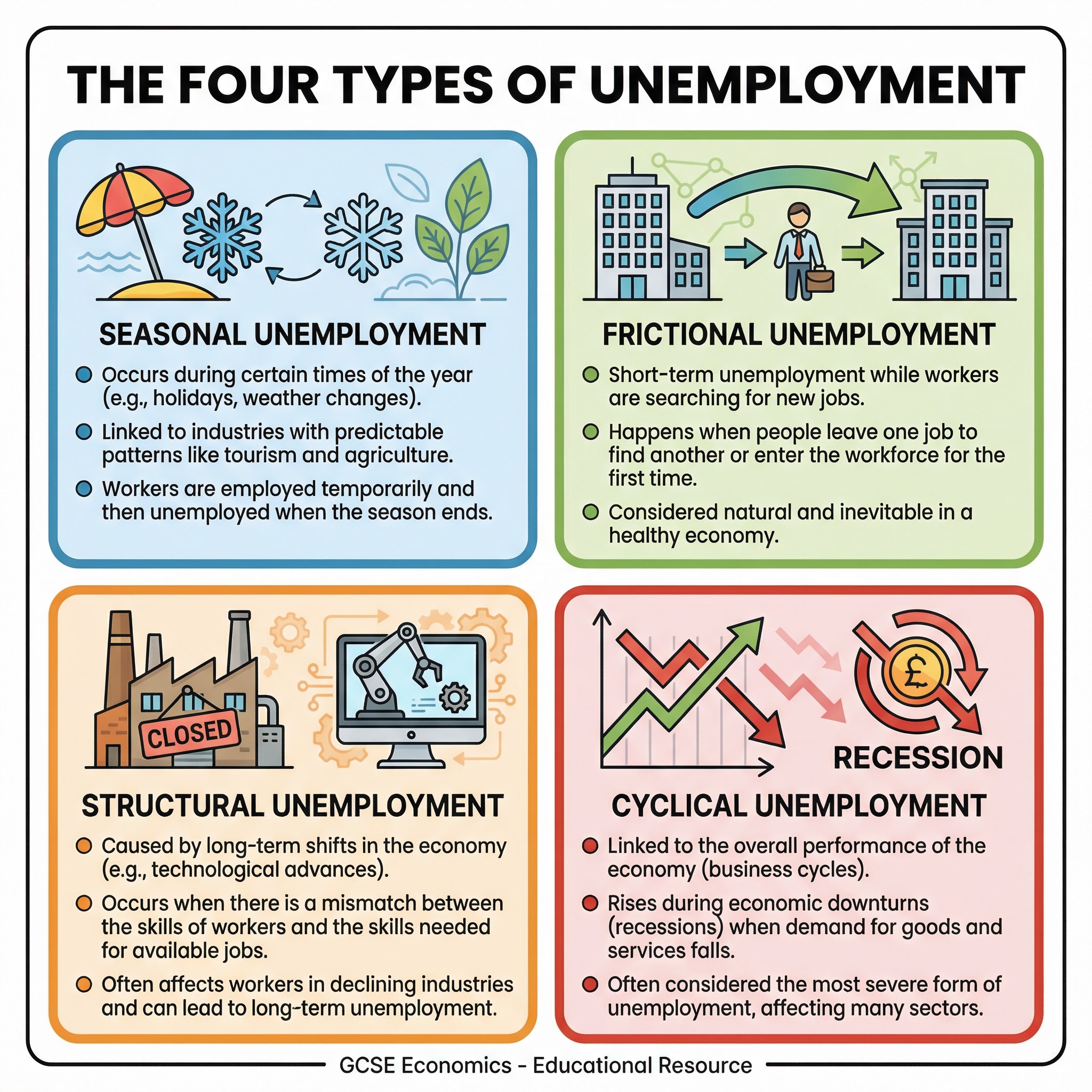
Candidates must be able to identify, explain, and give examples of the four main types of unemployment. Marks are awarded for linking the type of unemployment to its specific cause.
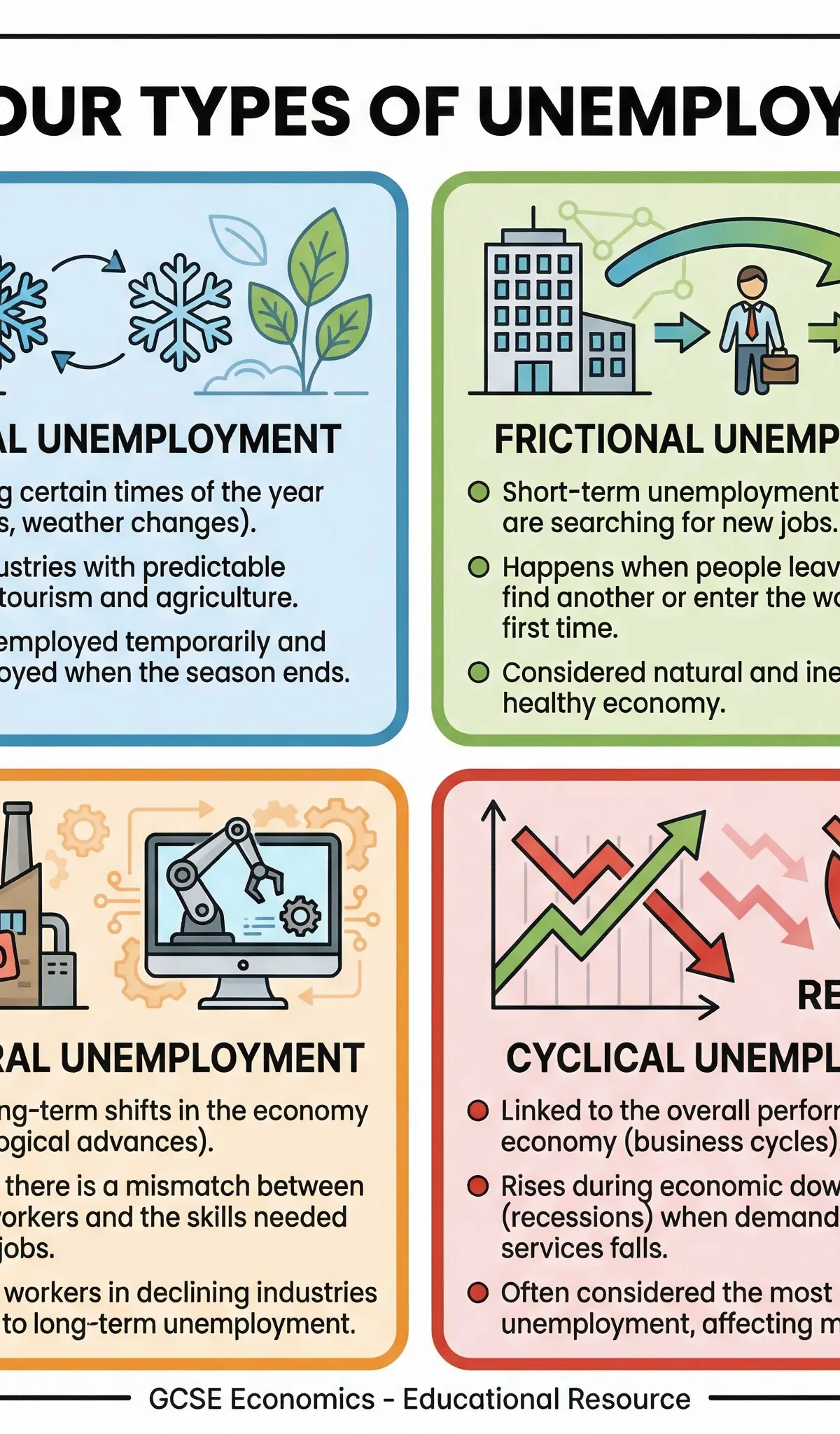
1. Frictional Unemployment
What it is: This is short-term, transitional unemployment that occurs when people are moving between jobs. It includes school leavers and graduates looking for their first job, and people who have voluntarily left a job to search for a better one.
Why it happens: It is caused by the time it takes for the labour market to match available workers with available jobs. Information is imperfect, and it takes time for job seekers to find suitable vacancies and for employers to find suitable candidates.
Significance: Frictional unemployment is considered a natural and even healthy feature of a dynamic economy. It is voluntary and suggests that the economy is flexible, allowing workers to move to more productive roles. It is not typically seen as a major economic problem.
2. Seasonal Unemployment
What it is: This type of unemployment exists because some industries only operate or have peak demand during certain times of the year.
Why it happens: It is linked to predictable, seasonal patterns. Classic examples include tourism (ski instructors in summer, lifeguards in winter), agriculture (fruit pickers outside of harvest season), and retail (temporary Christmas staff in January).
Significance: Like frictional unemployment, seasonal unemployment is predictable and short-term. The workers affected often know their employment is temporary. While it can cause hardship for individuals, it is not usually a sign of underlying economic weakness.
3. Structural Unemployment
What it is: This is a more serious, long-term form of unemployment that arises from a fundamental shift in the structure of an economy. It occurs when there is a mismatch between the skills of the unemployed and the skills required for the available jobs.
Why it happens: There are two main causes:
- Technological Change: Automation and new technologies can make certain jobs obsolete (e.g., robots replacing assembly line workers).
- Decline of Industries: Changes in consumer demand or international competition can lead to the long-term decline of entire industries (e.g., the decline of coal mining and shipbuilding in the UK).
Key Concepts: Structural unemployment is linked to occupational immobility (workers lack the right skills for new jobs and find it hard to retrain) and geographical immobility (workers are unwilling or unable to move to areas where jobs are available). Credit is given for explaining these immobilities.
Significance: Structural unemployment is a major economic problem. It can last for a long time, leading to a permanent loss of income and skills for those affected. It requires significant government intervention, such as retraining programmes and regional policy.
4. Cyclical (Demand-Deficient) Unemployment
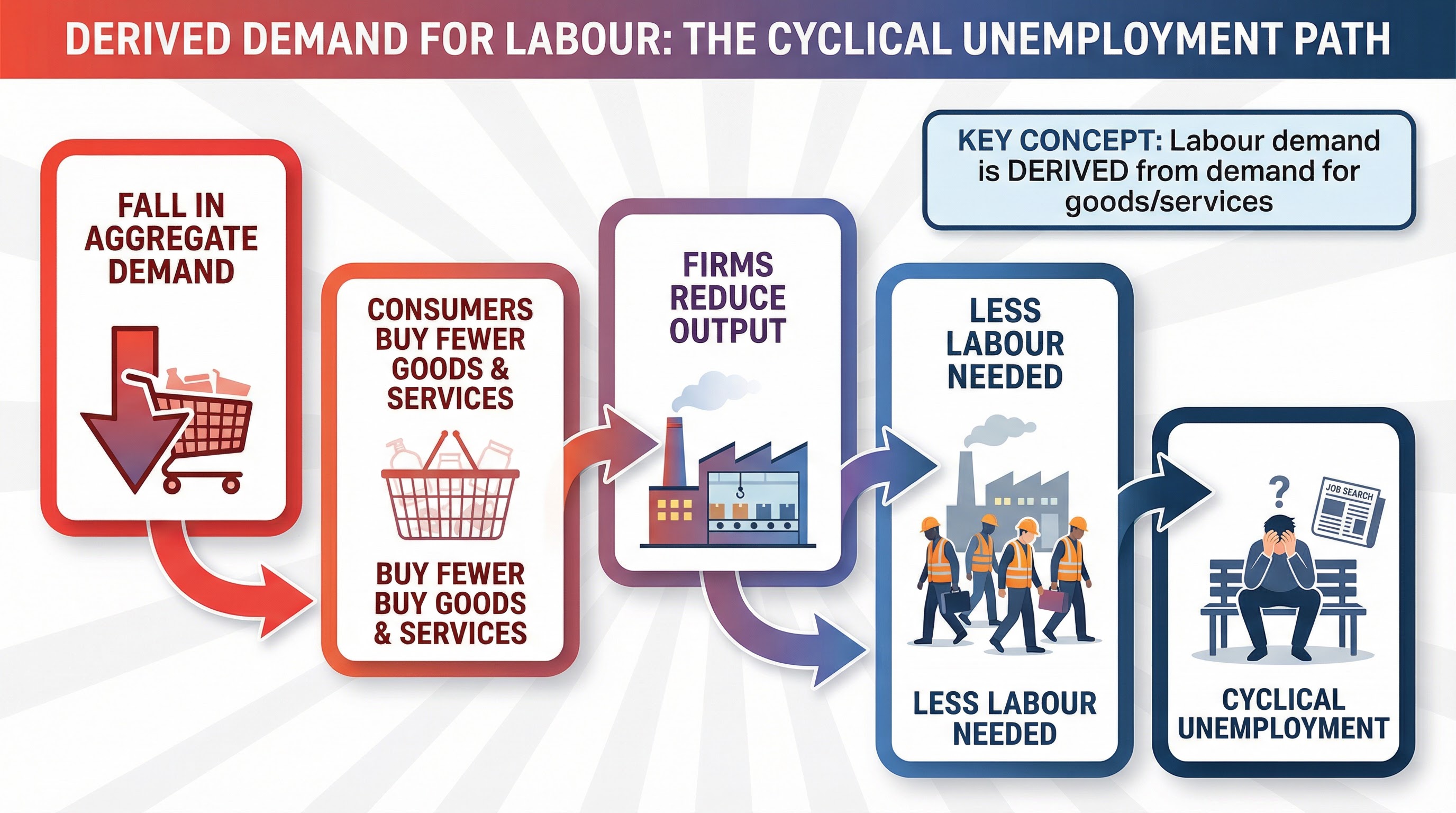
What it is: This is unemployment caused by a lack of Aggregate Demand (AD) in the economy, typically during a recession or economic downturn.
Why it happens: The demand for labour is a derived demand. This is a crucial term that examiners want to see. It means that labour is not demanded for its own sake, but for the goods and services it produces. The chain of reasoning is as follows:
- There is a fall in Aggregate Demand (e.g., during a recession).
- Consumers buy fewer goods and services.
- Firms experience a fall in demand and reduce their output.
- To reduce output, firms need fewer workers, so they stop hiring and may make existing staff redundant.
- This leads to a rise in cyclical unemployment.
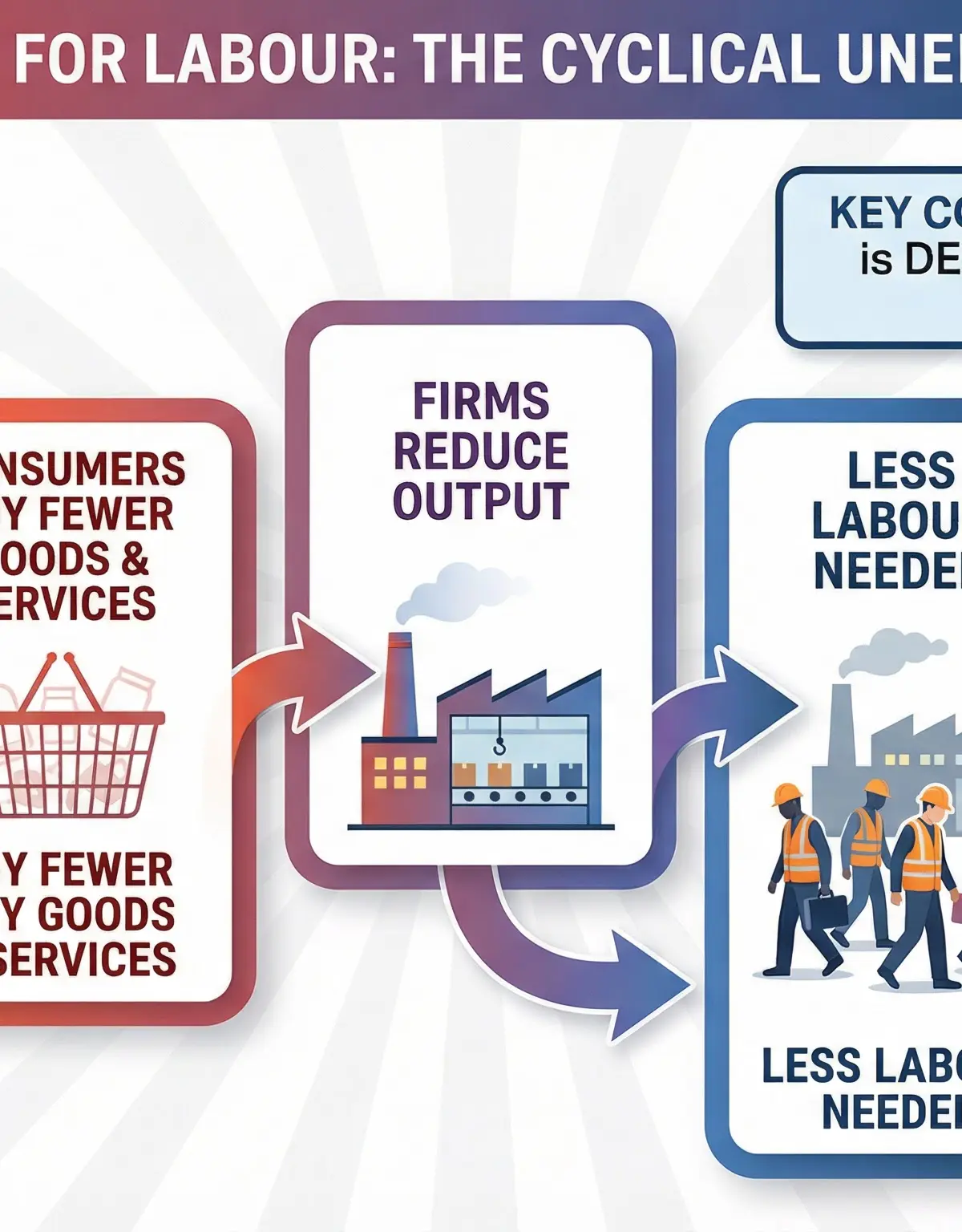
Significance: Cyclical unemployment is arguably the most serious type as it affects the entire economy, not just specific sectors. It can lead to a large number of job losses in a short period and can create a negative multiplier effect, where unemployed workers spend less, further reducing AD and causing more unemployment.
Consequences of Unemployment
Examiners expect candidates to evaluate the impact of unemployment on different economic agents.
| Economic Agent | Negative Consequences |
|---|---|
| Individuals | - Loss of income, leading to lower living standards. |
- Loss of skills (hysteresis) making it harder to find work in the future.
- Lower self-esteem, stress, and potential health problems. |
| Firms | - A large pool of available labour can drive down wages. - However, high unemployment means lower consumer spending, leading to lower revenue and profits.
- In the long run, firms may face a shortage of skilled workers if people have been out of work for a long time. |
| The Government | - Increased spending on unemployment benefits (JSA, Universal Credit). - Reduced tax revenue: fewer people paying income tax and National Insurance; lower consumer spending reduces VAT receipts; lower firm profits reduce Corporation Tax receipts.
- This can lead to a budget deficit, where government spending exceeds tax revenue. |
| The Economy | - A loss of potential output – the economy is operating inside its Production Possibility Frontier (PPF). - A waste of scarce resources (labour).
- Can lead to social problems such as increased crime and inequality. |
Worked Examples
3 worked examples — open one to explore the question and available guidance.
Practice Questions
Test your understanding — click to reveal model answers
Define the term 'frictional unemployment'. (2 marks)
Hint: Think about people moving between jobs.
Explain two reasons why the Labour Force Survey (LFS) figure for unemployment is usually higher than the Claimant Count figure. (4 marks)
Hint: Think about who is included in the LFS but might not be in the Claimant Count.
Analyse how a government could reduce structural unemployment. (6 marks)
Hint: Focus on policies that address the root causes: skills mismatch and immobility.
Explain the likely consequences of a significant rise in unemployment for the UK government's budget. (6 marks)
Hint: Think about both sides of the budget: government spending and tax revenue.
Evaluate the view that technological advancement is the main cause of unemployment in a modern economy like the UK. (9 marks)
Hint: This is an evaluation question. Argue for and against the statement before making a final judgement.
Test your understanding of Unemployment and its Causes
Active recall beats re-reading. Take an instant quiz now to test what you’ve learned and lock it into long-term memory.
7 days Premium · Then free forever · No card, no charge