OCR · GCSE · Economics
International Trade
This study guide for OCR GCSE Economics (J205) provides a comprehensive overview of International Trade, a topic crucial for understanding the UK's role in the global economy. It is designed to be exam-focused, breaking down complex concepts like the Balance of Payments, exchange rates, and protectionism into manageable sections to help students secure top marks.
- 6 min read
- 3 worked examples
- 5 practice questions
- 6 key terms
Study Notes
Overview
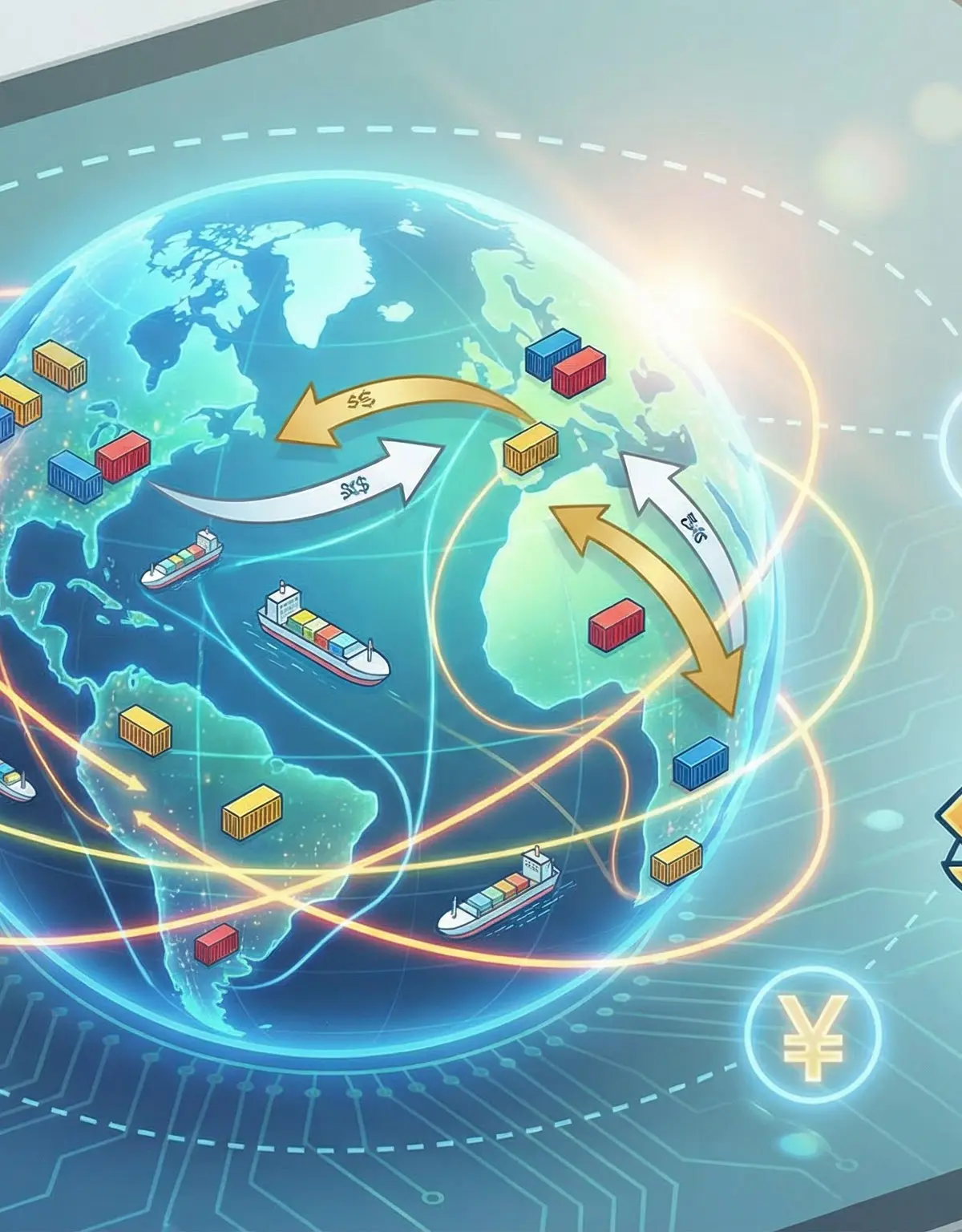
International Trade is a cornerstone of the OCR GCSE Economics specification, requiring candidates to apply economic theory to real-world global contexts. This topic explores how countries interact economically, focusing on the UK's financial transactions with the rest of the world. Examiners expect a rigorous understanding of the Balance of Payments, the precise mechanics of exchange rate systems, and a nuanced evaluation of protectionist policies. A key assessment focus is the ability to analyse the impact of these concepts on various stakeholders, including consumers, producers, and the government. Furthermore, candidates must demonstrate an appreciation of global economic interdependence and the significant role played by multinational corporations (MNCs). Success in this area hinges on building logical chains of reasoning and using specific data to support arguments, moving beyond generic statements to provide detailed, evidence-based analysis.
Key Concepts
The Balance of Payments
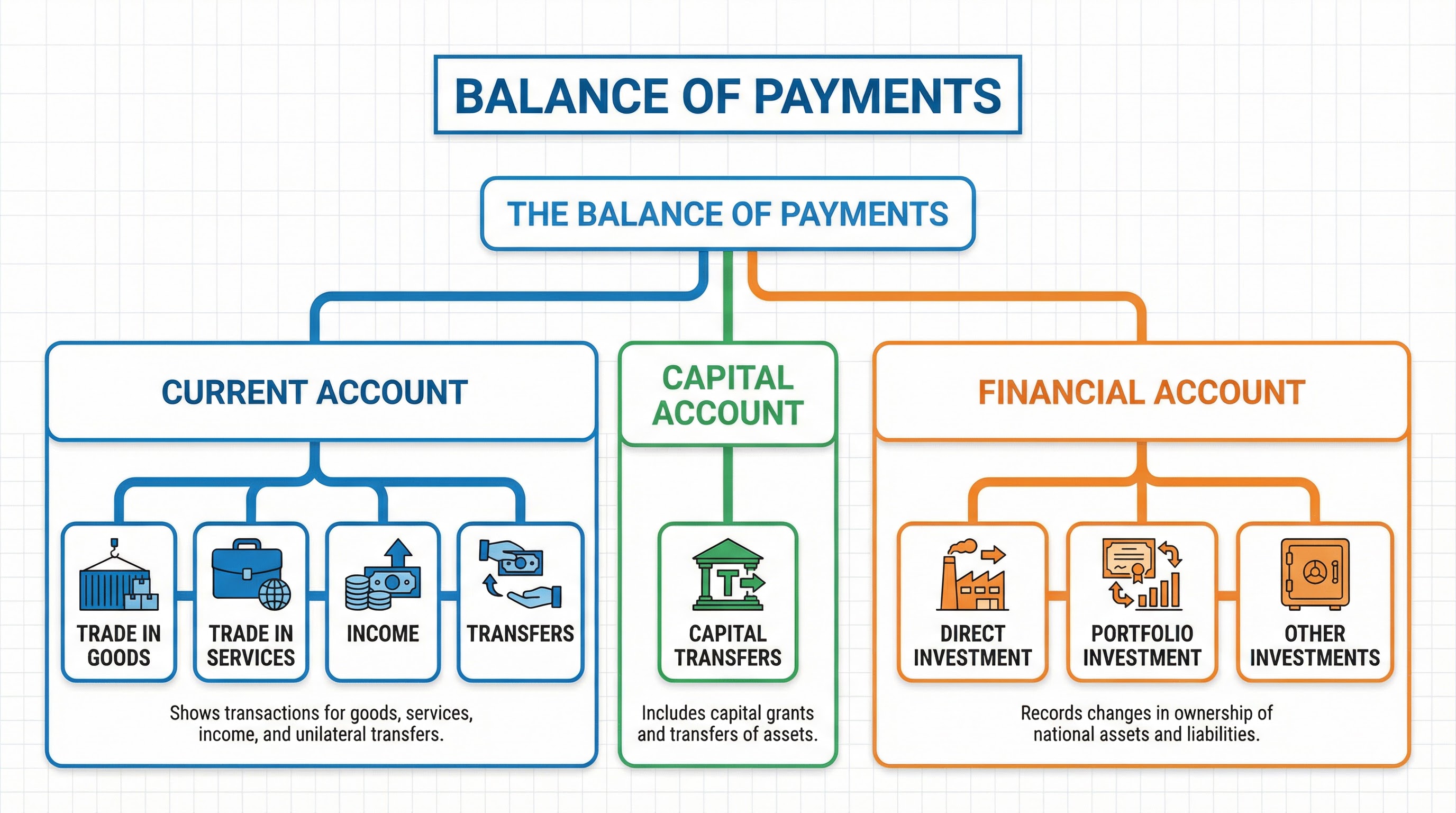
What it is: The Balance of Payments is a systematic record of all economic transactions between residents of a country (e.g., the UK) and the rest of the world over a given period, typically a year. It acts like a national set of accounts.
Why it matters: It provides a clear picture of a country's economic health and its relationship with other nations. A persistent deficit or surplus can have significant implications for the economy. For the exam, you must be able to dissect its components and explain the causes and consequences of imbalances.
Structure:
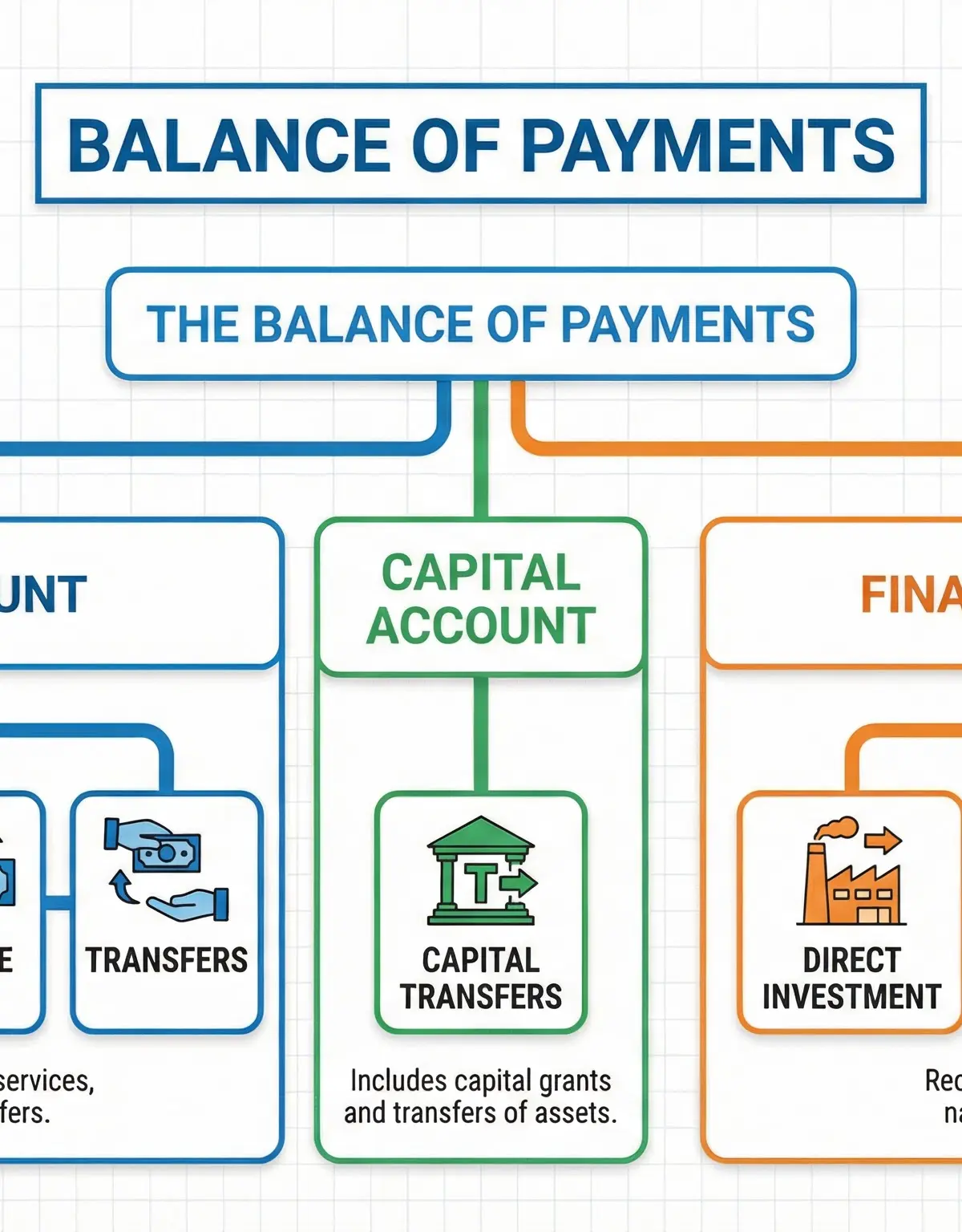
- Current Account: This is the most significant component. It measures the flow of funds from trade and income. It comprises:
- Trade in Goods: The buying and selling of tangible items (e.g., cars, food, electronics).
- Trade in Services: The buying and selling of intangible items (e.g., tourism, banking, insurance).
- Primary Income: Income earned from assets held abroad (e.g., profits, dividends, interest) minus income paid to foreigners holding domestic assets.
- Secondary Income (Transfers): One-way payments where nothing is received in return (e.g., foreign aid, payments to the EU).
- Capital Account: A smaller account that records capital transfers, such as debt forgiveness and the transfer of assets by migrants.
- Financial Account: This records the flows of investment into and out of the country. It includes:
- Foreign Direct Investment (FDI): Investment made by a firm or individual in one country into business interests located in another country (e.g., a foreign company building a factory in the UK).
- Portfolio Investment: The purchase of financial assets like stocks and bonds.
- Reserve Assets: The central bank's holdings of foreign currency, gold, and other reserves.
Exchange Rates
What it is: The price of one currency expressed in terms of another (e.g., £1 = $1.25). Exchange rates can be floating (determined by supply and demand) or fixed (set by the government).
Why it matters: Exchange rate fluctuations have a profound impact on the economy. They affect the price of imports and exports, which in turn influences the current account balance, inflation, and economic growth. Examiners frequently test the application of exchange rate changes.
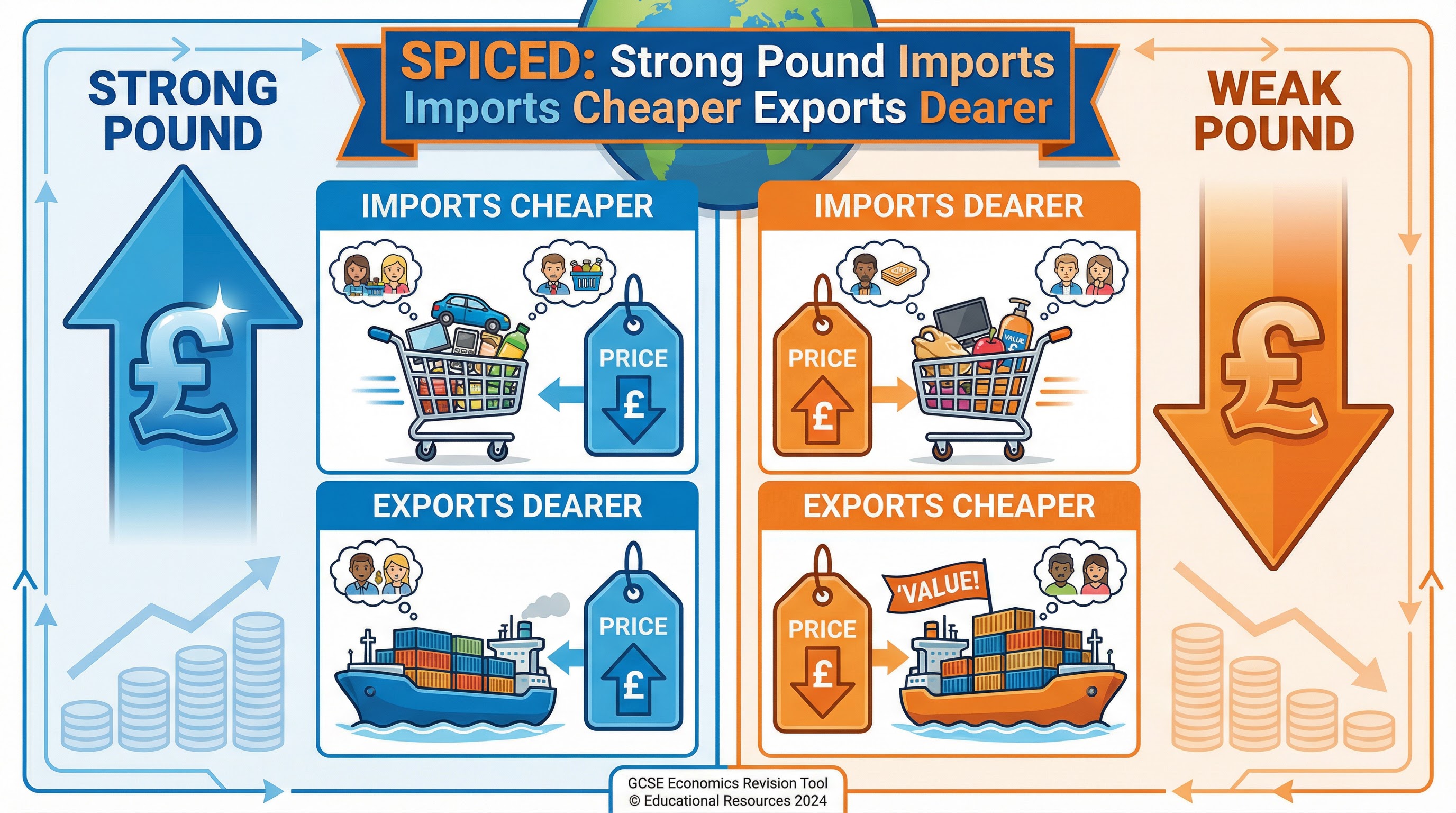
The SPICED Acronym: This is a vital memory hook.
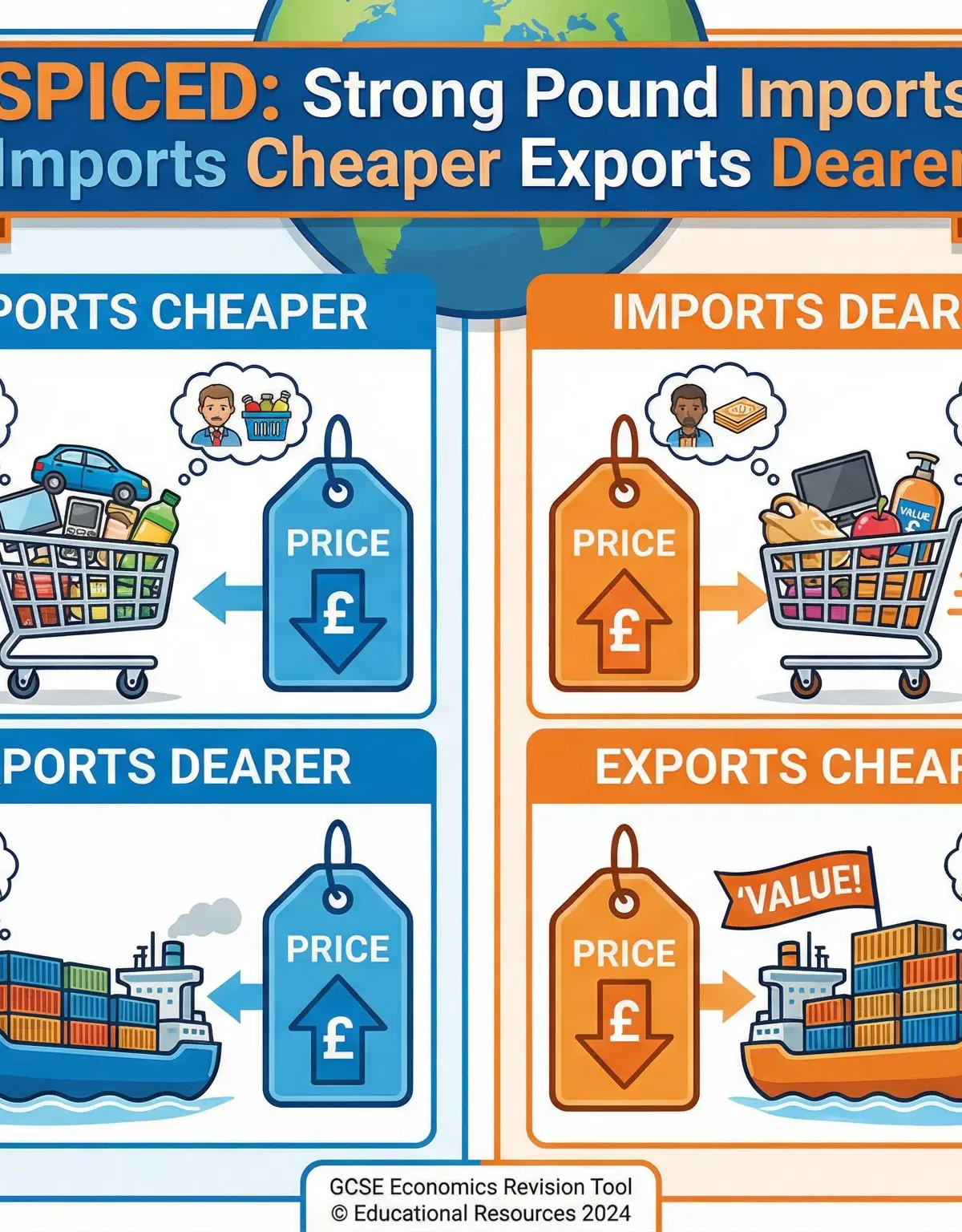
- Strong Pound Imports Cheaper Exports Dearer
- Appreciation: When the pound strengthens (appreciates), each pound buys more of a foreign currency. This makes imported goods cheaper for UK consumers but makes UK exports more expensive for foreigners. This is likely to worsen the current account balance (more imports, fewer exports).
- Depreciation: When the pound weakens (depreciates), each pound buys less of a foreign currency. This makes imported goods more expensive for UK consumers but makes UK exports cheaper for foreigners. This is likely to improve the current account balance (fewer imports, more exports).
Protectionism
What it is: Government policies designed to restrict free trade and protect domestic industries from foreign competition.
Why it matters: While it can shield domestic jobs and industries in the short term, protectionism often leads to higher prices for consumers, reduced choice, and potential retaliation from other countries (trade wars). Evaluating the pros and cons for different stakeholders is a key exam skill.
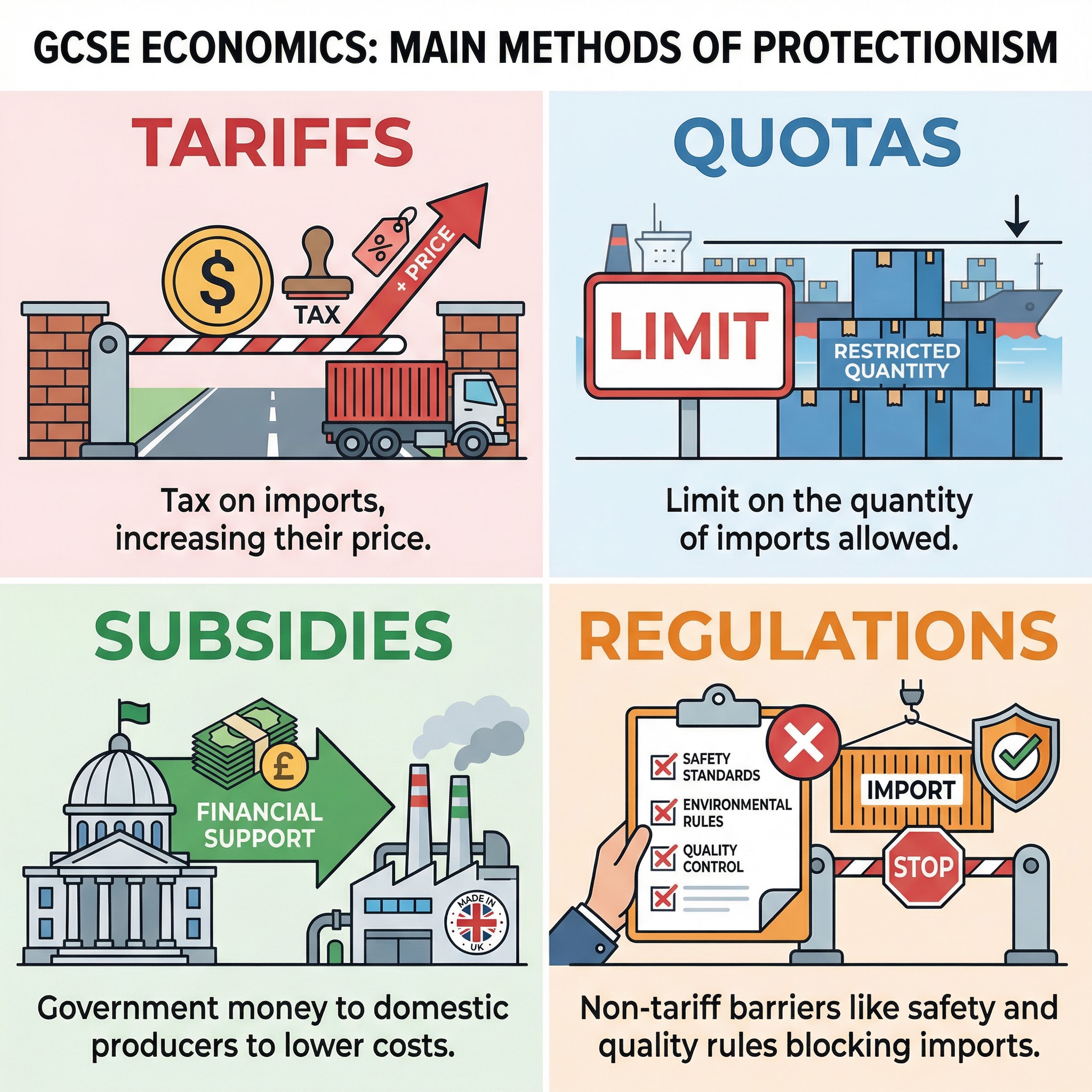
Methods of Protectionism:
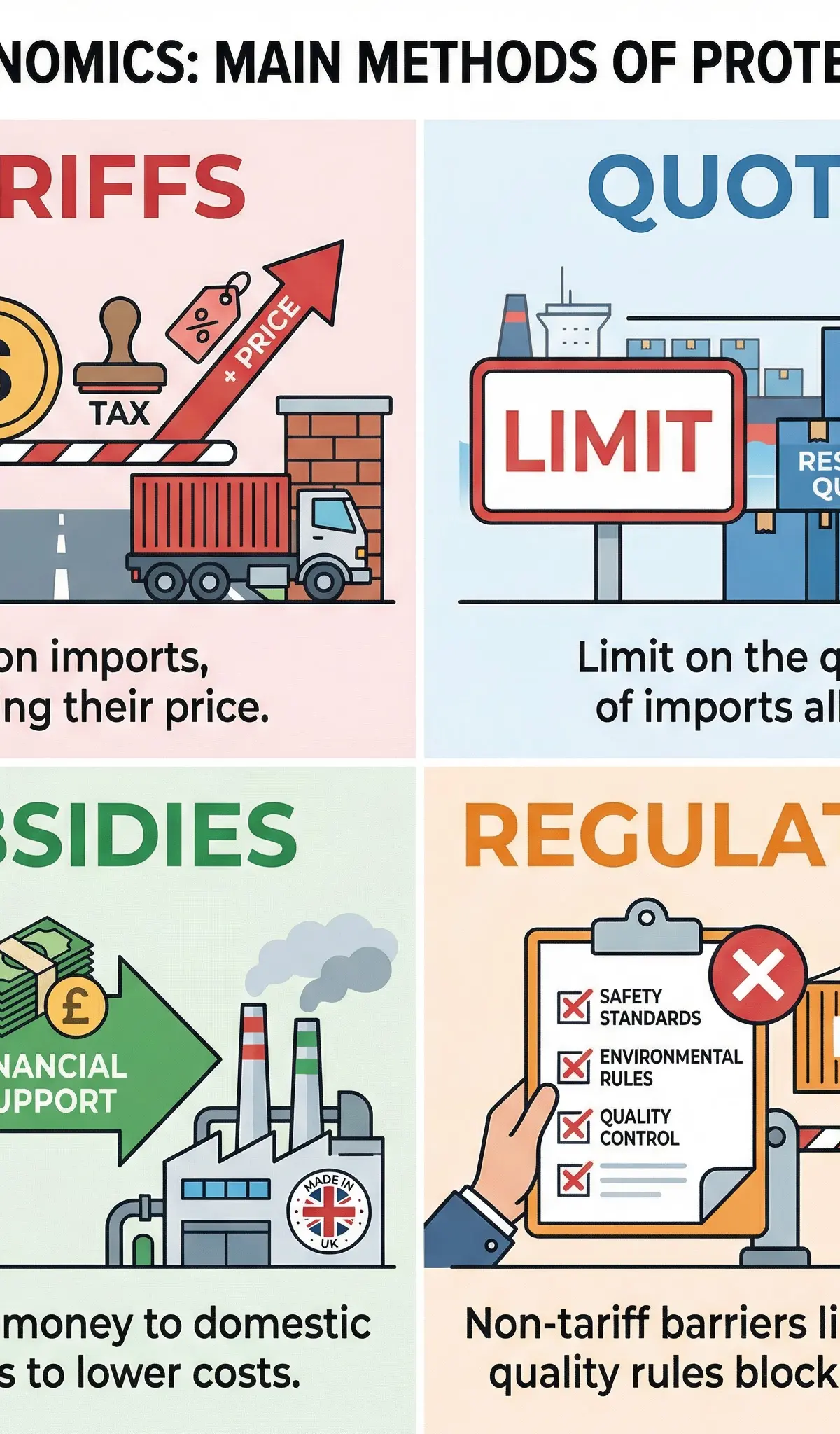
- Tariffs: A tax imposed on imported goods. This increases their price, making domestic goods more price-competitive. The government also receives tax revenue.
- Quotas: A physical limit on the quantity of a good that can be imported. This restricts supply and can drive up prices.
- Subsidies: A payment from the government to domestic producers. This lowers their production costs, allowing them to sell their goods more cheaply and compete with imports.
- Non-Tariff Barriers (Regulations): These are rules and regulations that make it difficult or expensive for foreign firms to sell their products in a country. Examples include stringent safety standards, complex paperwork, or specific product specifications.
Multinational Corporations (MNCs)
What they are: Companies that have operations (production or service delivery) in at least one country other than their home country (e.g., Apple, McDonald's, Toyota).
Why they matter: MNCs are major drivers of globalisation and investment. They can bring significant benefits to a host country but also pose challenges. Examiners expect a balanced evaluation.
- Benefits to Host Country: Creation of jobs, investment in infrastructure (FDI), transfer of skills and technology, increased tax revenue, and greater choice for consumers.
- Drawbacks for Host Country: Potential for exploitation of workers (low wages, poor conditions), environmental damage, tax avoidance through transfer pricing, and repatriation of profits to the home country rather than reinvesting them locally.
Visual Resources
3 diagrams and illustrations
Interactive Diagrams
1 interactive diagram to visualise key concepts
Conceptual Flow Outline
A concept map showing the key components of the International Trade topic.
Worked Examples
3 worked examples — open one to explore the question and available guidance.
Practice Questions
Test your understanding — click to reveal model answers
Explain how a fall in the value of the pound is likely to affect UK businesses that export their products. (6 marks)
Hint: Think about the acronym WIDEC (Weak pound, imports dearer, exports cheaper). How does this affect the price and quantity demanded of UK exports?
Analyse the impact of a quota on imported Japanese cars on the UK economy. (9 marks)
Hint: Consider the impact on multiple stakeholders: UK car producers, foreign (Japanese) car producers, UK consumers, and the government.
Calculate the new price in pounds (£) for a 200 product if the exchange rate moves from £1=1.25 to £1=$1.60. (2 marks)
Hint: To convert from a foreign currency to pounds, you divide by the exchange rate.
Explain one reason why a government might choose to subsidise its domestic farmers. (3 marks)
Hint: How does a subsidy affect a firm's costs and its ability to compete with imports?
Evaluate the view that multinational corporations (MNCs) are primarily beneficial for developing economies. (9 marks)
Hint: This is a high-level evaluation question. You must consider both the benefits (FDI, jobs, technology) and the drawbacks (exploitation, tax avoidance, profit repatriation). Come to a justified conclusion.
Test your understanding of International Trade
Active recall beats re-reading. Take an instant quiz now to test what you’ve learned and lock it into long-term memory.
7 days Premium · Then free forever · No card, no charge