AQA · GCSE · French
Course version: 8658 · Version from Sept 2016
The termination [œr] is always eur which may be English -or or -er eg acteur
Full specification wording
Near-cognates: the termination [œr] is always eur which may be English -or or -er eg acteur
Recognising near-cognates is a vital skill for deducing the meaning of unfamiliar vocabulary in French.
- Point 3 of 9
- 3 key terms
Study notes
From the teaching notes for this specification point.
The idea
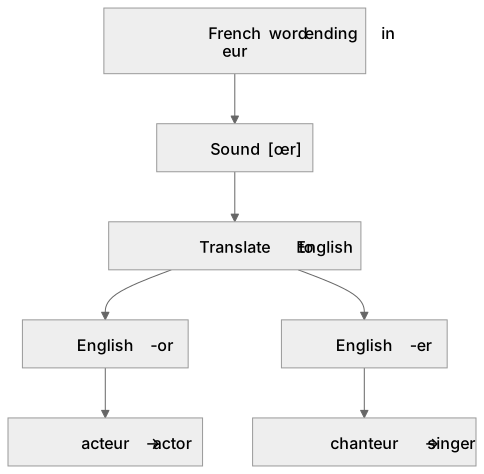
Recognising near-cognates is a vital skill for deducing the meaning of unfamiliar vocabulary in French. The French phonetic termination [œr] is consistently spelled as eur. When translating these words into English, this suffix frequently corresponds to either -or or -er. For example, the French word acteur translates to actor in English. Similarly, directeur translates to director, and chanteur translates to singer. Understanding this predictable pattern allows you to confidently identify professions and nouns describing people or objects that perform an action, bridging the gap between French and English vocabulary and improving your reading and listening comprehension significantly.
What earns the marks
- Identify the French suffix eur as corresponding to the phonetic sound [œr].
- Translate French nouns ending in eur to English nouns ending in -or.
- Translate French nouns ending in eur to English nouns ending in -er.
- Deduce the meaning of unfamiliar French words ending in eur by applying this near-cognate rule.
Common mistakes and how to put them right
Mistaking the French eur suffix for an English -ure ending.
Put it right by recognising it usually translates to -or or -er.
Assuming all eur words are masculine.
Put it right by remembering that while many are masculine, some abstract nouns like couleur are feminine.
Mispronouncing the eur ending as an English er.
Put it right by practising the French [œr] sound, which is deeper and more rounded.
Exam tips
- When faced with an unknown word ending in eur, try replacing it with -or or -er to see if it forms a recognisable English word.
- Pay attention to the context of the sentence to decide whether the eur word refers to a person or a concept.
- Remember that near-cognates might have slight spelling variations in the stem, so focus on the suffix pattern to guide your translation.
Try the lesson
The start of the Near-cognates: the termination [œr] is always eur which may be English -or or -er eg acteur lesson, made from teaching notes for this specification point.
Have a go first
In French near-cognates that correspond to English words ending in '-or' or '-er' (such as 'actor' or 'voyager'), how is this termination spelt?
Listen
Recognising near-cognates is a vital skill for deducing the meaning of unfamiliar vocabulary in French. The French phonetic termination [œr] is consistently spelled as eur. When translating these words into English, this suffix frequently corresponds to either -or or -er. For example, the French word acteur translates to actor in English. Similarly, directeur translates to director, and chanteur translates to singer. Understanding this predictable pattern allows you to confidently identify professions and nouns describing people or objects that perform an action, bridging the gap between French and English vocabulary and improving your reading and listening comprehension significantly. A strong answer earns marks for these points. Identify the French suffix eur as corresponding to the phonetic sound [œr]. Translate French nouns ending in eur to English nouns ending in -or. Translate French nouns ending in eur to English nouns ending in -er. Deduce the meaning of unfamiliar French words ending in eur by applying this near-cognate rule. A common slip: Mistaking the French eur suffix for an English -ure ending. Instead, recognising it usually translates to -or or -er. Exam tip: When faced with an unknown word ending in eur, try replacing it with -or or -er to see if it forms a recognisable English word.
See it
Key words
Say what each word means before you turn the card.
Near-cognates
Try answering aloud or in your head before turning the card.
Vocabulary deduction
Try answering aloud or in your head before turning the card.
Suffix patterns
Try answering aloud or in your head before turning the card.
See every definition
- Near-cognates
- Words that are similar between French and English, and recognising them is a vital skill for deducing the meaning of unfamiliar vocabulary.
- Vocabulary deduction
- Working out the meaning of unfamiliar vocabulary by applying a predictable pattern, such as the French suffix eur corresponding to English -or or -er.
- Suffix patterns
- The predictable pattern in which the French phonetic termination [œr] is consistently spelled as eur and frequently corresponds to either -or or -er in English.
Label the diagram
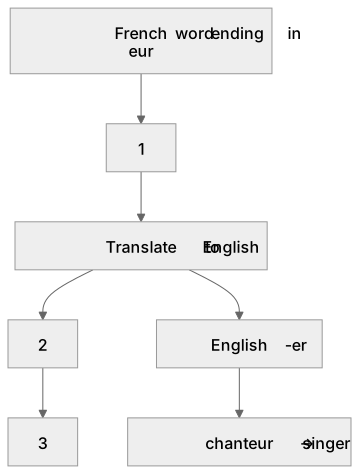
Some boxes have lost their names. Pick the right name for each number.
1Box 1
2Box 2
3Box 3
There is more to this lesson
The full lesson goes on to check your understanding and help you earn the marks. Create a free account to carry on, with your progress saved.
A week of Premium from your first lesson · Then the free plan continues · No card, no charge
Test your understanding of Near-cognates: the termination [œr] is always eur which may be English -or or -er eg acteur
Active recall beats re-reading. Take an instant quiz now to test what you’ve learned and lock it into long-term memory.
A week of Premium from your first lesson · Then the free plan continues · No card, no charge