AQA · GCSE · French
Course version: 8658 · Version from Sept 2016
Common prepositions eg à, au, à l', à la, aux; de, du, de l', de la, des;…
Full specification wording
Prepositions: common prepositions eg à, au, à l', à la, aux; de, du, de l', de la, des; après; avant; avec; chez;
Prepositions link words and show relationships such as location, time, or possession.
- Point 1 of 2
- 4 key terms
Study notes
From the teaching notes for this specification point.
The idea
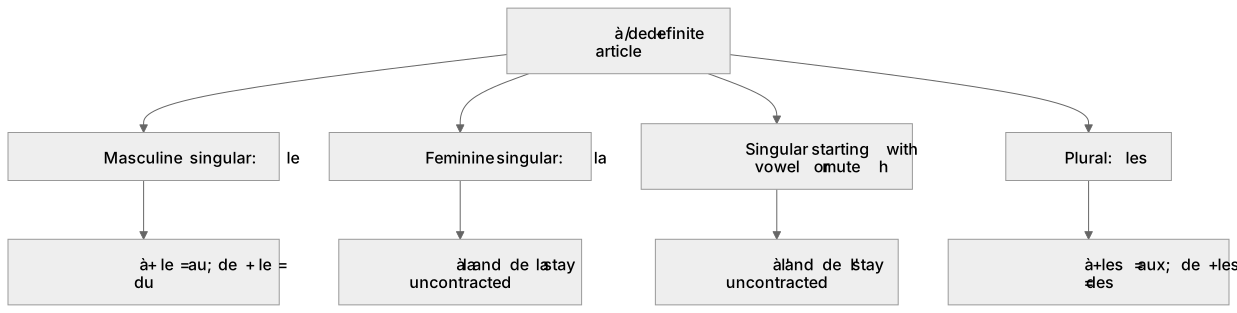
Prepositions link words and show relationships such as location, time, or possession. The preposition 'à' (at/to/in) contracts with definite articles: 'à + le' becomes 'au', and 'à + les' becomes 'aux'. 'À la' and 'à l'' do not contract. Similarly, 'de' (of/from) contracts to 'du' (de + le) and 'des' (de + les), while 'de la' and 'de l'' remain uncontracted. Other common prepositions include 'après' (after), 'avant' (before), 'avec' (with), and 'chez' (at the home/business of).
For example: 'Je vais au cinéma' uses the contracted 'au', and 'Je rentre chez moi' uses 'chez' to indicate returning to one's own home.
What earns the marks
- Select the correct contraction of 'à' or 'de' based on the gender and number of the following noun.
- Use 'chez' correctly to indicate a person's home or a professional's workplace (e.g., 'chez le médecin').
- Distinguish between 'avant' (before in time) and 'après' (after in time) in context.
- Recognise that 'à l'' and 'de l'' are used before singular nouns starting with a vowel or mute 'h'.
- Apply 'avec' correctly to indicate accompaniment or instrument.
Common mistakes and how to put them right
Writing the preposition 'à' or 'de' and the masculine definite article separately instead of using the contracted forms.
Put it right: Contract the words to 'au' and 'du'.
Using 'avant' to mean physically in front of a location.
Put it right: Use 'avant' for time to mean before, and 'devant' for location to mean in front of.
Confusing 'à' and 'de' when expressing possession or destination.
Put it right: Use 'de' for possession, such as 'le livre du garçon', and 'à' for destination, such as 'aller au parc'.
Exam tips
- Pay close attention to the gender and number of the noun following 'à' or 'de' to choose the correct contracted form.
- Remember that 'chez' can mean "at the house of" (chez Marie) or "at the shop/office of" (chez le dentiste).
- When reading timelines or schedules, look for 'avant' and 'après' to sequence events correctly.
Try the lesson
The start of the Prepositions: common prepositions eg à, au, à l', à la, aux; de, du, de l', de la, des; après; avant; avec; chez; lesson, made from teaching notes for this specification point.
Have a go first
Which preposition correctly completes the following sentence?
"Le week-end, nous allons ________ piscine."
Listen
Prepositions link words and show relationships such as location, time, or possession. The preposition 'à' (at/to/in) contracts with definite articles: 'à + le' becomes 'au', and 'à + les' becomes 'aux'. À la' and 'à l'' do not contract. Similarly, 'de' (of/from) contracts to 'du' (de + le) and 'des' (de + les), while 'de la' and 'de l'' remain uncontracted. Other common prepositions include 'après' (after), 'avant' (before), 'avec' (with), and 'chez' (at the home/business of). For example, 'Je vais au cinéma' uses the contracted 'au', and 'Je rentre chez moi' uses 'chez' to indicate returning to one's own home. A strong answer earns marks for these points. Select the correct contraction of 'à' or 'de' based on the gender and number of the following noun. Use 'chez' correctly to indicate a person's home or a professional's workplace (e.g., 'chez le médecin'). Distinguish between 'avant' (before in time) and 'après' (after in time) in context. Recognise that 'à l'' and 'de l'' are used before singular nouns starting with a vowel or mute 'h'. A common slip: Writing the preposition 'à' or 'de' and the masculine definite article separately instead of using the contracted forms. Instead, contract the words to 'au' and 'du'. Exam tip: Pay close attention to the gender and number of the noun following 'à' or 'de' to choose the correct contracted form.
See it
Key words
Say what each word means before you turn the card.
Locations and destinations
Try answering aloud or in your head before turning the card.
Time and sequencing
Try answering aloud or in your head before turning the card.
Possession and origins
Try answering aloud or in your head before turning the card.
Accompaniment
Try answering aloud or in your head before turning the card.
See every definition
- Locations and destinations
- Prepositions link words and show relationships such as location, time, or possession, and 'à' (at/to/in) is used for destination, as in 'aller au parc'.
- Time and sequencing
- 'Avant' means before in time and 'après' means after in time, and they are used to sequence events in time.
- Possession and origins
- 'De' (of/from) is used for possession, such as 'le livre du garçon', and contracts to 'du' (de + le) and 'des' (de + les).
- Accompaniment
- 'Avec' (with) is applied to indicate accompaniment or instrument.
Label the diagram
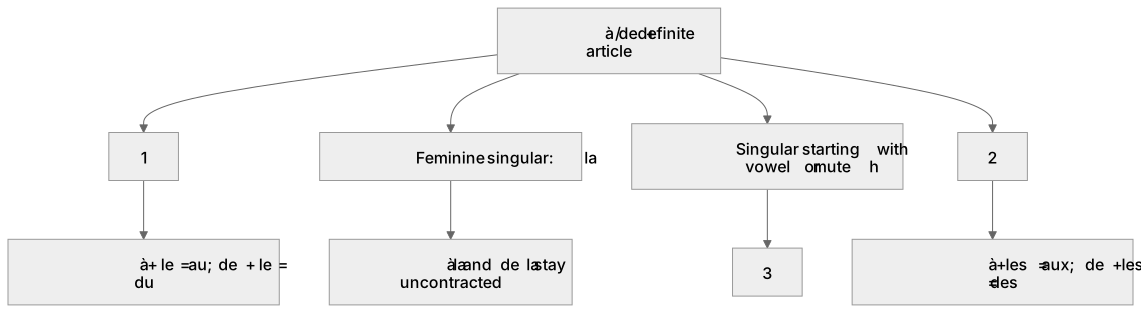
Some boxes have lost their names. Pick the right name for each number.
1Box 1
2Box 2
3Box 3
There is more to this lesson
The full lesson goes on to check your understanding and help you earn the marks. Create a free account to carry on, with your progress saved.
A week of Premium from your first lesson · Then the free plan continues · No card, no charge
Test your understanding of Prepositions: common prepositions eg à, au, à l', à la, aux; de, du, de l', de la, des; après; avant; avec; chez;
Active recall beats re-reading. Take an instant quiz now to test what you’ve learned and lock it into long-term memory.
A week of Premium from your first lesson · Then the free plan continues · No card, no charge