AQA · GCSE · French
Course version: 8658 · Version from Sept 2016
Contre; dans; depuis; derrière; devant; entre; pendant; pour; sans; sur;…
Full specification wording
Prepositions: contre; dans; depuis; derrière; devant; entre; pendant; pour; sans; sur; sous; vers common compound prepositions eg à côté de; près de; en face de, à cause de; au lieu de
French uses simple and compound prepositions to express complex relationships of space, time, and cause.
- Point 2 of 2
- 4 key terms
Study notes
From the teaching notes for this specification point.
The idea
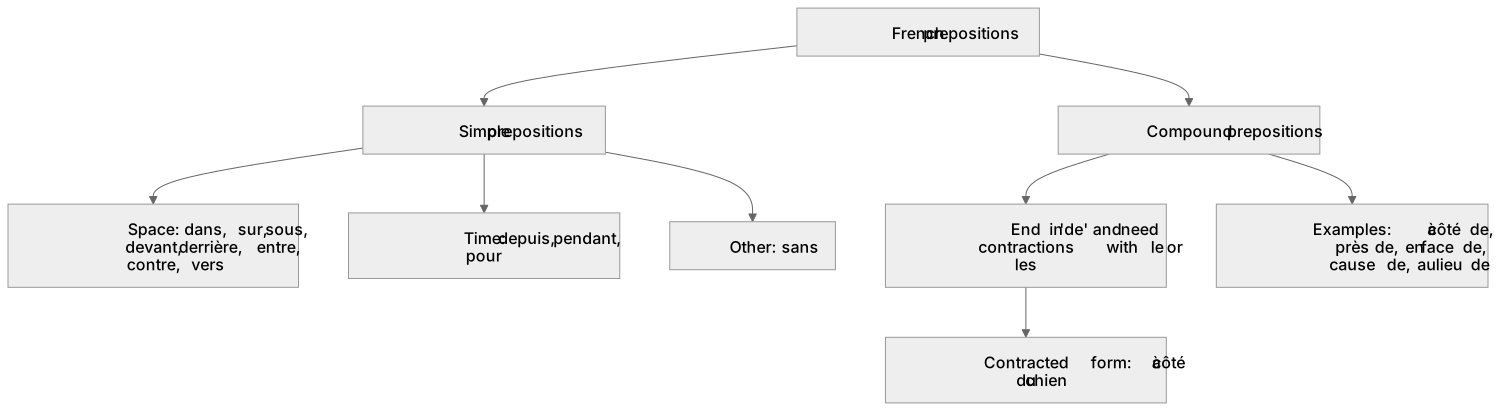
French uses simple and compound prepositions to express complex relationships of space, time, and cause. Simple prepositions include 'dans' (in), 'sur' (on), 'sous' (under), 'devant' (in front of), 'derrière' (behind), 'entre' (between), 'contre' (against), 'vers' (towards), 'depuis' (since/for), 'pendant' (during/for), 'pour' (for), and 'sans' (without). Compound prepositions end in 'de' and require contractions if followed by 'le' or 'les'. Examples include 'à côté de' (next to), 'près de' (near), 'en face de' (opposite), 'à cause de' (because of), and 'au lieu de' (instead of). For instance, 'Le chat est sous la table' uses a simple preposition, while 'Il est à côté du chien' uses a compound preposition with a contracted 'de'.
What earns the marks
- Identify spatial relationships using prepositions like 'sur', 'sous', 'devant', 'derrière', and 'entre'.
- Distinguish between 'depuis' (an ongoing action starting in the past) and 'pendant' (a completed duration).
- Apply correct contractions (du, des) when using compound prepositions ending in 'de' before masculine or plural nouns.
- Recognise causal and alternative relationships using 'à cause de' and 'au lieu de'.
- Understand the use of 'sans' followed by an infinitive or a noun to mean "without".
Common mistakes and how to put them right
Forgetting to contract the preposition 'de' in compound prepositions before a masculine noun.
Put it right: Contract the preposition and article to 'du', writing 'à côté du parc'.
Confusing 'devant' for location with 'avant' for time.
Put it right: Use 'devant' to mean physically in front of, and 'avant' for before in time.
Using 'pour' instead of 'pendant' or 'depuis' for durations of time.
Put it right: Use 'pendant' for a set duration, such as 'pendant deux heures', and 'depuis' for an action continuing from the past.
Exam tips
- When describing a photo, use spatial prepositions like 'au premier plan', 'à côté de', and 'derrière' to structure your description.
- Watch out for 'à cause de' in reading texts; it introduces a negative or neutral cause, unlike 'grâce à' (thanks to).
- Remember that prepositions like 'pour' and 'sans' are followed by the infinitive form of a verb (e.g., 'sans parler').
Try the lesson
The start of the Prepositions: contre; dans; depuis; derrière; devant; entre; pendant; pour; sans; sur; sous; vers common compound prepositions eg à côté de; près de; en face de, à cause de; au lieu de lesson, made from teaching notes for this specification point.
Have a go first
Which preposition correctly completes the sentence to mean "The dog is sleeping under the bed"? "Le chien dort ________ le lit."
Listen
French uses simple and compound prepositions to express complex relationships of space, time, and cause. Simple prepositions include 'dans' (in), 'sur' (on), 'sous' (under), 'devant' (in front of), 'derrière' (behind), 'entre' (between), 'contre' (against), 'vers' (towards), 'depuis' (since/for), 'pendant' (during/for), 'pour' (for), and 'sans' (without). Compound prepositions end in 'de' and require contractions if followed by 'le' or 'les'. Examples include 'à côté de' (next to), 'près de' (near), 'en face de' (opposite), 'à cause de' (because of), and 'au lieu de' (instead of). For instance, 'Le chat est sous la table' uses a simple preposition, while 'Il est à côté du chien' uses a compound preposition with a contracted 'de'. A strong answer earns marks for these points. Identify spatial relationships using prepositions like 'sur', 'sous', 'devant', 'derrière', and 'entre'. Distinguish between 'depuis' (an ongoing action starting in the past) and 'pendant' (a completed duration). Apply correct contractions (du, des) when using compound prepositions ending in 'de' before masculine or plural nouns. Recognise causal and alternative relationships using 'à cause de' and 'au lieu de'. A common slip: Forgetting to contract the preposition 'de' in compound prepositions before a masculine noun. Instead, Contract the preposition and article to 'du', writing 'à côté du parc'. Exam tip: When describing a photo, use spatial prepositions like 'au premier plan', 'à côté de', and 'derrière' to structure your description.
See it
Key words
Say what each word means before you turn the card.
Spatial descriptions
Try answering aloud or in your head before turning the card.
Time durations
Try answering aloud or in your head before turning the card.
Causes and alternatives
Try answering aloud or in your head before turning the card.
Photo descriptions
Try answering aloud or in your head before turning the card.
See every definition
- Spatial descriptions
- Simple prepositions such as 'sur', 'sous', 'devant', 'derrière' and 'entre' identify spatial relationships, and compound prepositions ending in 'de' also express space.
- Time durations
- 'Depuis' is used for an ongoing action starting in the past, while 'pendant' is used for a completed duration.
- Causes and alternatives
- Causal and alternative relationships are recognised using 'à cause de' and 'au lieu de'.
- Photo descriptions
- Spatial prepositions such as 'au premier plan', 'à côté de' and 'derrière' are used to structure a description of a photo.
Label the diagram
Some boxes have lost their names. Pick the right name for each number.
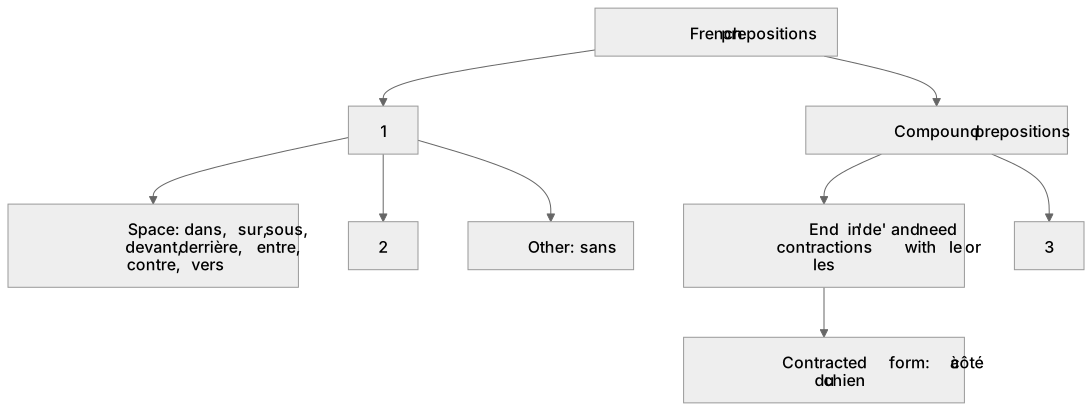
1Box 1
2Box 2
3Box 3
There is more to this lesson
The full lesson goes on to check your understanding and help you earn the marks. Create a free account to carry on, with your progress saved.
A week of Premium from your first lesson · Then the free plan continues · No card, no charge
Test your understanding of Prepositions: contre; dans; depuis; derrière; devant; entre; pendant; pour; sans; sur; sous; vers common compound prepositions eg à côté de; près de; en face de, à cause de; au lieu de
Active recall beats re-reading. Take an instant quiz now to test what you’ve learned and lock it into long-term memory.
A week of Premium from your first lesson · Then the free plan continues · No card, no charge