AQA · GCSE · French
Course version: 8658 · Version from Sept 2016
Understand and respond to written language: demonstrate understanding by…
Full specification wording
Reading: understand and respond to written language: demonstrate understanding by being able to scan for particular information, organise and present relevant details, draw inferences in context and recognise implicit meaning where appropriate
Beyond literal comprehension, they must organise and present relevant details logically.
- Point 6 of 6
- 4 key terms
Study notes
From the teaching notes for this specification point.
The idea
Beyond literal comprehension, they must organise and present relevant details logically. This means understanding what the text suggests without stating it directly.
For example: If a text says "Il pleuvait des cordes et j'avais oublié mon parapluie", the implicit meaning is that the person got very wet, even though it is not explicitly stated.
What earns the marks
- Scans texts successfully to locate particular information and specific details.
- Organises and presents relevant details accurately in response to questions.
- Draws logical inferences based on contextual clues within the text.
- Recognises implicit meanings, attitudes, or emotions not explicitly stated by the writer.
Common mistakes and how to put them right
Reading every word slowly instead of scanning.
Put it right: Move eyes quickly over the text to find specific keywords related to the question.
Taking idioms or figurative language literally.
Put it right: Recognise that phrases like "coûter les yeux de la tête" mean something is expensive, not a literal physical cost.
Failing to read between the lines.
Put it right: Ask yourself what the writer's choice of words implies about their feelings or the situation.
Exam tips
- Use the keywords in the question to scan the text for the exact paragraph where the answer is located.
- When asked about implicit meaning, look for adjectives and adverbs that reveal the writer's underlying attitude.
- Practice inferring meaning by guessing the outcome of a situation described in a text before reading the conclusion.
Try the lesson
The start of the Reading: understand and respond to written language: demonstrate understanding by being able to scan for particular information, organise and present relevant details, draw inferences in context and recognise implicit meaning where appropriate lesson, made from teaching notes for this specification point.
Have a go first
Read the following text: "Salut ! Je m'appelle Thomas. Le week-end dernier, je suis allé en ville avec mon frère. Nous avons acheté des vêtements. Après, nous avons pris un repas dans une brasserie. C'était très cher !" Who did Thomas go to town with?
Listen
Beyond literal comprehension, they must organise and present relevant details logically. This means understanding what the text suggests without stating it directly. For example, if a text says "Il pleuvait des cordes et j'avais oublié mon parapluie", the implicit meaning is that the person got very wet, even though it is not explicitly stated. A strong answer earns marks for these points. Scans texts successfully to locate particular information and specific details. Organises and presents relevant details accurately in response to questions. Draws logical inferences based on contextual clues within the text. Recognises implicit meanings, attitudes, or emotions not explicitly stated by the writer. A common slip: Reading every word slowly instead of scanning. Instead, move eyes quickly over the text to find specific keywords related to the question. Exam tip: Use the keywords in the question to scan the text for the exact paragraph where the answer is located.
See it
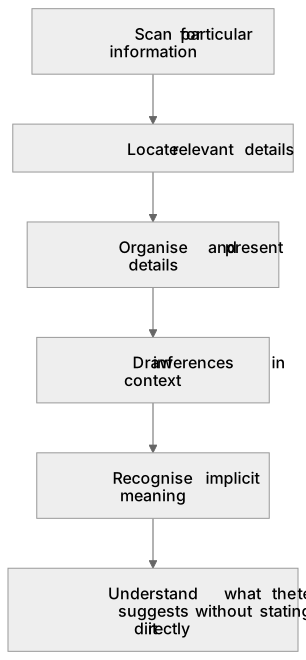
Put it in order
Put these steps in the order they happen.
- 1. Organise and present details
- 2. Locate relevant details
- 3. Scan for particular information
- 4. Understand what the text suggests without stating it directly
- 5. Recognise implicit meaning
- 6. Draw inferences in context
Key words
Say what each word means before you turn the card.
Scanning for information
Try answering aloud or in your head before turning the card.
Organising relevant details
Try answering aloud or in your head before turning the card.
Drawing inferences
Try answering aloud or in your head before turning the card.
Recognising implicit meaning
Try answering aloud or in your head before turning the card.
See every definition
- Scanning for information
- Moving the eyes quickly over the text to find specific keywords related to the question, rather than reading every word slowly.
- Organising relevant details
- Presenting relevant details accurately and logically in response to questions.
- Drawing inferences
- Using contextual clues, tone and vocabulary choices to deduce hidden meanings and infer the writer's true intentions.
- Recognising implicit meaning
- Understanding what the text suggests without stating it directly, including attitudes or emotions not explicitly stated by the writer.
Label the diagram
Some boxes have lost their names. Pick the right name for each number.
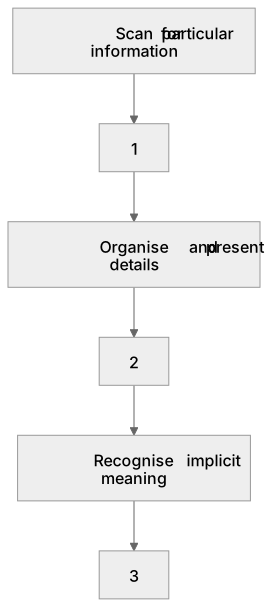
1Box 1
2Box 2
3Box 3
There is more to this lesson
The full lesson goes on to check your understanding and help you earn the marks. Create a free account to carry on, with your progress saved.
A week of Premium from your first lesson · Then the free plan continues · No card, no charge
Test your understanding of Reading: understand and respond to written language: demonstrate understanding by being able to scan for particular information, organise and present relevant details, draw inferences in context and recognise implicit meaning where appropriate
Active recall beats re-reading. Take an instant quiz now to test what you’ve learned and lock it into long-term memory.
A week of Premium from your first lesson · Then the free plan continues · No card, no charge