AQA · GCSE · French
Course version: 8658 · Version from Sept 2016
Understand and respond to written language: recognise and respond to key…
Full specification wording
Reading: understand and respond to written language: recognise and respond to key information, important themes and ideas in more extended written text and authentic sources, including some extracts from relevant abridged or adapted literary texts
This includes reading abridged or adapted literary texts, such as poems, short stories, or novel extracts.
- Point 5 of 6
- 4 key terms
Study notes
From the teaching notes for this specification point.
The idea
This includes reading abridged or adapted literary texts, such as poems, short stories, or novel extracts. For instance, in an adapted literary extract, students might need to recognise a character's motivation or the narrator's viewpoint. Responding accurately requires distinguishing between main ideas and secondary details, and understanding the writer's overall purpose or attitude within the authentic source.
What earns the marks
- Identifies key information and specific details in extended written texts.
- Recognises important themes and overarching ideas in authentic sources.
- Understands character motivations, viewpoints, or plot points in adapted literary extracts.
- Distinguishes between primary themes and supporting details in complex texts.
Common mistakes and how to put them right
Confusing the opinions of different characters in a literary extract.
Put it right: Track who is speaking or acting by paying attention to pronouns and names.
Focusing too heavily on minor details rather than the main theme.
Put it right: Read the text holistically first to grasp the overarching idea before looking for specific facts.
Misinterpreting the writer's attitude.
Put it right: Look for positive or negative adjectives and adverbs that indicate the writer's tone.
Exam tips
- Skim the extended text first to get a general sense of the important themes and ideas.
- Highlight or underline key names, dates, and opinions when reading authentic sources.
- In literary extracts, pay close attention to descriptive language that reveals character emotions or settings.
Try the lesson
The start of the Reading: understand and respond to written language: recognise and respond to key information, important themes and ideas in more extended written text and authentic sources, including some extracts from relevant abridged or adapted literary texts lesson, made from teaching notes for this specification point.
Have a go first
Read the following extract:
"L'hiver de 1924 fut particulièrement rude dans notre petit village de montagne. La neige tombait sans cesse, bloquant les routes et isolant les habitants pendant des semaines. Malgré le froid glacial et le manque de provisions, une véritable solidarité s'est installée parmi les voisins. Chaque soir, nous nous réunissions autour du feu chez Monsieur Dupont pour partager le peu de nourriture qu'il nous restait et écouter ses histoires fascinantes. Ces moments de chaleur humaine m'ont fait oublier la dureté de la saison."
How did the villagers cope with the isolation and lack of supplies during the harsh winter?
Listen
This includes reading abridged or adapted literary texts, such as poems, short stories, or novel extracts. For instance, in an adapted literary extract, students might need to recognise a character's motivation or the narrator's viewpoint. Responding accurately requires distinguishing between main ideas and secondary details, and understanding the writer's overall purpose or attitude within the authentic source. A strong answer earns marks for these points. Identifies key information and specific details in extended written texts. Recognises important themes and overarching ideas in authentic sources. Understands character motivations, viewpoints, or plot points in adapted literary extracts. Distinguishes between primary themes and supporting details in complex texts. A common slip: Confusing the opinions of different characters in a literary extract. Instead, track who is speaking or acting by paying attention to pronouns and names. Exam tip: Skim the extended text first to get a general sense of the important themes and ideas.
See it
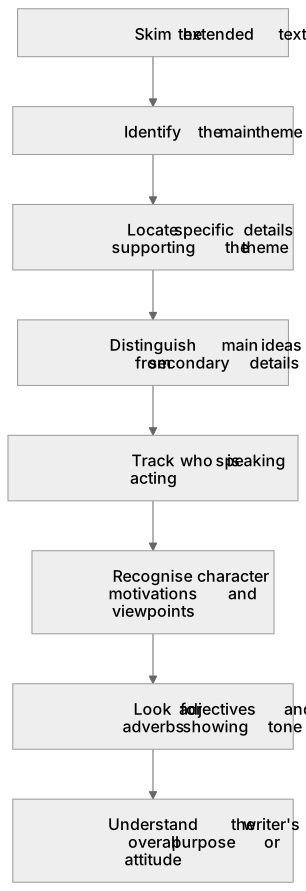
Put it in order
Put these steps in the order they happen.
- 1. Track who is speaking or acting
- 2. Understand the writer's overall purpose or attitude
- 3. Recognise character motivations and viewpoints
- 4. Skim the extended text
- 5. Identify the main theme
- 6. Look for adjectives and adverbs showing tone
- 7. Locate specific details supporting the theme
- 8. Distinguish main ideas from secondary details
Key words
Say what each word means before you turn the card.
Extended written texts
Try answering aloud or in your head before turning the card.
Authentic sources
Try answering aloud or in your head before turning the card.
Important themes and ideas
Try answering aloud or in your head before turning the card.
Adapted literary texts
Try answering aloud or in your head before turning the card.
See every definition
- Extended written texts
- Longer pieces of writing from which students must extract key information and specific details.
- Authentic sources
- Real materials in French in which students recognise important themes and overarching ideas.
- Important themes and ideas
- The overarching ideas in a text, which students must distinguish from supporting details.
- Adapted literary texts
- Abridged or adapted literary extracts in which students understand character motivations, viewpoints or plot points.
Label the diagram
Some boxes have lost their names. Pick the right name for each number.
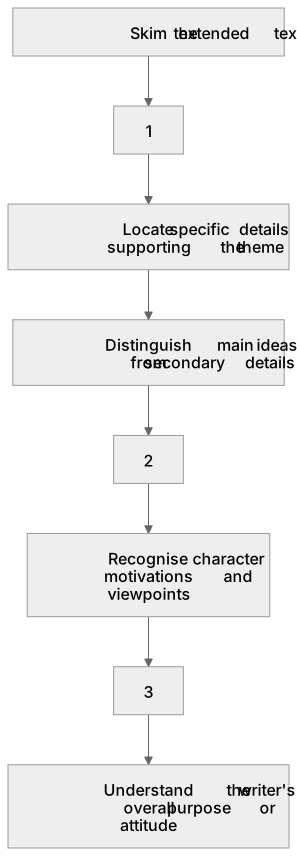
1Box 1
2Box 2
3Box 3
There is more to this lesson
The full lesson goes on to check your understanding and help you earn the marks. Create a free account to carry on, with your progress saved.
A week of Premium from your first lesson · Then the free plan continues · No card, no charge
Test your understanding of Reading: understand and respond to written language: recognise and respond to key information, important themes and ideas in more extended written text and authentic sources, including some extracts from relevant abridged or adapted literary texts
Active recall beats re-reading. Take an instant quiz now to test what you’ve learned and lock it into long-term memory.
A week of Premium from your first lesson · Then the free plan continues · No card, no charge