AQA · GCSE · French
Course version: 8658 · Version from Sept 2016
Understand and respond to written language: understand and respond to…
Full specification wording
Reading: understand and respond to written language: understand and respond to different types of written language
Learners must navigate a wide variety of French text formats, ranging from informal emails and text messages to formal articles, literary extracts, and advertisements.
- Point 1 of 6
- 4 key terms
Study notes
From the teaching notes for this specification point.
The idea
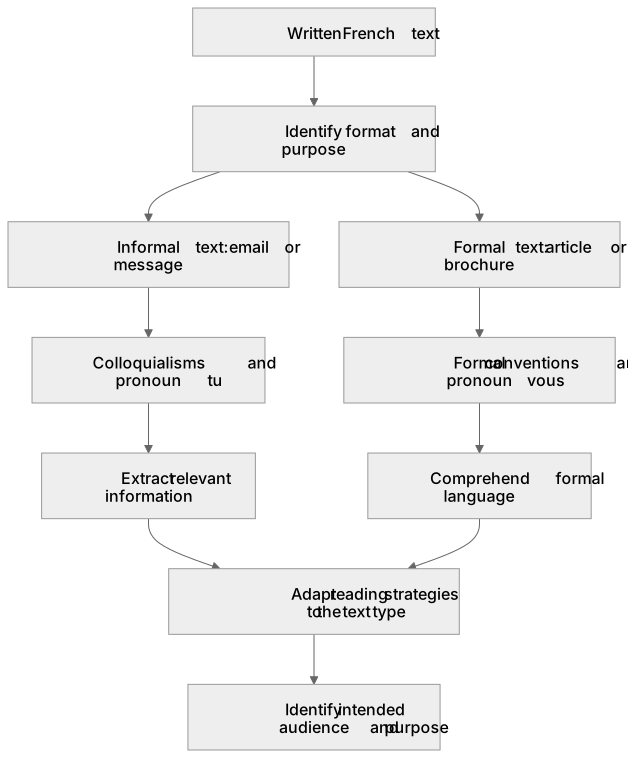
Learners must navigate a wide variety of French text formats, ranging from informal emails and text messages to formal articles, literary extracts, and advertisements. Each text type has distinct conventions; for instance, a formal letter will use the pronoun vous and standard greetings, whereas a blog post might feature colloquialisms and the pronoun tu. Recognising these stylistic differences aids in understanding the context and the author intent.
What earns the marks
- Identify the format and purpose of the written text.
- Extract relevant information from informal texts such as emails or messages.
- Comprehend formal language and conventions in articles or brochures.
- Adapt reading strategies to suit the specific type of written language presented.
Common mistakes and how to put them right
Assuming all texts use the same register.
Put it right: Recognise that a text message will use informal language, while a news article will use formal structures.
Overlooking formatting clues like headings or bullet points.
Put it right: Use the layout of the text to guide comprehension and locate information quickly.
Misinterpreting the target audience of the text.
Put it right: Identify whether the text is aimed at a friend, the general public, or a professional to better understand its tone.
Exam tips
- Pay attention to the source or title of the text, as it often reveals the text type and context.
- Familiarise yourself with common abbreviations used in informal French writing.
- Notice the use of pronouns like tu and vous to determine the relationship between the writer and the reader.
Try the lesson
The start of the Reading: understand and respond to written language: understand and respond to different types of written language lesson, made from teaching notes for this specification point.
Have a go first
You receive this text message from your French exchange partner, Luc: "Salut ! Je suis désolé, mais je vais être en retard ce soir. J'ai raté mon bus. On se retrouve au cinéma à 19h30 au lieu de 19h00 ?" Why is Luc going to be late?
Listen
Learners must navigate a wide variety of French text formats, ranging from informal emails and text messages to formal articles, literary extracts, and advertisements. Each text type has distinct conventions; for instance, a formal letter will use the pronoun vous and standard greetings, whereas a blog post might feature colloquialisms and the pronoun tu. Recognising these stylistic differences aids in understanding the context and the author intent. A strong answer earns marks for these points. Identify the format and purpose of the written text. Extract relevant information from informal texts such as emails or messages. Comprehend formal language and conventions in articles or brochures. Adapt reading strategies to suit the specific type of written language presented. A common slip: Assuming all texts use the same register. Instead, Recognise that a text message will use informal language, while a news article will use formal structures. Exam tip: Pay attention to the source or title of the text, as it often reveals the text type and context.
See it
Key words
Say what each word means before you turn the card.
Text types and formats
Try answering aloud or in your head before turning the card.
Formal and informal registers
Try answering aloud or in your head before turning the card.
Audience and purpose
Try answering aloud or in your head before turning the card.
Stylistic conventions
Try answering aloud or in your head before turning the card.
See every definition
- Text types and formats
- Written French comes in a wide variety of formats, ranging from informal emails and text messages to formal articles, literary extracts and advertisements.
- Formal and informal registers
- A formal letter will use the pronoun vous and standard greetings, whereas a blog post might feature colloquialisms and the pronoun tu.
- Audience and purpose
- Identifying whether a text is aimed at a friend, the general public or a professional helps you better understand its tone.
- Stylistic conventions
- Each text type has distinct conventions, and recognising these stylistic differences aids in understanding the context and the author intent.
Label the diagram
Some boxes have lost their names. Pick the right name for each number.
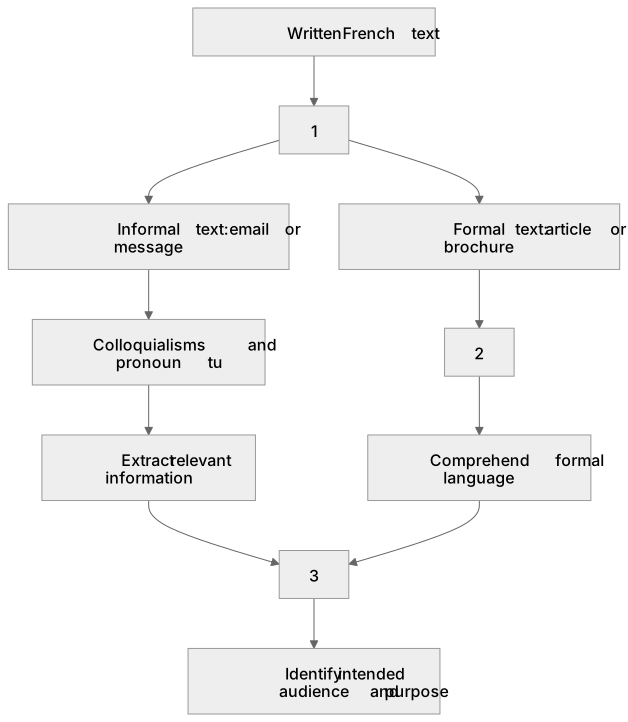
1Box 1
2Box 2
3Box 3
There is more to this lesson
The full lesson goes on to check your understanding and help you earn the marks. Create a free account to carry on, with your progress saved.
A week of Premium from your first lesson · Then the free plan continues · No card, no charge
Test your understanding of Reading: understand and respond to written language: understand and respond to different types of written language
Active recall beats re-reading. Take an instant quiz now to test what you’ve learned and lock it into long-term memory.
A week of Premium from your first lesson · Then the free plan continues · No card, no charge