AQA · GCSE · French
Course version: 8658 · Version from Sept 2016
Understand and respond to written language: understand general and…
Full specification wording
Reading: understand and respond to written language: understand general and specific details within texts using high frequency familiar language across a range of contexts
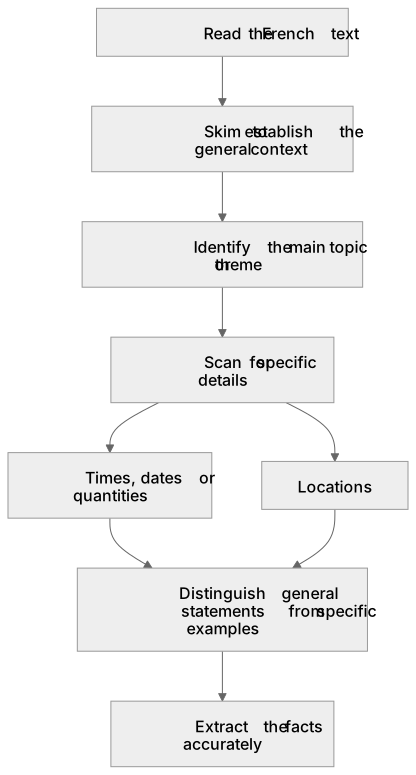
Comprehension requires distinguishing between the broad theme of a French text and its precise factual elements.
- Point 2 of 6
- 4 key terms
Study notes
From the teaching notes for this specification point.
The idea
Comprehension requires distinguishing between the broad theme of a French text and its precise factual elements. When reading passages containing common, everyday vocabulary across various topics like school, holidays, or family, learners should first skim to establish the general context. Subsequently, they must scan for specific details such as times, quantities, or locations. For example, in a text about a holiday, the general detail is the trip itself, while specific details include the duration of trois jours or the location à la montagne. Mastery involves accurately extracting these facts without being distracted by surrounding unfamiliar words.
What earns the marks
- Identify the main topic or theme of a familiar text.
- Locate specific factual details such as times, dates, or quantities.
- Understand high-frequency vocabulary related to everyday contexts.
- Distinguish between general statements and specific examples within a passage.
Common mistakes and how to put them right
Confusing the general topic with a specific detail.
Put it right: Ensure you differentiate between what the whole text is about and the specific facts mentioned.
Misreading numbers, dates, or times.
Put it right: Double-check numerical information and time expressions carefully when scanning for specific details.
Getting distracted by a single unfamiliar word.
Put it right: Focus on the high-frequency vocabulary you do know to grasp the overall meaning.
Exam tips
- Skim the text first to get the gist before looking for specific answers.
- Underline key question words like qui, quand, and où to focus your search for specific details.
- Check that your answer directly addresses the specific detail asked for, rather than just a related general point.
Try the lesson
The start of the Reading: understand and respond to written language: understand general and specific details within texts using high frequency familiar language across a range of contexts lesson, made from teaching notes for this specification point.
Have a go first
Read the following text: "J'habite dans une grande maison avec ma famille. Le week-end, j'aime jouer au foot avec mes amis." What does the writer like to do at the weekend?
Listen
Comprehension requires distinguishing between the broad theme of a French text and its precise factual elements. When reading passages containing common, everyday vocabulary across various topics like school, holidays, or family, learners should first skim to establish the general context. Subsequently, they must scan for specific details such as times, quantities, or locations. For example, in a text about a holiday, the general detail is the trip itself, while specific details include the duration of trois jours or the location à la montagne. Mastery involves accurately extracting these facts without being distracted by surrounding unfamiliar words. A strong answer earns marks for these points. Identify the main topic or theme of a familiar text. Locate specific factual details such as times, dates, or quantities. Understand high-frequency vocabulary related to everyday contexts. Distinguish between general statements and specific examples within a passage. A common slip: Confusing the general topic with a specific detail. Instead, Ensure you differentiate between what the whole text is about and the specific facts mentioned. Exam tip: Skim the text first to get the gist before looking for specific answers.
See it
Key words
Say what each word means before you turn the card.
High-frequency vocabulary
Try answering aloud or in your head before turning the card.
General comprehension
Try answering aloud or in your head before turning the card.
Specific detail extraction
Try answering aloud or in your head before turning the card.
Everyday contexts
Try answering aloud or in your head before turning the card.
See every definition
- High-frequency vocabulary
- Common, everyday words that learners understand and that appear across a range of contexts.
- General comprehension
- Establishing the broad theme or overall context of a French text by skimming it first.
- Specific detail extraction
- Scanning a passage for precise factual elements such as times, quantities or locations.
- Everyday contexts
- Familiar topics such as school, holidays or family in which common vocabulary is used.
Label the diagram
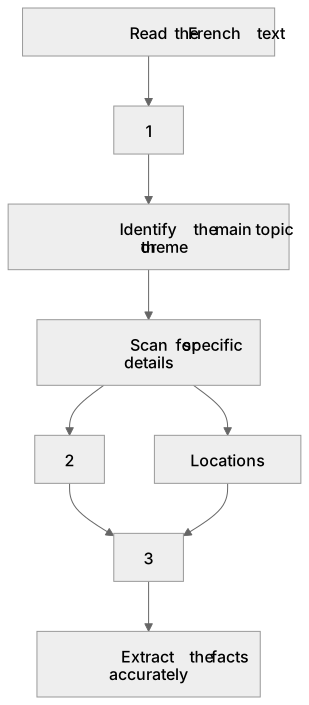
Some boxes have lost their names. Pick the right name for each number.
1Box 1
2Box 2
3Box 3
There is more to this lesson
The full lesson goes on to check your understanding and help you earn the marks. Create a free account to carry on, with your progress saved.
A week of Premium from your first lesson · Then the free plan continues · No card, no charge
Test your understanding of Reading: understand and respond to written language: understand general and specific details within texts using high frequency familiar language across a range of contexts
Active recall beats re-reading. Take an instant quiz now to test what you’ve learned and lock it into long-term memory.
A week of Premium from your first lesson · Then the free plan continues · No card, no charge