AQA · GCSE · French
Course version: 8658 · Version from Sept 2016
Ette ending (eg maison – maisonette; tarte – tartelette; camion –…
Full specification wording
Using common patterns with French: ette ending (eg maison – maisonette; tarte – tartelette; camion – camionette)
The French suffix '-ette' is a diminutive ending added to nouns to indicate a smaller version of the original object.
- Point 3 of 9
- 4 key terms
Study notes
From the teaching notes for this specification point.
The idea
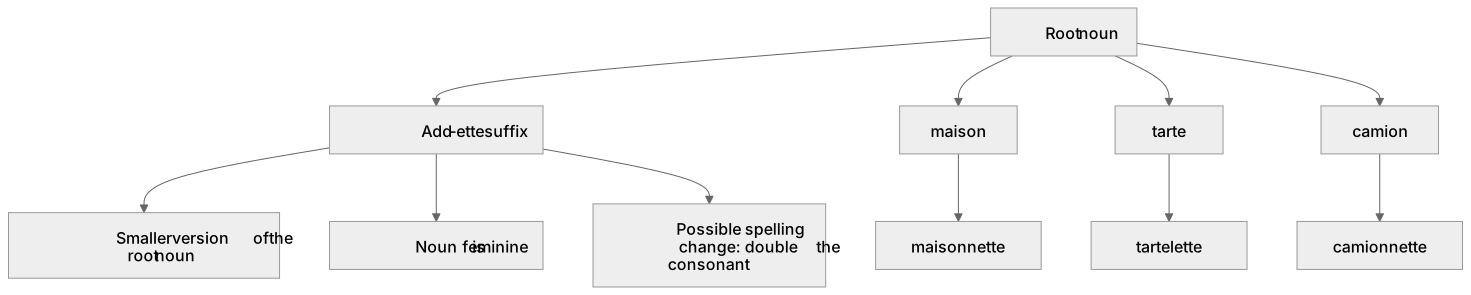
The French suffix '-ette' is a diminutive ending added to nouns to indicate a smaller version of the original object. This pattern is highly recognisable and helps learners deduce the meaning of new vocabulary. For example, adding '-ette' to 'maison' (house) creates 'maisonnette' (small house or cottage). Similarly, 'tarte' (tart) becomes 'tartelette' (small tart), and 'camion' (lorry or truck) becomes 'camionnette' (small van). It is important to note that nouns ending in '-ette' are almost always feminine, regardless of the gender of the root noun (for example, 'le camion' becomes 'la camionnette'). Recognising this suffix allows students to understand nuances in size and scale within reading and listening texts without needing to consult a dictionary.
What earns the marks
- Identify the root noun when encountering a word ending in the '-ette' suffix.
- Deduce that the '-ette' suffix indicates a smaller, diminutive version of the root noun.
- Recognise that nouns ending in '-ette' are grammatically feminine, even if the original root noun was masculine.
- Note spelling changes that may occur when adding the suffix, such as doubling a consonant (for example, 'maison' to 'maisonnette').
Common mistakes and how to put them right
Assuming the gender of the new '-ette' noun is the same as the root noun, forgetting that '-ette' makes the new noun feminine (for example, using 'le camionnette' instead of 'la camionnette').
Translating the '-ette' word as a completely different object rather than a smaller version of the root word.
Misspelling the diminutive form by forgetting to double the consonant where required, such as writing 'maisonete' instead of 'maisonnette'.
Exam tips
- If you spot a word ending in '-ette', mentally remove the suffix to find the root noun, then translate it as 'a small [root noun]'.
- Always use feminine articles and adjective agreements with nouns ending in '-ette', as this suffix dictates the gender.
- Look out for this suffix in reading comprehension tasks, as it often provides specific details about the size of objects being described.
Try the lesson
The start of the Using common patterns with French: ette ending (eg maison – maisonette; tarte – tartelette; camion – camionette) lesson, made from teaching notes for this specification point.
Have a go first
In French, what does the suffix "-ette" typically indicate when it is added to the end of a noun?
Listen
The French suffix '-ette' is a diminutive ending added to nouns to indicate a smaller version of the original object. This pattern is highly recognisable and helps learners deduce the meaning of new vocabulary. For example, adding '-ette' to 'maison' (house) creates 'maisonnette' (small house or cottage). Similarly, 'tarte' (tart) becomes 'tartelette' (small tart), and 'camion' (lorry or truck) becomes 'camionnette' (small van). It is important to note that nouns ending in '-ette' are almost always feminine, regardless of the gender of the root noun (for example, 'le camion' becomes 'la camionnette'). Recognising this suffix allows students to understand nuances in size and scale within reading and listening texts without needing to consult a dictionary. A strong answer earns marks for these points. Identify the root noun when encountering a word ending in the '-ette' suffix. Deduce that the '-ette' suffix indicates a smaller, diminutive version of the root noun. Recognise that nouns ending in '-ette' are grammatically feminine, even if the original root noun was masculine. Note spelling changes that may occur when adding the suffix, such as doubling a consonant (for example, 'maison' to 'maisonnette'). Exam tip: If you spot a word ending in '-ette', mentally remove the suffix to find the root noun, then translate it as 'a small [root noun]'.
See it
Key words
Say what each word means before you turn the card.
Diminutive suffixes
Try answering aloud or in your head before turning the card.
Noun modification
Try answering aloud or in your head before turning the card.
Grammatical gender rules
Try answering aloud or in your head before turning the card.
Vocabulary deduction
Try answering aloud or in your head before turning the card.
See every definition
- Diminutive suffixes
- The French suffix '-ette' is a diminutive ending added to nouns to indicate a smaller version of the original object.
- Noun modification
- Adding '-ette' to a noun creates a smaller version of the original object, such as 'maison' becoming 'maisonnette'.
- Grammatical gender rules
- Nouns ending in '-ette' are almost always feminine, regardless of the gender of the root noun.
- Vocabulary deduction
- Recognising this suffix allows students to understand nuances in size and scale within reading and listening texts without needing to consult a dictionary.
Label the diagram
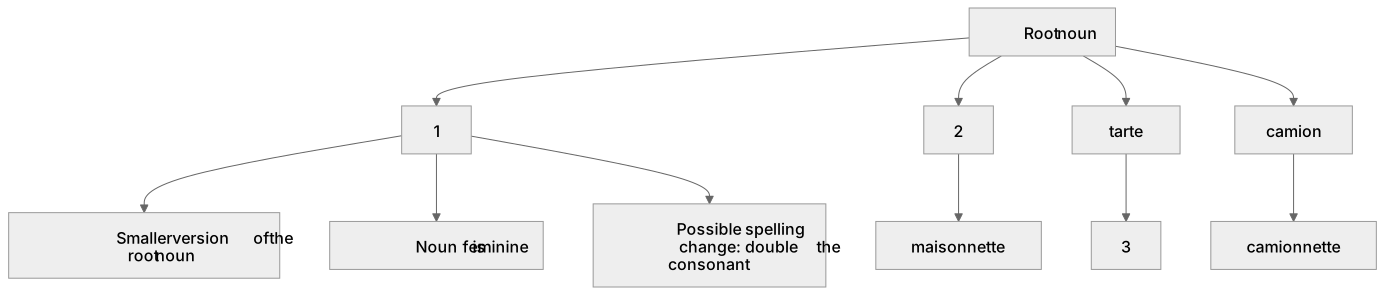
Some boxes have lost their names. Pick the right name for each number.
1Box 1
2Box 2
3Box 3
There is more to this lesson
The full lesson goes on to check your understanding and help you earn the marks. Create a free account to carry on, with your progress saved.
A week of Premium from your first lesson · Then the free plan continues · No card, no charge
Test your understanding of Using common patterns with French: ette ending (eg maison – maisonette; tarte – tartelette; camion – camionette)
Active recall beats re-reading. Take an instant quiz now to test what you’ve learned and lock it into long-term memory.
A week of Premium from your first lesson · Then the free plan continues · No card, no charge