AQA · GCSE · French
Course version: 8658 · Version from Sept 2016
The eur ending applied to verbs (eg employer – employeur) and applied to…
Full specification wording
Using common patterns with French: the eur ending applied to verbs (eg employer – employeur) and applied to adjectives (eg grand, grandeur, etc)
The French suffix '-eur' serves two primary functions in word formation, transforming verbs and adjectives into nouns.
- Point 2 of 9
- 4 key terms
Study notes
From the teaching notes for this specification point.
The idea
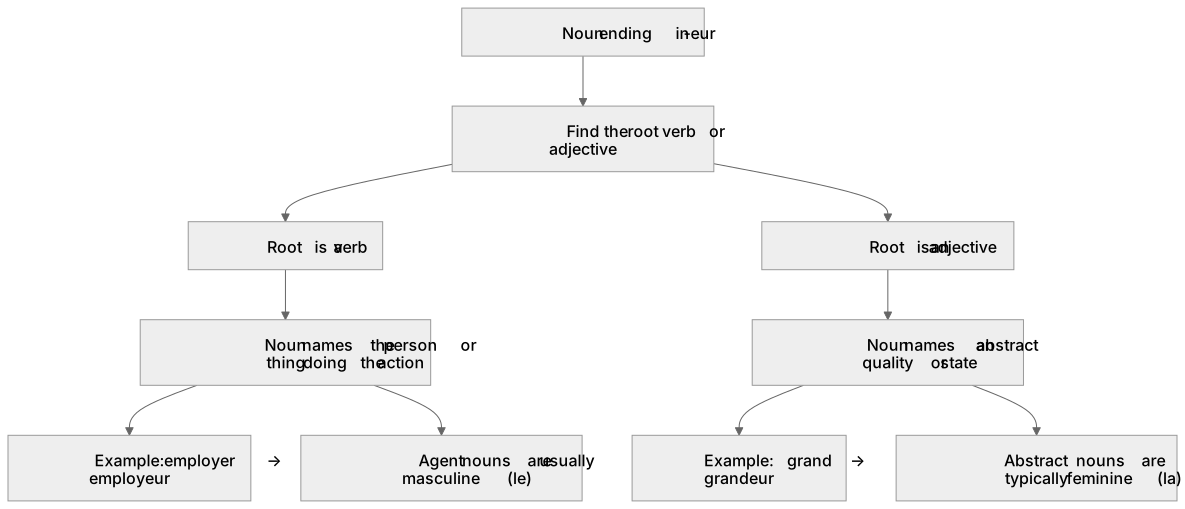
The French suffix '-eur' serves two primary functions in word formation, transforming verbs and adjectives into nouns. When applied to a verb, it creates a noun representing the person or thing performing the action, similar to the English '-er'. For example, from the verb 'employer' (to employ), we get 'employeur' (employer). When applied to an adjective, the '-eur' suffix forms an abstract noun denoting a quality or state, akin to the English '-ness'. For instance, the adjective 'grand' (big) becomes the noun 'grandeur' (size or greatness). Recognising these patterns allows learners to deduce the meaning of unfamiliar nouns by identifying the underlying verb or adjective root, significantly expanding their receptive vocabulary in reading tasks.
What earns the marks
- Identify the root verb or adjective when encountering a noun ending in '-eur'.
- Deduce that a noun ending in '-eur' derived from a verb refers to the agent performing the action (for example, 'vendeur' from 'vendre').
- Deduce that a noun ending in '-eur' derived from an adjective refers to an abstract quality or state (for example, 'lenteur' from 'lent').
- Recognise that nouns ending in '-eur' denoting abstract qualities are typically feminine (for example, 'la grandeur'), while agent nouns are usually masculine but can have feminine equivalents (for example, '-euse').
Common mistakes and how to put them right
Assuming all words ending in '-eur' are masculine, forgetting that abstract nouns formed from adjectives (like 'la chaleur' or 'la grandeur') are feminine.
Confusing the agent noun (the person doing the action) with the action itself when translating words derived from verbs.
Failing to recognise the root adjective because of slight spelling modifications when the '-eur' suffix is added (for example, 'blanc' to 'blancheur').
Exam tips
- When you see an unfamiliar noun ending in '-eur', look for a familiar verb or adjective hidden within it to guess its meaning.
- Pay attention to the article preceding the '-eur' noun; 'la' often indicates an abstract quality derived from an adjective, while 'le' often indicates a person or machine.
- Use your knowledge of English suffixes like '-er', '-or', and '-ness' to help translate these French nouns accurately in context.
Try the lesson
The start of the Using common patterns with French: the eur ending applied to verbs (eg employer – employeur) and applied to adjectives (eg grand, grandeur, etc) lesson, made from teaching notes for this specification point.
Have a go first
When the ending *-eur* is added to the stem of a French verb, such as changing *employer* to *employeur*, what type of word is typically formed?
Listen
The French suffix '-eur' serves two primary functions in word formation, transforming verbs and adjectives into nouns. When applied to a verb, it creates a noun representing the person or thing performing the action, similar to the English '-er'. For example, from the verb 'employer' (to employ), we get 'employeur' (employer). When applied to an adjective, the '-eur' suffix forms an abstract noun denoting a quality or state, akin to the English '-ness'. For instance, the adjective 'grand' (big) becomes the noun 'grandeur' (size or greatness). Recognising these patterns allows learners to deduce the meaning of unfamiliar nouns by identifying the underlying verb or adjective root, significantly expanding their receptive vocabulary in reading tasks. A strong answer earns marks for these points. Identify the root verb or adjective when encountering a noun ending in '-eur'. Deduce that a noun ending in '-eur' derived from a verb refers to the agent performing the action (for example, 'vendeur' from 'vendre'). Deduce that a noun ending in '-eur' derived from an adjective refers to an abstract quality or state (for example, 'lenteur' from 'lent'). Recognise that nouns ending in '-eur' denoting abstract qualities are typically feminine (for example, 'la grandeur'), while agent nouns are usually masculine but can have feminine equivalents (for example, '-euse'). Exam tip: When you see an unfamiliar noun ending in '-eur', look for a familiar verb or adjective hidden within it to guess its meaning.
See it
Key words
Say what each word means before you turn the card.
Noun formation
Try answering aloud or in your head before turning the card.
Suffixes indicating agents and qualities
Try answering aloud or in your head before turning the card.
Grammatical gender patterns
Try answering aloud or in your head before turning the card.
Abstract versus concrete nouns
Try answering aloud or in your head before turning the card.
See every definition
- Noun formation
- The '-eur' ending applied to verbs and to adjectives transforms them into nouns.
- Suffixes indicating agents and qualities
- Applied to a verb, the '-eur' ending creates a noun representing the person or thing performing the action; applied to an adjective, it forms an abstract noun denoting a quality or state.
- Grammatical gender patterns
- Nouns ending in '-eur' denoting abstract qualities are typically feminine, while agent nouns are usually masculine but can have feminine equivalents.
- Abstract versus concrete nouns
- An abstract noun formed from an adjective denotes a quality or state, whereas an agent noun derived from a verb refers to the person or thing performing the action.
Label the diagram
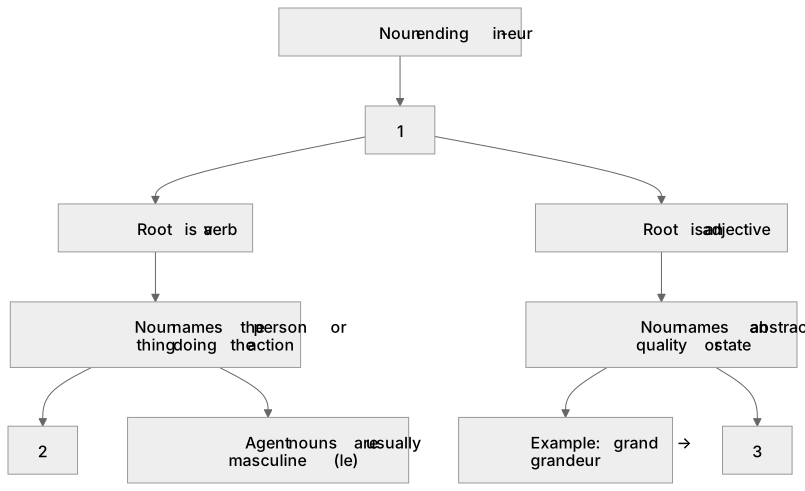
Some boxes have lost their names. Pick the right name for each number.
1Box 1
2Box 2
3Box 3
There is more to this lesson
The full lesson goes on to check your understanding and help you earn the marks. Create a free account to carry on, with your progress saved.
A week of Premium from your first lesson · Then the free plan continues · No card, no charge
Test your understanding of Using common patterns with French: the eur ending applied to verbs (eg employer – employeur) and applied to adjectives (eg grand, grandeur, etc)
Active recall beats re-reading. Take an instant quiz now to test what you’ve learned and lock it into long-term memory.
A week of Premium from your first lesson · Then the free plan continues · No card, no charge