AQA · GCSE · French
Course version: 8658 · Version from Sept 2016
In prefix (eg actif – inactif; connu – inconnu; cassable – incassable)
Full specification wording
Using common patterns with French: in prefix (eg actif – inactif; connu – inconnu; cassable – incassable)
Teach the use of the 'in-' prefix in French to form antonyms, which are words with opposite meanings.
- Point 8 of 9
- 3 key terms
Study notes
From the teaching notes for this specification point.
The idea
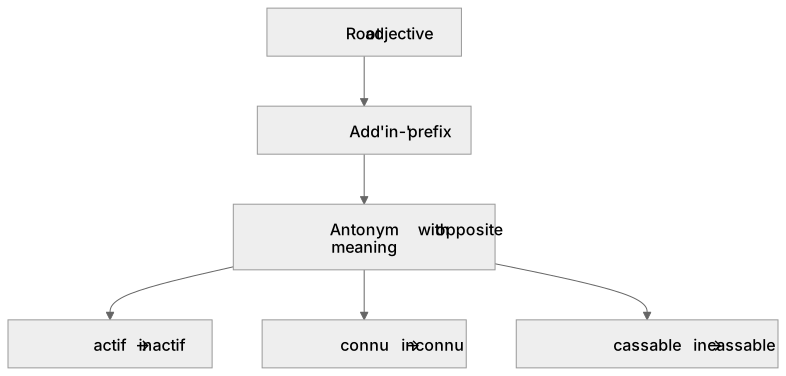
Teach the use of the 'in-' prefix in French to form antonyms, which are words with opposite meanings. Explain that adding 'in-' to the beginning of an adjective often creates its direct opposite, a pattern that is very similar to English (for example, active becomes inactive). Use the specific examples provided in the specification: 'actif' becomes 'inactif', 'connu' (known) becomes 'inconnu' (unknown), and 'cassable' (breakable) becomes 'incassable' (unbreakable). Understanding this common pattern helps students deduce the meaning of unfamiliar words in reading and listening tasks by recognising the familiar root word and understanding that the prefix simply negates its meaning.
What earns the marks
- Identify the root word when encountering an adjective starting with the 'in-' prefix.
- Recognise that the 'in-' prefix typically negates the meaning of the root adjective to form an antonym.
- Translate 'inactif' as 'inactive' based on the root 'actif'.
- Deduce that 'inconnu' means 'unknown' from the root 'connu' (known).
- Deduce that 'incassable' means 'unbreakable' from the root 'cassable' (breakable).
Common mistakes and how to put them right
Mistaking the 'in-' prefix for a preposition meaning 'in' or 'inside'.
Put it right: Recognise it as a negative prefix forming an antonym.
Assuming all words starting with 'in-' are negative adjectives.
Put it right: Check if removing 'in-' leaves a valid root word (e.g., 'intéressant' is not the opposite of 'téressant').
Failing to apply agreement rules to the new adjective.
Put it right: Adjectives with the 'in-' prefix must still agree in gender and number with the noun they describe (e.g., 'inconnue').
Exam tips
- When faced with an unfamiliar word starting with 'in-', cover the prefix and see if you recognise the root word.
- Use context clues in the sentence to confirm if a negative meaning makes sense.
- Remember this pattern when you need to express the opposite of a known adjective in your writing or speaking tasks.
Try the lesson
The start of the Using common patterns with French: in prefix (eg actif – inactif; connu – inconnu; cassable – incassable) lesson, made from teaching notes for this specification point.
Have a go first
If the French word *actif* means 'active', what does the word *inactif* mean?
Listen
Teach the use of the 'in-' prefix in French to form antonyms, which are words with opposite meanings. Explain that adding 'in-' to the beginning of an adjective often creates its direct opposite, a pattern that is very similar to English (for example, active becomes inactive). Use the specific examples provided in the specification: 'actif' becomes 'inactif', 'connu' (known) becomes 'inconnu' (unknown), and 'cassable' (breakable) becomes 'incassable' (unbreakable). Understanding this common pattern helps students deduce the meaning of unfamiliar words in reading and listening tasks by recognising the familiar root word and understanding that the prefix simply negates its meaning. A strong answer earns marks for these points. Identify the root word when encountering an adjective starting with the 'in-' prefix. Recognise that the 'in-' prefix typically negates the meaning of the root adjective to form an antonym. Translate 'inactif' as 'inactive' based on the root 'actif'. Deduce that 'inconnu' means 'unknown' from the root 'connu' (known). A common slip: Mistaking the 'in-' prefix for a preposition meaning 'in' or 'inside'. Instead, recognise it as a negative prefix forming an antonym. Exam tip: When faced with an unfamiliar word starting with 'in-', cover the prefix and see if you recognise the root word.
See it
Key words
Say what each word means before you turn the card.
Word formation
Try answering aloud or in your head before turning the card.
Reading comprehension strategies
Try answering aloud or in your head before turning the card.
Vocabulary building
Try answering aloud or in your head before turning the card.
See every definition
- Word formation
- Adding 'in-' to the beginning of an adjective often creates its direct opposite, a pattern very similar to English.
- Reading comprehension strategies
- Recognising the familiar root word and understanding that the prefix simply negates its meaning helps students deduce the meaning of unfamiliar words in reading and listening tasks.
- Vocabulary building
- Applying the 'in-' prefix to known adjectives expands vocabulary and expresses opposite meanings.
Label the diagram
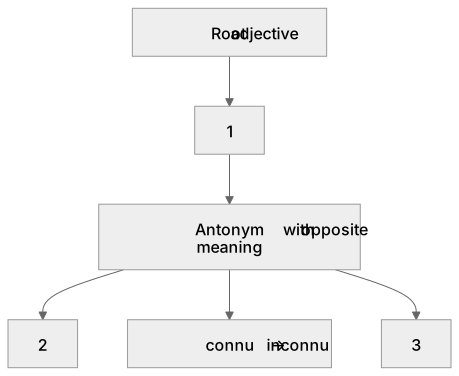
Some boxes have lost their names. Pick the right name for each number.
1Box 1
2Box 2
3Box 3
There is more to this lesson
The full lesson goes on to check your understanding and help you earn the marks. Create a free account to carry on, with your progress saved.
A week of Premium from your first lesson · Then the free plan continues · No card, no charge
Test your understanding of Using common patterns with French: in prefix (eg actif – inactif; connu – inconnu; cassable – incassable)
Active recall beats re-reading. Take an instant quiz now to test what you’ve learned and lock it into long-term memory.
A week of Premium from your first lesson · Then the free plan continues · No card, no charge