AQA · GCSE · French
Course version: 8658 · Version from Sept 2016
Ion and ation endings (eg réparer – réparation; inventer – invention).
Full specification wording
Using common patterns with French: ion and ation endings (eg réparer – réparation; inventer – invention).
Teach the pattern of forming nouns from verbs using '-ion' and '-ation' endings.
- Point 9 of 9
- 4 key terms
Study notes
From the teaching notes for this specification point.
The idea
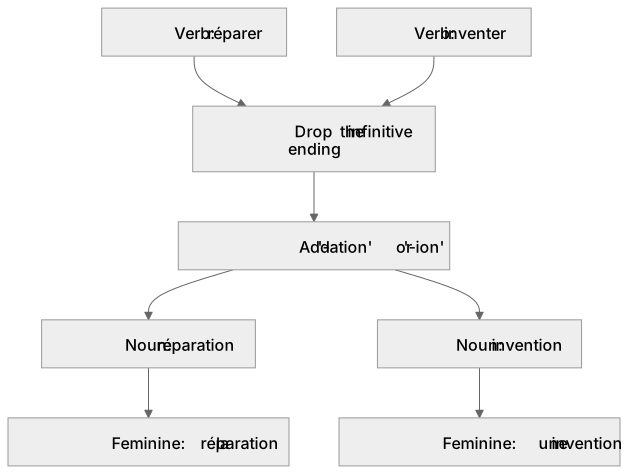
Teach the pattern of forming nouns from verbs using '-ion' and '-ation' endings. Explain that many French verbs can be transformed into related nouns by dropping the infinitive ending and adding these suffixes. For example, the verb 'réparer' (to repair) becomes the noun 'réparation' (repair/reparation), and 'inventer' (to invent) becomes 'invention' (invention). Understanding this pattern allows students to expand their vocabulary and deduce the meaning of unfamiliar nouns by recognising the root verb. Note that nouns ending in '-ion' are almost always feminine.
What earns the marks
- Identify the root verb within a noun ending in '-ion' or '-ation'.
- Deduce the meaning of a noun by linking it to its corresponding verb (e.g., 'réparation' from 'réparer').
- Recognise that the verb 'inventer' transforms into the noun 'invention'.
- Apply the rule that nouns ending in '-tion' or '-sion' are typically feminine (e.g., 'une invention').
Common mistakes and how to put them right
Assuming the noun has a completely different meaning from the verb.
Put it right: Look for the shared root to deduce the related meaning.
Using the wrong gender for nouns ending in '-ion'.
Put it right: These nouns are almost exclusively feminine (e.g., 'la réparation').
Misspelling the noun by keeping the infinitive ending before adding the suffix.
Put it right: Drop the '-er' or '-re' before adding '-ation' or '-ion'.
Exam tips
- If you encounter an unknown noun ending in '-ion', try to think of a similar-looking verb to guess its meaning.
- Use this pattern in writing tasks to show a wider range of vocabulary by using both verbs and their related nouns.
- Always use feminine articles (la, une) with nouns ending in '-tion' unless you specifically know an exception.
Try the lesson
The start of the Using common patterns with French: ion and ation endings (eg réparer – réparation; inventer – invention). lesson, made from teaching notes for this specification point.
Have a go first
Which of the following nouns is formed from the verb *réparer* (to repair) to mean 'a repair'?
Listen
Teach the pattern of forming nouns from verbs using '-ion' and '-ation' endings. Explain that many French verbs can be transformed into related nouns by dropping the infinitive ending and adding these suffixes. For example, the verb 'réparer' (to repair) becomes the noun 'réparation' (repair/reparation), and 'inventer' (to invent) becomes 'invention' (invention). Understanding this pattern allows students to expand their vocabulary and deduce the meaning of unfamiliar nouns by recognising the root verb. Note that nouns ending in '-ion' are almost always feminine. A strong answer earns marks for these points. Identify the root verb within a noun ending in '-ion' or '-ation'. Deduce the meaning of a noun by linking it to its corresponding verb (e.g., 'réparation' from 'réparer'). Recognise that the verb 'inventer' transforms into the noun 'invention'. Apply the rule that nouns ending in '-tion' or '-sion' are typically feminine (e.g., 'une invention'). A common slip: Assuming the noun has a completely different meaning from the verb. Instead, look for the shared root to deduce the related meaning. Exam tip: If you encounter an unknown noun ending in '-ion', try to think of a similar-looking verb to guess its meaning.
See it
Key words
Say what each word means before you turn the card.
Noun formation
Try answering aloud or in your head before turning the card.
Suffixes
Try answering aloud or in your head before turning the card.
Vocabulary expansion
Try answering aloud or in your head before turning the card.
Gender of nouns
Try answering aloud or in your head before turning the card.
See every definition
- Noun formation
- Many French verbs can be transformed into related nouns by dropping the infinitive ending and adding '-ion' or '-ation'.
- Suffixes
- The '-ion' and '-ation' endings are added to a verb's root to create a related noun.
- Vocabulary expansion
- Understanding this pattern allows students to expand their vocabulary and deduce the meaning of unfamiliar nouns by recognising the root verb.
- Gender of nouns
- Nouns ending in '-ion' are almost always feminine, so feminine articles are used with them.
Label the diagram
Some boxes have lost their names. Pick the right name for each number.
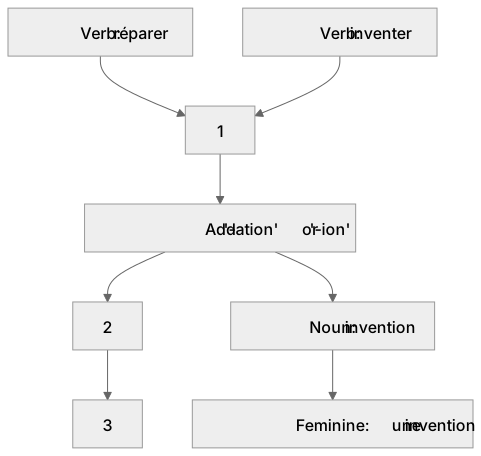
1Box 1
2Box 2
3Box 3
There is more to this lesson
The full lesson goes on to check your understanding and help you earn the marks. Create a free account to carry on, with your progress saved.
A week of Premium from your first lesson · Then the free plan continues · No card, no charge
Test your understanding of Using common patterns with French: ion and ation endings (eg réparer – réparation; inventer – invention).
Active recall beats re-reading. Take an instant quiz now to test what you’ve learned and lock it into long-term memory.
A week of Premium from your first lesson · Then the free plan continues · No card, no charge