AQA · GCSE · French
Course version: 8658 · Version from Sept 2016
Verbs: immediate future
The immediate future tense (le futur proche) describes actions that are going to happen in the near future, translating to 'going to' do something.
- Point 6 of 20
Study notes
From the teaching notes for this specification point.
The idea
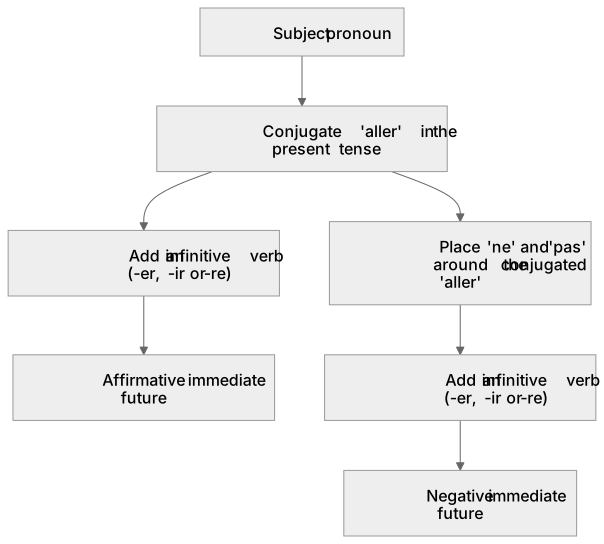
The immediate future tense (le futur proche) describes actions that are going to happen in the near future, translating to 'going to' do something. It is formed using two components: the present tense of the verb 'aller' (to go) followed by an infinitive verb (ending in -er, -ir, or -re). The conjugations of 'aller' are: je vais, tu vas, il/elle/on va, nous allons, vous allez, ils/elles vont. For example, 'je vais manger' means 'I am going to eat', and 'nous allons partir' means 'we are going to leave'. To make it negative, place 'ne' and 'pas' around the conjugated form of 'aller', such as 'je ne vais pas jouer' (I am not going to play). This tense is highly regular and useful for expressing future plans.
What earns the marks
- Identify the correct present tense conjugation of the verb 'aller' for the given subject pronoun.
- Recognise that the immediate future requires an infinitive verb immediately following the conjugated form of 'aller'.
- Comprehend sentences using the immediate future tense as referring to events that will happen soon.
- Identify the correct placement of negative particles ('ne' and 'pas') around the conjugated verb 'aller'.
Common mistakes and how to put them right
Conjugating the second verb instead of leaving it in the infinitive form.
Put it right: Only conjugate the auxiliary verb 'aller'; the main verb must remain in its full dictionary form (infinitive).
Using the wrong part of 'aller', such as confusing 'ils vont' with 'ils ont'.
Put it right: Memorise the present tense paradigm of 'aller' thoroughly to avoid confusion with 'avoir'.
Placing the negative particles around the infinitive verb rather than the conjugated verb.
Put it right: Ensure 'ne' and 'pas' surround the conjugated form of 'aller' (e.g., 'je ne vais pas regarder').
Exam tips
- The immediate future is an excellent way to demonstrate knowledge of future timeframes without needing to learn the complex stems of the simple future tense.
- Always double-check that the second verb in your immediate future construction ends in -er, -ir, or -re.
- Look for time phrases like 'ce soir' (this evening) or 'le week-end prochain' (next weekend) which often accompany the immediate future tense.
Try the lesson
The start of the Verbs: immediate future lesson, made from teaching notes for this specification point.
Have a go first
What is the correct English translation of the sentence "Je vais manger une pomme"?
Listen
The immediate future tense (le futur proche) describes actions that are going to happen in the near future, translating to 'going to' do something. It is formed using two components: the present tense of the verb 'aller' (to go) followed by an infinitive verb (ending in -er, -ir, or -re). The conjugations of 'aller' are: je vais, tu vas, il/elle/on va, nous allons, vous allez, ils/elles vont. For example, 'je vais manger' means 'I am going to eat', and 'nous allons partir' means 'we are going to leave'. To make it negative, place 'ne' and 'pas' around the conjugated form of 'aller', such as 'je ne vais pas jouer' (I am not going to play). This tense is highly regular and useful for expressing future plans. A strong answer earns marks for these points. Identify the correct present tense conjugation of the verb 'aller' for the given subject pronoun. Recognise that the immediate future requires an infinitive verb immediately following the conjugated form of 'aller'. Comprehend sentences using the immediate future tense as referring to events that will happen soon. Identify the correct placement of negative particles ('ne' and 'pas') around the conjugated verb 'aller'. A common slip: Conjugating the second verb instead of leaving it in the infinitive form. Instead, Only conjugate the auxiliary verb 'aller'; the main verb must remain in its full dictionary form (infinitive). Exam tip: The immediate future is an excellent way to demonstrate knowledge of future timeframes without needing to learn the complex stems of the simple future tense.
See it
There is more to this lesson
The full lesson goes on to check your understanding and help you earn the marks. Create a free account to carry on, with your progress saved.
A week of Premium from your first lesson · Then the free plan continues · No card, no charge
Test your understanding of Verbs: immediate future
Active recall beats re-reading. Take an instant quiz now to test what you’ve learned and lock it into long-term memory.
A week of Premium from your first lesson · Then the free plan continues · No card, no charge