AQA · GCSE · French
Course version: 8658 · Version from Sept 2016
Verbs: other common verbs in the imperfect tense (R)
The imperfect is used for descriptions, habits, and ongoing actions in the past (translating to 'was doing' or 'used to do').
- Point 5 of 20
- 4 key terms
Study notes
From the teaching notes for this specification point.
The idea
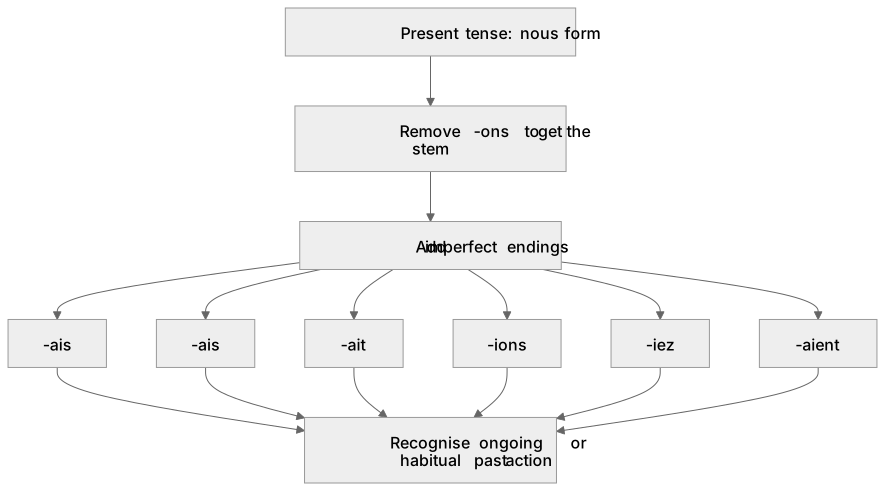
The imperfect is used for descriptions, habits, and ongoing actions in the past (translating to 'was doing' or 'used to do'). You can recognise the imperfect tense by its distinctive endings: -ais, -ais, -ait, -ions, -iez, -aient. These endings are added to a stem, usually formed by taking the 'nous' form of the present tense and removing the '-ons' (e.g., nous jouons -> jou- -> je jouais). When reading or listening, spotting these endings helps you identify that the action took place in the past and was continuous or habitual.
For example: 'je regardais' means 'I was watching' or 'I used to watch', distinguishing it from the perfect tense.
What earns the marks
- Identify the imperfect tense endings (-ais, -ais, -ait, -ions, -iez, -aient) on regular and irregular verb stems.
- Distinguish the imperfect tense from the perfect and present tenses in reading and listening passages.
- Comprehend the meaning of common verbs in the imperfect tense as describing ongoing past actions or habits.
- Recognise the 'nous' stem of present tense verbs as the foundation for the imperfect tense stem.
Common mistakes and how to put them right
Translating the imperfect tense as a completed action rather than an ongoing or habitual action.
Put it right: Translate the imperfect as 'was doing' or 'used to do' to capture the continuous nature of the tense.
Confusing the imperfect ending '-ions' with the present tense 'nous' ending.
Put it right: Look at the context of the sentence and the stem of the verb to determine if the action is in the present or the past.
Failing to recognise the imperfect tense when the stem is slightly irregular, such as verbs ending in -ger (e.g., je mangeais).
Put it right: Learn the spelling rules for -ger and -cer verbs in the imperfect tense to maintain the soft consonant sound.
Exam tips
- Use time markers like 'souvent' (often) or 'tous les jours' (every day) in past contexts as clues that the imperfect tense is being used.
- When listening, pay attention to the 'é' sound at the end of verbs, which often indicates the imperfect tense for 'je', 'tu', 'il/elle/on', and 'ils/elles' forms.
- Do not worry about producing these forms if the specification only requires recognition (R), but ensure you can accurately translate them into English.
Try the lesson
The start of the Verbs: other common verbs in the imperfect tense (R) lesson, made from teaching notes for this specification point.
Have a go first
What is the correct English translation of the verb "je pouvais" in the sentence "Avant, je pouvais courir très vite"?
Listen
The imperfect is used for descriptions, habits, and ongoing actions in the past (translating to 'was doing' or 'used to do'). You can recognise the imperfect tense by its distinctive endings: -ais, -ais, -ait, -ions, -iez, -aient. These endings are added to a stem, usually formed by taking the 'nous' form of the present tense and removing the '-ons' (e.g., nous jouons -> jou- -> je jouais). When reading or listening, spotting these endings helps you identify that the action took place in the past and was continuous or habitual. For example, 'je regardais' means 'I was watching' or 'I used to watch', distinguishing it from the perfect tense. A strong answer earns marks for these points. Identify the imperfect tense endings (-ais, -ais, -ait, -ions, -iez, -aient) on regular and irregular verb stems. Distinguish the imperfect tense from the perfect and present tenses in reading and listening passages. Comprehend the meaning of common verbs in the imperfect tense as describing ongoing past actions or habits. Recognise the 'nous' stem of present tense verbs as the foundation for the imperfect tense stem. A common slip: Translating the imperfect tense as a completed action rather than an ongoing or habitual action. Instead, Translate the imperfect as 'was doing' or 'used to do' to capture the continuous nature of the tense. Exam tip: Use time markers like 'souvent' (often) or 'tous les jours' (every day) in past contexts as clues that the imperfect tense is being used.
See it
Key words
Say what each word means before you turn the card.
Habitual actions
Try answering aloud or in your head before turning the card.
Past continuous events
Try answering aloud or in your head before turning the card.
Verb recognition
Try answering aloud or in your head before turning the card.
Time markers
Try answering aloud or in your head before turning the card.
See every definition
- Habitual actions
- Actions in the past that were continuous or habitual, translated as 'was doing' or 'used to do'.
- Past continuous events
- Ongoing actions in the past, which the imperfect tense describes and which are translated as 'was doing'.
- Verb recognition
- The specification requires you to recognise other common verbs in the imperfect tense rather than to produce them.
- Time markers
- Clues such as 'souvent' (often) or 'tous les jours' (every day) in past contexts that show the imperfect tense is being used.
There is more to this lesson
The full lesson goes on to check your understanding and help you earn the marks. Create a free account to carry on, with your progress saved.
A week of Premium from your first lesson · Then the free plan continues · No card, no charge
Test your understanding of Verbs: other common verbs in the imperfect tense (R)
Active recall beats re-reading. Take an instant quiz now to test what you’ve learned and lock it into long-term memory.
A week of Premium from your first lesson · Then the free plan continues · No card, no charge