AQA · GCSE · French
Course version: 8658 · Version from Sept 2016
Verbs: passive voice: future, imperfect and perfect tenses (R)
The passive voice is used to focus on the recipient of an action rather than the doer.
- Point 17 of 20
- 4 key terms
Study notes
From the teaching notes for this specification point.
The idea
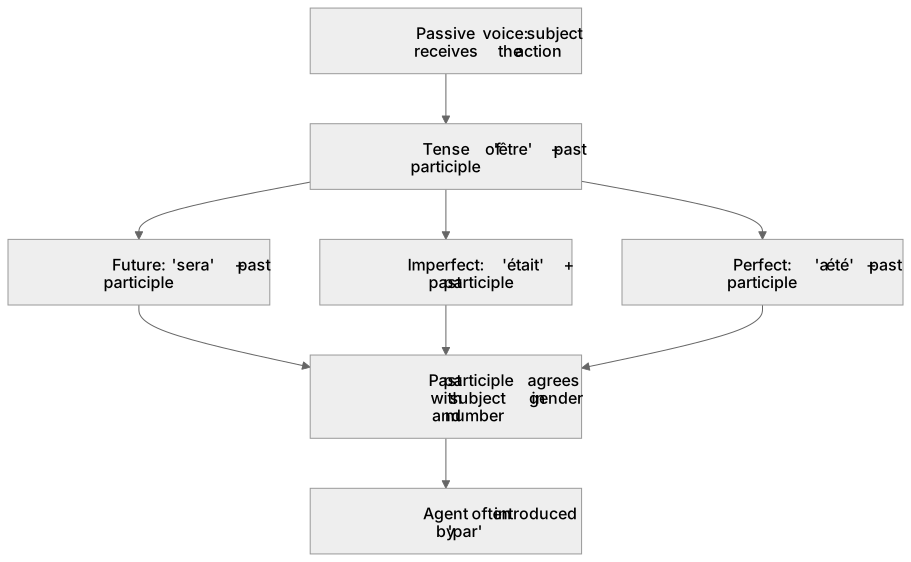
The passive voice is used to focus on the recipient of an action rather than the doer. In the passive voice, the subject receives the action. It is formed using the relevant tense of 'être' followed by the past participle, which must agree in gender and number with the subject. For example, future: 'la porte sera fermée' (the door will be closed); imperfect: 'les lettres étaient écrites' (the letters were being written); perfect: 'le gâteau a été mangé' (the cake was eaten). The agent is often introduced by 'par'.
What earns the marks
- Recognise the passive voice in the future tense (e.g., 'sera fait') to understand what will be done.
- Identify the passive voice in the imperfect tense (e.g., 'était fait') to understand what was being done.
- Comprehend the passive voice in the perfect tense (e.g., 'a été fait') to understand what has been done.
- Understand that the past participle in a passive construction agrees with the subject in gender and number.
- Identify the agent of the passive action, typically introduced by the preposition 'par' (by).
Common mistakes and how to put them right
Confusing the perfect passive ('a été mangé') with the active pluperfect.
Put it right: Recognise that 'a été' is the perfect tense of 'être', making it passive ('has been eaten' / 'was eaten'), whereas the pluperfect uses 'avait' ('had eaten').
Misinterpreting the subject of the passive sentence as the doer of the action.
Put it right: Look for the verb 'être' plus a past participle to identify that the subject is receiving the action.
Ignoring the past participle agreement and misidentifying the subject.
Put it right: Use the agreement on the past participle as a clue to identify the gender and number of the subject receiving the action.
Exam tips
- Since this is a receptive skill (R), focus on translating passive sentences accurately into English during reading and listening tasks.
- Look for the preposition 'par' as a strong indicator that the sentence is in the passive voice.
- Pay attention to the tense of the verb 'être' to correctly identify when the action took place (future, imperfect, or perfect).
Try the lesson
The start of the Verbs: passive voice: future, imperfect and perfect tenses (R) lesson, made from teaching notes for this specification point.
Have a go first
What is the correct English translation of the following sentence?
"Le gâteau a été mangé par le chien."
Listen
The passive voice is used to focus on the recipient of an action rather than the doer. In the passive voice, the subject receives the action. It is formed using the relevant tense of 'être' followed by the past participle, which must agree in gender and number with the subject. For example, future: 'la porte sera fermée' (the door will be closed); imperfect: 'les lettres étaient écrites' (the letters were being written); perfect: 'le gâteau a été mangé' (the cake was eaten). The agent is often introduced by 'par'. A strong answer earns marks for these points. Recognise the passive voice in the future tense (e.g., 'sera fait') to understand what will be done. Identify the passive voice in the imperfect tense (e.g., 'était fait') to understand what was being done. Comprehend the passive voice in the perfect tense (e.g., 'a été fait') to understand what has been done. Understand that the past participle in a passive construction agrees with the subject in gender and number. A common slip: Confusing the perfect passive ('a été mangé') with the active pluperfect. Instead, Recognise that 'a été' is the perfect tense of 'être', making it passive ('has been eaten' / 'was eaten'), whereas the pluperfect uses 'avait' ('had eaten'). Exam tip: Since this is a receptive skill (R), focus on translating passive sentences accurately into English during reading and listening tasks.
See it
Key words
Say what each word means before you turn the card.
Receptive grammar recognition
Try answering aloud or in your head before turning the card.
Voice
Try answering aloud or in your head before turning the card.
Tense identification
Try answering aloud or in your head before turning the card.
Agreement of past participles
Try answering aloud or in your head before turning the card.
See every definition
- Receptive grammar recognition
- Recognising the passive voice in the future, imperfect and perfect tenses for understanding, as shown by the (R) for receptive use.
- Voice
- The passive voice is used to focus on the recipient of an action rather than the doer, and in it the subject receives the action.
- Tense identification
- Paying attention to the tense of the verb 'être' to correctly identify when the action took place: future, imperfect or perfect.
- Agreement of past participles
- The past participle in a passive construction must agree in gender and number with the subject.
Label the diagram
Some boxes have lost their names. Pick the right name for each number.
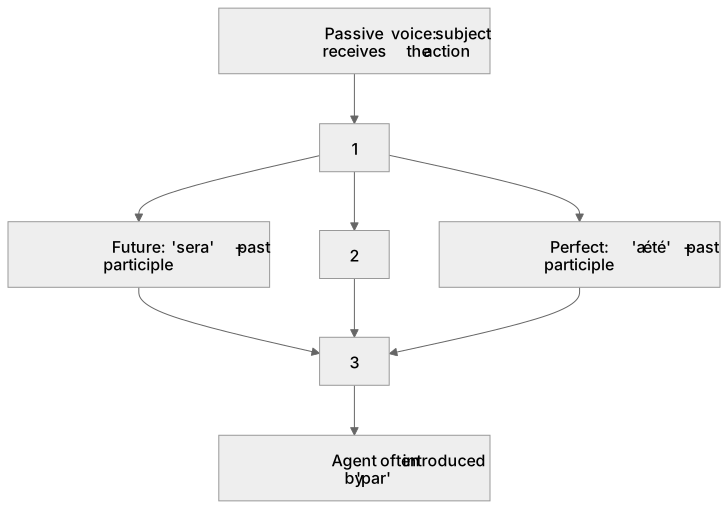
1Box 1
2Box 2
3Box 3
There is more to this lesson
The full lesson goes on to check your understanding and help you earn the marks. Create a free account to carry on, with your progress saved.
A week of Premium from your first lesson · Then the free plan continues · No card, no charge
Test your understanding of Verbs: passive voice: future, imperfect and perfect tenses (R)
Active recall beats re-reading. Take an instant quiz now to test what you’ve learned and lock it into long-term memory.
A week of Premium from your first lesson · Then the free plan continues · No card, no charge